
Application Guide
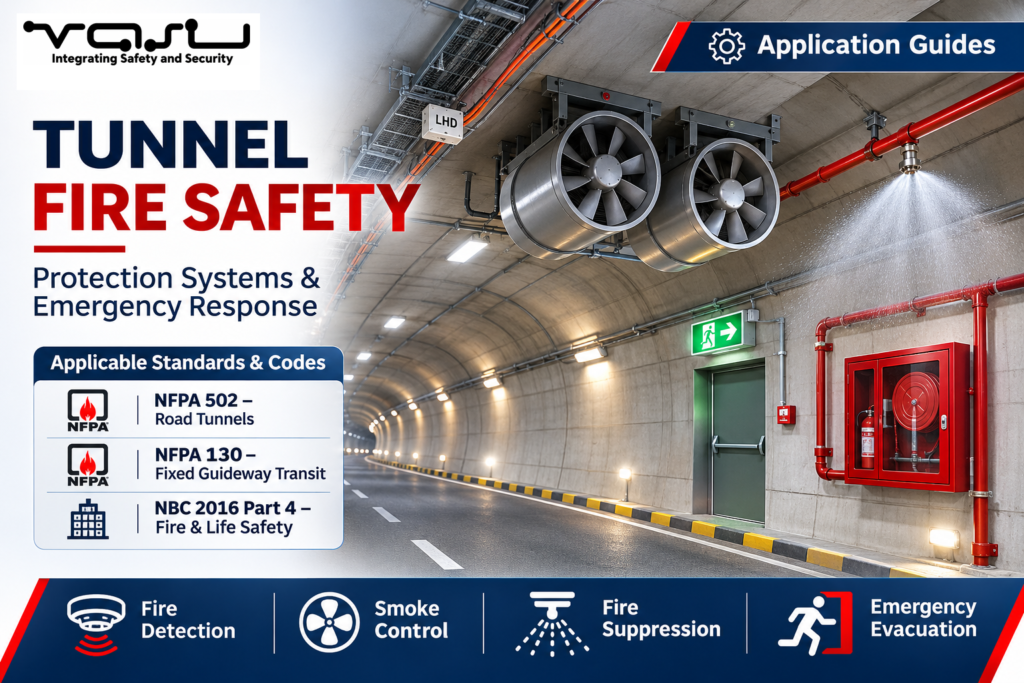
Tunnel Fire Safety – Protection Systems & Emergency Response
Nov 2026
Introduction
Tunnel Fire Safety is essential for protecting passengers, commuters, vehicles and infrastructure. Due to confined spaces, limited escape routes and smoke accumulation, tunnel fires require reliable detection, suppression, ventilation and emergency evacuation arrangements.
Key Fire Safety Systems
- Fire Detection System: Linear Heat Detection (LHD), smoke detection and CCTV-based incident monitoring for early fire identification.
- Fire Suppression System: Hydrant, fixed firefighting and High Pressure Water Mist (HPWM) systems, as applicable.
- Emergency Ventilation: Controls smoke movement and helps maintain safer evacuation conditions.
- Emergency Communication: Public Address (PA), emergency telephones and alarm systems.
- Evacuation & Exit Systems: Emergency exits, escape routes, signage and emergency lighting.
Applicable Standards & Guidelines
- NFPA 502 – Road Tunnels, Bridges and Other Limited Access Highways.
- NFPA 130 – Fixed Guideway Transit and Passenger Rail Systems.
- NBC 2016 Part 4 – Fire and Life Safety.
- Applicable local fire authority requirements and project specifications.
Key Engineering Considerations
Tunnel fire safety design should consider tunnel length, traffic conditions, fire risk assessment, detector positioning, ventilation strategy, suppression coverage, emergency power supply and evacuation time.
All systems should be integrated through a coordinated Cause & Effect Matrix and tested during commissioning.
Conclusion
An effective tunnel fire safety strategy combines early detection, smoke management, firefighting systems and safe evacuation. Proper engineering, system integration and periodic testing help improve passenger safety and infrastructure resilience.
VASU Infosec Limited provides Fire & Life Safety and Electronic Security solutions for critical infrastructure, including engineering, installation, testing and commissioning.