
Article
Addressable vs Conventional Fire Alarm Systems
Oct 2026
Direct Answer
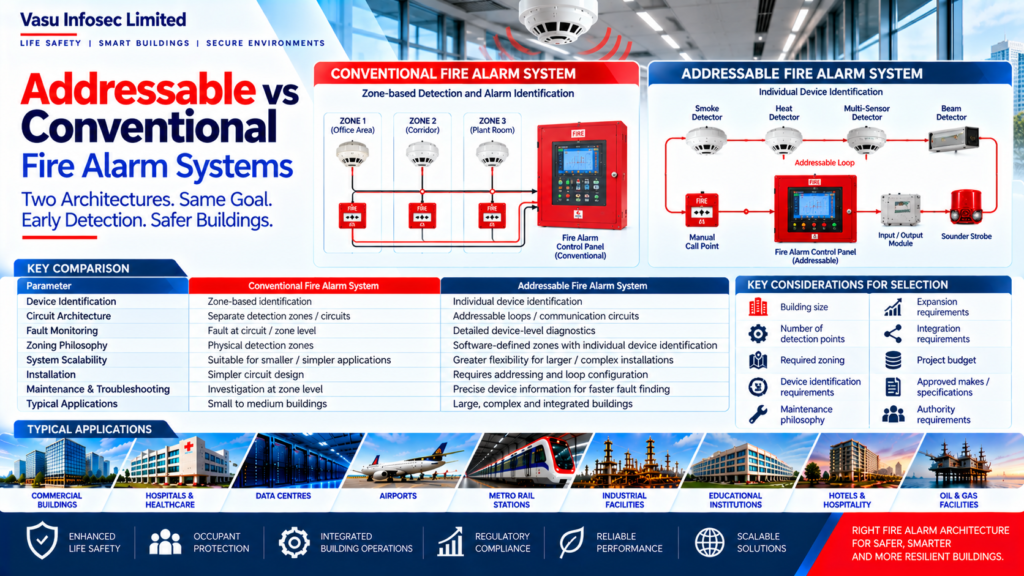
Addressable and conventional fire alarm systems both detect fire-related conditions, process alarm signals and provide notification. The key difference is identification: conventional systems generally indicate the affected zone or circuit, while addressable systems can identify an individual compatible device or point. The appropriate choice depends on the building, required identification, system capacity, maintenance needs, integration requirements, approved specifications and budget.
1. Engineering Overview
Addressable and Conventional Fire Alarm Systems are two fundamental fire alarm architectures. Both are designed to detect fire conditions, process alarm signals and provide notification, but they differ in device identification, circuit architecture, fault diagnostics, zoning, flexibility and scalability.
2. Conventional Fire Alarm Architecture
Conventional Detection Devices → Detection Zone Circuits → Fire Alarm Control Panel → Zone Identification → Notification Appliances → Cause & Effect Interfaces
3. Addressable Fire Alarm Architecture
Addressable Detection Devices → Addressable Loop / Network → Fire Alarm Control Panel → Individual Device Identification → Notification Appliances → Cause & Effect Interfaces
4. Conventional System Working Principle
In a conventional system, initiating devices are grouped into defined zones. When a detector or manual call point operates, the panel identifies the affected circuit or zone. The exact initiating device is generally not individually identified at the panel.
5. Addressable System Working Principle
In an addressable system, each compatible field device is assigned an individual address. When a device operates, the control panel can identify the particular device or point and display its programmed location information.
6. Device Identification
Conventional systems generally provide zone-level identification, while addressable systems provide individual device-level identification. This difference affects emergency response, fault finding, maintenance and event investigation.
7. Circuit Architecture
Conventional systems typically use separate detection zones or circuits connected to the control panel. Addressable systems commonly use addressable loops or communication circuits capable of supporting multiple individually identified devices.
8. Fault Monitoring
Both architectures provide circuit and system fault monitoring according to their design. Addressable systems can provide more detailed device-level diagnostic information, while conventional systems commonly indicate faults at the relevant circuit or zone level.
9. Zoning Philosophy
Conventional systems naturally operate through physical detection zones. Addressable systems can use software-defined zones while retaining individual device identification. The final zoning philosophy should follow the approved fire strategy and emergency response requirements.
10. Cause & Effect Integration
Both systems can initiate programmed outputs through approved Cause & Effect logic, subject to panel capabilities and project configuration. Typical interfaces include HVAC shutdown, fire damper operation, lift fire mode, access control release, smoke control, fire suppression interface and IBMS / BMS alarm transmission. These functions should not be assumed unless they are included in the approved design and Cause & Effect Matrix.
11. System Scalability
Conventional systems are generally suitable where the number of zones and system complexity are limited. Addressable systems can provide greater flexibility for larger or more complex installations, subject to panel and loop capacity.
12. Installation Considerations
Both architectures require correct detector placement, suitable cabling, appropriate circuit design, device identification and coordinated installation. Addressable systems additionally require correct addressing, loop configuration and compatibility between devices and control equipment.
13. Maintenance and Troubleshooting
Conventional systems generally require investigation at the affected zone or circuit level. Addressable systems can provide more precise device information, which may assist maintenance teams in locating alarm, fault or communication issues.
14. System Selection Considerations
Selection should consider:
- Building size
- Number of detection points
- Required zoning
- Device identification requirements
- Maintenance philosophy
- Expansion requirements
- Integration requirements
- Project budget
- Approved makes / specifications
- Authority requirements
15. Comparative Engineering View
| Comparison factor | Conventional system | Addressable system |
| Device identification | Generally identifies the affected zone or circuit. | Can identify an individual compatible device or point. |
| Circuit architecture | Typically uses separate detection zones or circuits. | Commonly uses addressable loops or communication circuits. |
| Diagnostics | Fault information is commonly indicated at circuit / zone level. | Can provide more detailed device-level diagnostics. |
| Zoning | Primarily based on physical detection zones. | Can use software-defined zones while retaining individual device identification. |
| Typical suitability | Often considered for smaller or simpler applications. | Often considered for larger, more complex or integrated applications. |
| Expansion | Depends on panel zone capacity and circuit design. | Depends on panel, loop and device capacity. |
| Installation considerations | Zone/circuit design and device placement. | Includes zone/circuit design plus addressing, loop configuration and compatibility. |
These are general engineering distinctions, not an automatic selection rule. Final suitability depends on the approved design, project requirements, equipment capabilities and authority requirements.
16. Testing and Commissioning
Testing should verify the selected architecture and its intended operation. Testing may include:
- Detector activation
- Manual call point activation
- Alarm indication
- Notification appliance operation
- Fault simulation
- Cause & Effect testing
- Interface testing
- Battery testing
- Reset / restoration
The testing method, acceptance criteria and responsible parties should follow the approved project documentation and agreed scope. This list is indicative and does not itself establish certification or project acceptance.
17. Common Engineering Considerations
Engineering review should verify:
- Correct system type
- Approved equipment compatibility
- Detection coverage
- Zoning
- Circuit / loop capacity
- Power supply and battery capacity
- Notification coverage
- Cause & Effect logic
- Interface requirements
- Future expansion requirements
18. Documentation
Documentation should include, as applicable:
- System architecture
- Control panel datasheet
- Device schedule
- Zone / loop drawings
- Cause & Effect Matrix
- Input / Output schedule
- Battery calculation
- Cable schedule
- Testing records
- Commissioning records
- As-built drawings
- Operation and Maintenance (O&M) manual
19. Engineering Objective
Correct Architecture Selection → Appropriate Device Identification → Reliable Circuit / Loop Communication → Accurate Alarm Location → Effective Cause & Effect → Maintainable System → Verified Testing → Scalable and Reliable Fire Alarm Protection
Frequently Asked Questions
What is the main difference between addressable and conventional fire alarm systems?
A conventional system generally identifies the affected zone or circuit, while an addressable system can identify an individual compatible device or point.
Is an addressable system always better?
Not necessarily. Selection depends on building requirements, point count, identification needs, maintenance, expansion, integration, approved specifications, authority requirements and budget.
Which system is easier to troubleshoot?
Addressable systems can provide more precise device-level information. Conventional systems commonly indicate the affected zone or circuit, which may require further investigation to locate the device.
Can both system types control HVAC, lifts or access control?
Both may initiate programmed outputs where panel capabilities, project configuration and the approved Cause & Effect Matrix provide for those interfaces.
What should be considered when selecting a system?
Consider building size, detection-point count, zoning, device identification, maintenance, expansion, integration, budget, approved makes and authority requirements.
What should be checked during commissioning?
Checks may include detector and manual call point activation, alarm indication, notification appliances, fault monitoring, Cause & Effect, interfaces, battery operation and reset / restoration.
Engineering and Publication Notes
This article provides a general comparison based on the supplied source document. Actual system performance, diagnostic detail, capacity, compatibility and interface functionality depend on the selected equipment, approved design, project specifications and applicable requirements.
The article does not prescribe one architecture for every application and does not establish statutory compliance, certification or project acceptance. Project-specific responsibilities and deliverables should be stated only where supported by approved contractual and project records.
SEO and CMS Metadata Suggestions
| Field | Suggested content |
| SEO title | Addressable vs Conventional Fire Alarm Systems | Vasu Infosec |
| Meta description | Compare addressable and conventional fire alarm systems by device identification, circuit architecture, diagnostics, zoning, maintenance and system selection. |
| Suggested URL slug | /addressable-vs-conventional-fire-alarm-systems/ |
| Primary topic | Addressable vs conventional fire alarm systems |
| Related topics | Fire Alarm Control Panel architecture; fire detection-to-alarm sequence; fire alarm system working principle; Cause & Effect Matrix; fire alarm commissioning |
| Author / technical reviewer | To be assigned by Vasu Infosec Limited before publication |
| Review date | Enter the actual technical review date before publication |
| Standards and references | Add only standards, editions, clauses and references that have actually been reviewed and are applicable. |
Pre-Publication Checklist
- Assign a competent technical reviewer and enter the actual review date.
- Confirm any standards or authority-specific requirements before making compliance statements.
- Ensure examples, company credentials and project responsibility statements are documented and authorised.
- Enter the SEO title, meta description and URL slug in the website CMS.
- Use structured data only where it accurately represents the published page and is supported by the CMS / search platform.