
Article
Aspirating Smoke Detection: Working Principle & Applications
Oct 2026
Direct Answer
An Aspirating Smoke Detection (ASD) system actively draws air from a protected area through a network of sampling pipes and analyses the air for smoke particles. When the sampled smoke level reaches configured alarm criteria, the detector sends an alarm signal to the Fire Alarm Control Panel (FACP). ASD may be considered where very early warning, high sensitivity or a specialised sampling arrangement is required, subject to the selected equipment, environmental conditions and approved design.
1. Engineering Overview
An Aspirating Smoke Detection (ASD) System is an active air-sampling fire detection system that continuously draws air from a protected area through a network of sampling pipes and analyses the sampled air for smoke particles. It is used where very early warning, high sensitivity, concealed detection or specialised environmental performance is required.
2. Aspirating Smoke Detection Architecture
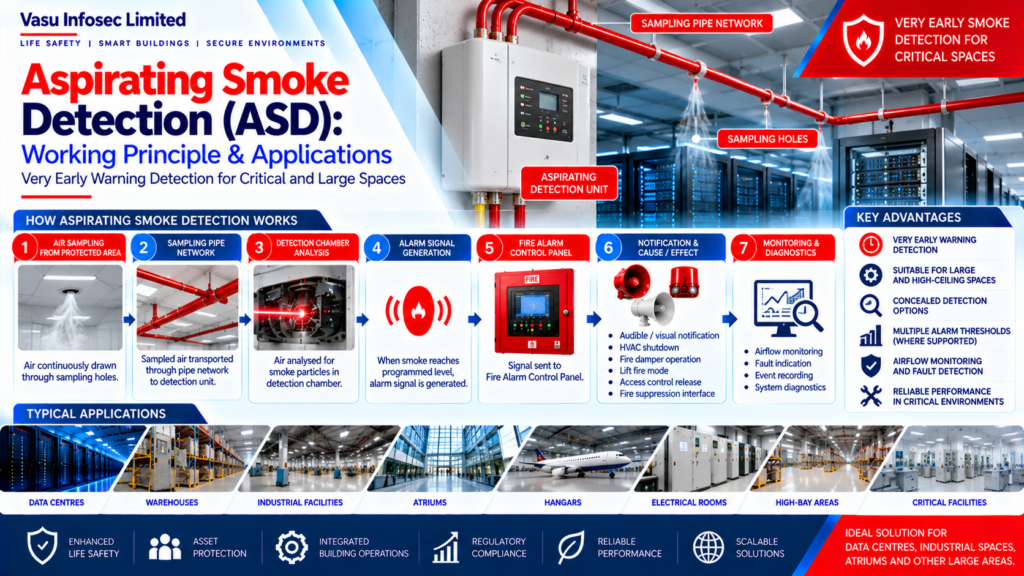
Protected Area → Sampling Holes → Air Sampling Pipe Network → Aspirator / Air Sampling Unit → Smoke Detection Chamber → Signal Processing → Fire Alarm Control Panel → Alarm / Fault / Interface Functions
| Stage | Function |
| Sampling holes and pipe network | Collect air samples from the protected area and transport them to the detector. |
| Aspirator / air sampling unit | Draws air through the network at the designed airflow. |
| Smoke detection chamber | Analyses the sampled air for smoke particles. |
| Signal processing | Evaluates the measured condition against configured alarm criteria and available alarm levels. |
| Fire alarm panel interface | Communicates alarm, fault and other supported status signals to the FACP. |
3. Working Principle
The aspirating detector continuously draws air from the protected area through sampling pipes. The sampled air is transported to the detection chamber, where the system analyses the air for smoke particles. When the detected smoke level reaches the programmed alarm criteria, the detector generates the applicable alarm signal.
4. Sampling Pipe Network
The sampling pipe network forms the sensing interface between the protected space and the aspirating detector. The network may include:
- Sampling pipes
- Sampling holes
- End-of-line arrangements
- Pipe fittings
- Pipe identification
- Airflow monitoring provisions
5. Aspirator / Air Sampling Unit
The aspirator provides the airflow required to draw air continuously from the protected area into the detection unit. Its operation should maintain the designed airflow through the sampling network and support reliable transport of air samples to the detection chamber.
6. Smoke Detection Chamber
The detection chamber analyses the sampled air for smoke particles. Depending on the approved detector technology, the system may provide multiple sensitivity levels and alarm thresholds to support staged early-warning detection.
7. Alarm Levels and Staged Detection
ASD systems may provide multiple alarm thresholds according to the selected equipment and approved design. Typical stages may include:
- Pre-alarm / very early warning
- Fire alarm
- High smoke condition
- Additional configured warning levels, where supported
The meaning, settings and response associated with each level should be defined by the selected equipment, approved design and Cause & Effect Matrix.
8. Airflow Monitoring
The system should monitor airflow through the sampling network to identify abnormal conditions that may affect detection performance. Potential conditions include:
- Pipe blockage
- Pipe breakage
- Aspirator fault
- Abnormal airflow
- Sampling network impairment
9. Application Selection Criteria
ASD should be considered based on:
- Required detection sensitivity
- Protected area characteristics
- Ceiling height
- Criticality of equipment
- Accessibility
- Environmental conditions
- Air movement
- Dust / contamination
- Maintenance requirements
- Required early-warning capability
10. Data Centre Applications
ASD is commonly considered for critical spaces where early warning is important and where conventional point detection may not provide the desired detection strategy. Potential areas include:
- Server rooms
- Data halls
- UPS rooms
- Electrical rooms
- Raised-floor spaces
- Critical equipment areas
11. High-Ceiling and Difficult-Access Applications
ASD can be used where access to conventional detectors is difficult or where large / high spaces require a distributed sampling arrangement. Potential applications include:
- Warehouses
- High-bay areas
- Industrial spaces
- Atriums
- Large equipment rooms
12. Environmental Considerations
The sampling system should be designed for the actual environment. Dust, humidity, temperature variation, airflow, contamination and other environmental factors can influence detector performance and sampling-pipe maintenance requirements.
13. Sampling Hole and Pipe Layout
Sampling hole locations and pipe routing should follow the approved design and manufacturer requirements. Engineering review should consider:
- Coverage
- Sampling-hole spacing
- Pipe length
- Pipe diameter
- Airflow balance
- Protected volume
- Obstructions
- Accessibility
14. Integration with Fire Alarm System
The ASD system should be correctly interfaced with the Fire Alarm Control Panel. Integration should verify:
- Alarm signals
- Pre-alarm signals, where applicable
- Fault signals
- Airflow / system fault indications
- Device / zone identification
- Cause & Effect operation
- Event recording
15. Testing and Commissioning
Testing should demonstrate the complete sampling and alarm sequence. Testing may include:
- Aspirator operation
- Airflow verification
- Sampling pipe integrity
- Alarm simulation
- Alarm level verification
- Fault simulation
- Panel indication
- Cause & Effect testing
- Reset and restoration
Test methods, acceptance criteria and responsibilities should follow approved project documentation, manufacturer instructions and the agreed scope. This list is indicative and does not itself establish certification or project acceptance.
16. Inspection and Maintenance
Maintenance should preserve sampling-system integrity and detection performance. Activities may include:
- Detector inspection
- Filter inspection / replacement
- Sampling-pipe inspection
- Sampling-hole inspection
- Airflow verification
- Alarm testing
- Fault review
- Cleaning, where permitted
17. Common Engineering Considerations
Engineering review should verify:
- Correct ASD technology
- Suitable sensitivity
- Sampling network design
- Pipe routing
- Sampling-hole arrangement
- Airflow performance
- Environmental suitability
- Fire alarm integration
- Maintenance access
- Documentation
18. Documentation
ASD documentation should include, as applicable:
- Detector datasheet
- Sampling pipe layout
- Sampling-hole schedule
- Equipment schedule
- Airflow / design calculations
- Detection sensitivity settings
- Cause & Effect Matrix
- Testing and commissioning records
- Maintenance records
- As-built documentation
19. Engineering Objective
Continuous Air Sampling → Reliable Smoke Analysis → Very Early Warning → Accurate Alarm / Fault Identification → Effective Fire Alarm Integration → Verified Airflow & Detection Performance → Maintainable Sampling Network → Reliable Fire Detection
Frequently Asked Questions
What is an aspirating smoke detection system?
It is an active air-sampling system that draws air through sampling pipes and analyses it for smoke particles.
How does ASD detect smoke?
An aspirator draws air to a detection chamber, where the sampled air is analysed. When the smoke level meets configured criteria, the detector generates the applicable alarm signal.
Where is ASD commonly considered?
Potential applications include data halls, server rooms, UPS and electrical rooms, raised-floor spaces, warehouses, high-bay areas, atriums and large equipment rooms.
What is the purpose of airflow monitoring?
It helps identify abnormal airflow or sampling-network conditions, such as blockage, breakage or aspirator faults, that could affect detection performance.
What are ASD alarm levels?
Depending on the equipment and approved design, levels may include pre-alarm or very early warning, fire alarm, high smoke condition and other configured warning levels.
What should be verified during commissioning?
Checks may include aspirator operation, airflow, pipe integrity, alarm levels, fault simulation, panel indication, Cause & Effect, and reset/restoration.
Engineering and Publication Notes
This article provides general information based on the supplied source document. ASD sensitivity, alarm levels, sampling-hole spacing, pipe dimensions, airflow limits, design calculations and maintenance requirements depend on the selected equipment, manufacturer instructions, approved design, environmental conditions and applicable requirements.
No numerical sensitivity, pipe length, sampling-hole spacing, code clause or compliance status is asserted in this draft. Mention of an application or interface does not establish suitability for every site or inclusion in Vasu Infosec Limited’s contractual scope.
SEO and CMS Metadata Suggestions
| Field | Suggested content |
| SEO title | Aspirating Smoke Detection: Working Principle & Applications | Vasu Infosec |
| Meta description | Understand how aspirating smoke detection draws air through sampling pipes, detects smoke, monitors airflow and supports early warning in critical and large spaces. |
| Suggested URL slug | /aspirating-smoke-detection-working-principle-applications/ |
| Primary topic | Aspirating smoke detection working principle and applications |
| Related topics | Smoke detector selection; beam smoke detection; fire alarm control panel; data centre fire detection; fire alarm commissioning and maintenance |
| Author / technical reviewer | To be assigned by Vasu Infosec Limited before publication |
| Review date | Enter the actual technical review date before publication |
| Standards and references | Add only standards, editions, clauses and references actually reviewed and applicable to the published content. |
Pre-Publication Checklist
- Assign a competent technical reviewer and enter the actual review date.
- Verify manufacturer-specific design, sensitivity, pipe layout, airflow and maintenance guidance.
- Do not add numerical design limits or compliance statements without a verified source and approved design context.
- Confirm company credentials, project examples and responsibility statements are documented and authorised.
- Enter the SEO title, meta description and URL slug in the website CMS.
- Use structured data only where it accurately represents the published page and is supported by the CMS / search platform.