
Article
Fire Alarm Battery Backup Calculation
Oct 2026
Direct Answer
Fire alarm battery backup calculation estimates the standby battery capacity needed to keep the system operating during loss of normal power. It uses connected equipment’s standby and alarm currents, required operating durations, and applicable design factors. Final inputs must come from approved equipment data and project requirements.
1. Engineering Overview
Fire Alarm Battery Backup Calculation determines the standby battery capacity required to maintain the Fire Alarm System during loss of the normal power supply. The calculation should account for the system’s quiescent load, alarm load, required standby duration, design margins, battery characteristics and applicable project requirements.
2. Battery Backup Architecture
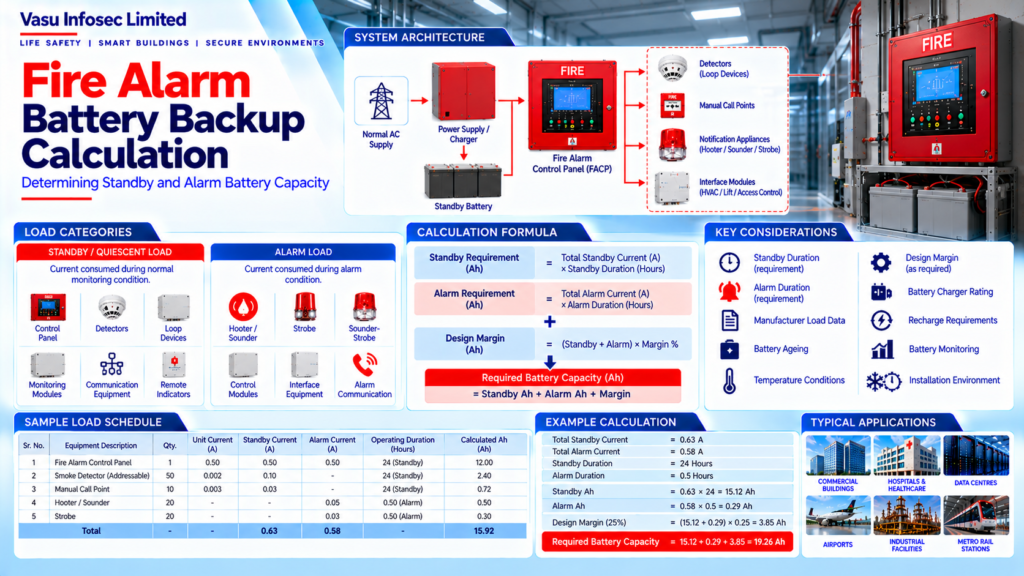
Normal AC Supply → Fire Alarm Power Supply / Charger → Standby Battery → Fire Alarm Control Panel → Field Devices / Notification Appliances / Interfaces
3. Purpose of Battery Calculation
The battery calculation verifies that the selected standby battery can supply the connected fire alarm equipment for the required standby period and the required alarm period after loss of normal power.
4. Basic Load Categories
Battery calculations generally consider two principal operating conditions:
- Quiescent / standby load
- Alarm load
The actual equipment loads should be taken from approved manufacturer data and the final system configuration.
5. Standby Load
Standby load is the current consumed by the fire alarm system while operating in its normal monitoring condition during loss of the primary power supply.
Typical loads may include:
- Fire Alarm Control Panel
- Detectors
- Addressable loop devices
- Monitoring modules
- Communication equipment
- Remote indicators
- Other continuously energised system components
6. Alarm Load
Alarm load is the current consumed when the system is in an alarm condition.
Typical loads may include:
- Hooters / sounders
- Strobes
- Sounder-strobes
- Control modules
- Interface equipment
- Alarm communication equipment
- Other equipment activated during alarm
7. Basic Calculation Principle
Required Battery Capacity = Standby Capacity Requirement + Alarm Capacity Requirement + Applicable Design Margin
The exact calculation methodology, standby period, alarm period and correction factors should follow the approved project requirements, applicable standards and manufacturer recommendations.
8. Load Schedule
A battery calculation should identify each connected load and its current requirement.
Typical schedule fields include:
- Equipment description
- Quantity
- Unit current
- Total current
- Standby current
- Alarm current
- Operating duration
- Calculated ampere-hours
9. Standby Ampere-Hour Calculation
Standby ampere-hour requirement is determined from the total standby current and the specified standby duration.
Standby Ah = Total Standby Current × Required Standby Duration
The resulting value should then be assessed against the applicable battery design requirements and correction factors.
10. Alarm Ampere-Hour Calculation
Alarm ampere-hour requirement is determined from the alarm current and the specified alarm duration.
Alarm Ah = Total Alarm Current × Required Alarm Duration
Where multiple alarm loads have different operating durations, each load should be calculated separately and then combined.
11. Battery Capacity Selection
The selected battery capacity should exceed the calculated requirement after considering applicable design factors, battery discharge characteristics, ageing considerations and the manufacturer’s permitted operating conditions.
12. Battery Charger Considerations
The battery charger should be capable of maintaining the standby batteries in a charged condition and supporting the required system operation in accordance with the approved equipment design.
Engineering review should consider:
- Charger rating
- Battery capacity
- Recharge requirements
- Battery monitoring
- Power supply arrangement
13. Design Margin
An appropriate design margin should be applied where required by the approved design, applicable standard, manufacturer recommendation or project specification. The selected margin should be clearly identified in the calculation.
14. Battery Ageing & Temperature Considerations
Battery performance can be affected by ageing and operating temperature. The final battery selection should therefore consider the manufacturer’s published performance data and the actual installation environment.
15. Example Calculation Structure
Example calculation structure:
Total Standby Current = Sum of all standby loads
Total Alarm Current = Sum of all alarm loads
Standby Requirement = Standby Current × Standby Duration
Alarm Requirement = Alarm Current × Alarm Duration
Total Requirement = Standby Requirement + Alarm Requirement
Selected Battery Capacity ≥ Total Requirement × Applicable Design Factor
16. Testing & Verification
Battery backup performance should be verified during testing and commissioning.
Testing may include:
- Normal power failure simulation
- Standby operation verification
- Alarm operation on battery supply
- Battery voltage verification
- Charger operation
- Battery fault monitoring
- Restoration of normal power
17. Common Engineering Considerations
Engineering review should verify:
- Correct equipment load data
- Complete load schedule
- Standby duration
- Alarm duration
- Battery capacity
- Design margin
- Charger capacity
- Battery ageing consideration
- Environmental conditions
- Manufacturer requirements
18. Documentation
Battery calculation documentation should include, as applicable:
- Equipment load schedule
- Manufacturer current data
- Standby calculation
- Alarm calculation
- Battery selection
- Design factor / margin
- Charger information
- Battery datasheet
- Approved system architecture
- Testing records
19. Engineering Objective
The engineering objective is:
Accurate Load Assessment → Correct Standby & Alarm Duration → Valid Ampere-Hour Calculation → Appropriate Design Margin → Correct Battery Selection → Adequate Charger Capacity → Verified Battery Performance → Reliable Fire Alarm Operation During Power Failure
Frequently Asked Questions
What information is needed for a battery backup calculation?
The calculation needs the connected equipment list, quantities, approved standby and alarm current data, required standby and alarm durations, and applicable design factors.
What is the difference between standby load and alarm load?
Standby load is the current consumed in the normal monitoring condition during loss of primary power. Alarm load is the current consumed when alarm devices and other programmed equipment operate.
How is standby ampere-hour capacity calculated?
The source document gives: Standby Ah = Total Standby Current × Required Standby Duration. The result must then be assessed against applicable design requirements and correction factors.
How is alarm ampere-hour capacity calculated?
The source document gives: Alarm Ah = Total Alarm Current × Required Alarm Duration. Where loads have different alarm durations, calculate each load separately and combine the results.
Can the calculated ampere-hour value be used directly as the battery rating?
Not automatically. The selected battery should account for applicable design factors, discharge characteristics, ageing, operating temperature and manufacturer-permitted conditions.
What should be checked during commissioning?
Checks may include simulated normal-power failure, standby operation, alarm operation on battery, battery voltage, charger operation, battery fault monitoring and restoration of normal power.
SEO and CMS Recommendations
| SEO title | Fire Alarm Battery Backup Calculation: Method & Load Assessment | Vasu Infosec |
| Meta description | Learn how fire alarm battery backup capacity is calculated using standby current, alarm current, operating duration, design factors and manufacturer data. |
| Suggested URL slug | /fire-alarm-battery-backup-calculation/ |
| Primary keyword | fire alarm battery backup calculation |
| Related keywords | fire alarm battery capacity, standby ampere-hour calculation, alarm load calculation, fire alarm battery charger |
| Suggested internal links | Fire Alarm System Architecture; Fire Alarm Control Panel; Fire Alarm Loop Architecture; Hooter, Sounder & Strobe Comparison |
Technical Review and Pre-Publication Checklist
- Confirm standby and alarm currents against approved manufacturer data for the final equipment configuration.
- Verify required standby and alarm durations from approved project requirements and applicable standards; the source does not specify universal durations.
- Check that loads operating for different durations are calculated separately where applicable.
- Confirm design margins, correction factors, ageing and temperature assumptions are explicitly stated and supported.
- Verify battery discharge characteristics, selected capacity and charger rating against manufacturer documentation.
- Do not publish a numerical worked example unless all inputs and assumptions are documented and checked.
- Keep project-specific responsibilities and deliverables within the approved contract and scope.