
Article
Fire Alarm Control Panel: Architecture & Functions
Oct 2026
Direct Answer
A Fire Alarm Control Panel (FACP) is the central processing, supervision and control element of a fire alarm system. It receives signals from field devices, processes alarm and fault conditions, activates programmed outputs, manages specified system interfaces and provides status indications and event information. Its actual functions depend on the selected system architecture, approved programming and project requirements.
1. Engineering Overview
The Fire Alarm Control Panel (FACP) is the central processing, supervision and control element of a Fire Alarm System. It receives inputs from field devices, processes alarm and fault conditions, activates programmed outputs, manages system interfaces and provides local status indication and event information.
2. Control Panel Architecture
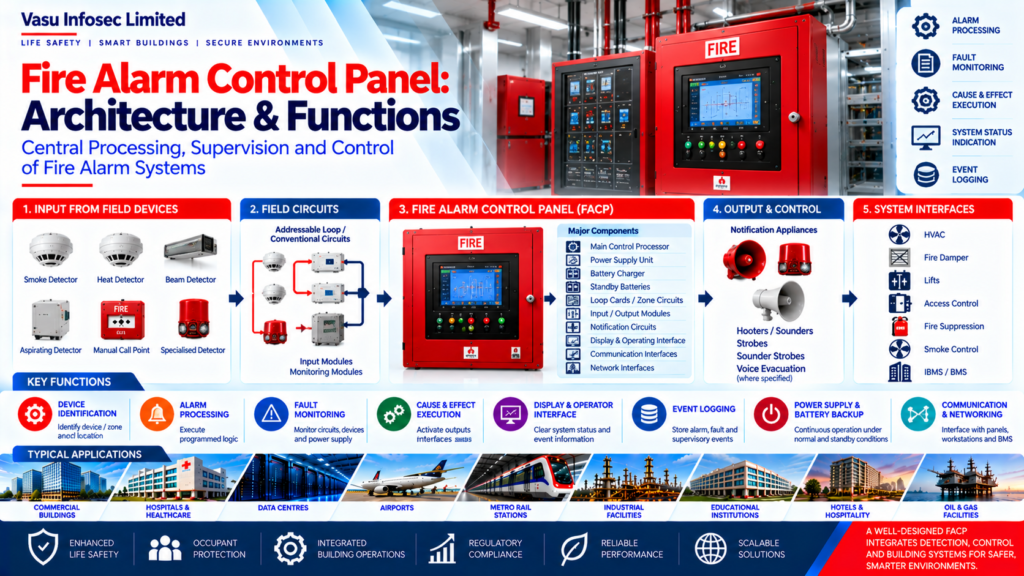
Field Detection Devices → Addressable Loop / Conventional Circuits → Input Modules → Fire Alarm Control Panel → Processing & Logic → Output Modules → Notification Appliances / Control Interfaces → Monitoring & Building System Interfaces
| Architecture element | Typical role |
| Field detection devices | Provide initiating signals from detectors, manual call points or approved monitored inputs. |
| Addressable loops / conventional circuits | Carry device or zone signals to the panel according to the system design. |
| Input modules | Receive approved monitored inputs or interface signals where required. |
| FACP processing and logic | Identifies and processes inputs according to programmed logic. |
| Output modules and notification appliances | Operate specified alarm appliances or control interfaces. |
| Monitoring and building-system interfaces | Exchange approved status or alarm signals with connected systems where specified. |
3. Major Panel Components
A typical FACP architecture may comprise:
- Main control processor
- Power supply unit
- Battery charger
- Standby batteries
- Addressable loop cards / zone circuits
- Input modules
- Output / control modules
- Notification circuits
- Display and operating interface
- Communication interfaces
- Network interfaces, where specified
4. Input Processing
The panel receives signals from connected initiating devices and monitored interfaces. Typical inputs include smoke detectors, heat detectors, beam detectors, aspirating detection systems, flame detectors, manual call points, supervisory inputs and fire suppression interfaces.
5. Alarm Processing Function
The FACP evaluates incoming signals according to its programmed system logic and establishes the applicable alarm condition. Functions may include device identification, zone identification, alarm indication, event prioritisation, alarm logging and Cause & Effect execution.
6. Fault Monitoring
The panel continuously supervises connected circuits, devices and internal functions for abnormal conditions, including open circuit, short circuit, device communication failure, power supply failure, battery fault, processor / internal fault, network communication fault and earth fault where applicable.
7. Display and Operator Interface
The operator interface should provide clear information regarding fire alarm, fault, supervisory condition, disabled / isolated point, power status, system status, alarm location and event information.
8. Output and Control Functions
The FACP may activate local notification appliances and external control functions according to the approved Cause & Effect Matrix. Outputs may include sounders, hooters, strobes, sounder strobes, control relays, HVAC shutdown, fire damper controls, lift interface, access control interface and fire suppression interface. These outputs should not be assumed to be included unless supported by the approved project design and Cause & Effect Matrix.
9. Addressable Panel Architecture
In an addressable system, the control panel communicates with individually identified field devices through addressable loops or networks. This architecture can provide individual device identification, device status monitoring, fault identification, event location and enhanced diagnostics.
10. Conventional Panel Architecture
In a conventional system, initiating devices are grouped into defined zones or circuits. The control panel identifies the affected zone and provides the corresponding alarm or fault indication.
11. Power Supply and Battery Charger
The panel power architecture should provide continuous operation under normal and standby conditions through the primary AC supply, internal power supply, battery charger, standby batteries and battery monitoring. Required standby capacity and calculation criteria must be taken from the applicable approved design and project requirements; this article does not establish a specific battery capacity.
12. Communication and Networking
Where required, the FACP may communicate with other panels, graphical workstations, monitoring systems or building management systems. Communication architecture should consider network topology, communication protocol, redundancy where specified, fault monitoring and interface compatibility.
13. Cause & Effect Processing
The panel executes programmed actions based on defined inputs and outputs, such as detector alarm to sounder activation, fire alarm to HVAC shutdown, fire alarm to lift fire mode, access control release, suppression release interface and IBMS / BMS alarm. These actions must follow the approved Cause & Effect Matrix and project-specific interface design.
14. Event Logging
The panel should maintain event information appropriate to the approved system architecture. Events may include alarm events, fault events, supervisory events, disablements, resets, operator actions and system status changes.
15. Testing and Commissioning
FACP testing should verify hardware, software, field-device communication and programmed functionality. Testing may include:
- Input activation
- Alarm processing
- Output activation
- Fault simulation
- Battery operation
- Communication testing
- Cause & Effect testing
- Interface testing
- Event logging
- Reset operation
Testing procedures, acceptance criteria and responsibilities should be taken from the approved project documents, applicable requirements and agreed scope. The list above is indicative and is not a standalone certification or acceptance criterion.
16. Common Engineering Considerations
Engineering review should verify panel capacity, loop / circuit capacity, power supply capacity, battery capacity, device compatibility, input / output capacity, network requirements, Cause & Effect logic, interface requirements and future expansion provisions.
17. Documentation
Control panel documentation should include, as applicable:
- Panel datasheet
- System architecture
- Panel configuration
- Loop drawings
- Input / Output schedule
- Cause & Effect Matrix
- Battery calculation
- Network architecture
- Programming records
- Testing records
- Commissioning records
- As-built documentation
- Operation and Maintenance (O&M) manual
18. Engineering Objective
Reliable Input Reception → Accurate Signal Processing → Continuous Supervision → Correct Output Control → Clear Operator Indication → Reliable Power Backup → Coordinated Interfaces → Verified Cause & Effect → Complete Event Recording → Robust Fire Alarm Control Panel Performance
Frequently Asked Questions
What is the main function of an FACP?
It receives and processes field inputs, supervises system conditions, activates programmed outputs and provides status and event information.
What components are commonly found in an FACP?
A typical arrangement may include a processor, power supply, battery charger and standby batteries, loop cards or zone circuits, input/output modules, notification circuits, display and communication interfaces.
What is the difference between addressable and conventional panels?
An addressable panel can identify individual devices, while a conventional panel generally identifies the affected zone or circuit.
What faults can a panel monitor?
Depending on its design, it may monitor circuit open/short conditions, device communication failures, power and battery faults, internal faults, network faults and earth faults.
Does an FACP automatically control HVAC, lifts or suppression systems?
Only where the required control outputs and interfaces are provided, programmed and included in the approved Cause & Effect Matrix.
What should FACP commissioning verify?
It may include input processing, field communication, outputs, fault monitoring, battery operation, interfaces, event logging and reset operation, in accordance with approved project procedures.
Engineering and Publication Notes
This article presents a general description based on the supplied source document. Actual FACP capabilities, compatible devices, network arrangements, battery requirements, output functions and test/acceptance criteria depend on the selected equipment, approved design, project specifications and applicable requirements.
Mention of a function or interface does not confirm that it is included in every project or in Vasu Infosec Limited’s scope. Project responsibilities and deliverables must be stated only where supported by approved contractual and project records. This article does not independently establish statutory compliance, certification or project acceptance.
SEO and CMS Metadata Suggestions
| Field | Suggested content |
| SEO title | Fire Alarm Control Panel: Architecture & Functions | Vasu Infosec |
| Meta description | Learn how a Fire Alarm Control Panel receives inputs, processes alarms and faults, supervises circuits, controls approved outputs and records system events. |
| Suggested URL slug | /fire-alarm-control-panel-architecture-functions/ |
| Primary topic | Fire Alarm Control Panel architecture and functions |
| Related topics | Fire alarm system working principle; detection-to-alarm sequence; Cause & Effect Matrix; fire alarm commissioning; addressable vs conventional systems |
| Author / technical reviewer | To be assigned by Vasu Infosec Limited before publication |
| Review date | Enter the actual technical review date before publication |
| Standards and references | Add only standards, editions, clauses and references that have actually been reviewed and are applicable. |
Pre-Publication Checklist
- Assign a competent technical reviewer and enter the actual review date.
- Verify applicable standards and editions before adding specific compliance statements.
- Confirm project examples, company credentials and responsibility statements are documented and authorised.
- Enter the SEO title, meta description and URL slug in the website CMS.
- Use structured data only where it accurately reflects the published page and is supported by the CMS and search platform.