
Article
Fire Alarm Inspection, Testing & Maintenance Cycle
Oct 2026
Direct Answer
Fire Alarm System inspection, testing and maintenance (ITM) is a planned cycle of routine inspection, functional testing, preventive and corrective maintenance, retesting and recordkeeping. The schedule should be based on the approved system design, manufacturer requirements, project maintenance philosophy, applicable authority requirements and relevant standards.
1. Engineering Overview
Inspection, testing and maintenance (ITM) of a Fire Alarm System are essential to maintain system reliability, availability and life-safety performance throughout its operational life. The maintenance cycle should be based on the approved system design, manufacturer requirements, project maintenance philosophy and applicable requirements.
2. Maintenance Cycle Architecture
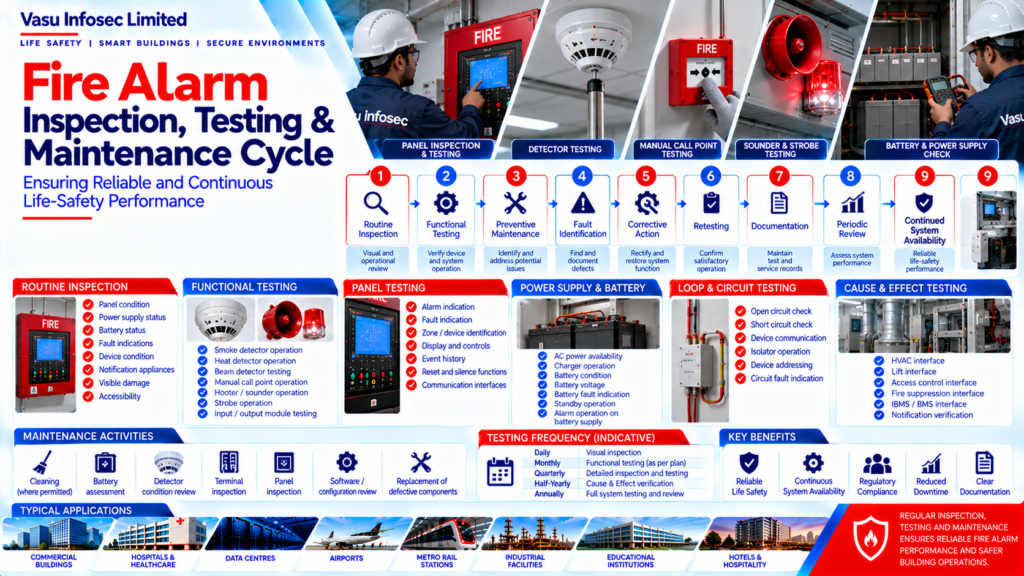
Routine Inspection → Functional Testing → Preventive Maintenance → Fault Identification → Corrective Action → Retesting → Documentation → Periodic Review → Continued System Availability
3. Purpose of Inspection
Inspection provides a structured visual and operational review of the Fire Alarm System to identify conditions that may affect performance, reliability or accessibility.
4. Routine Inspection
Routine inspection may include:
- Fire Alarm Control Panel condition
- Power supply status
- Battery status
- Fault indications
- Detector condition
- Manual call point condition
- Hooter / sounder condition
- Strobe condition
- Visible cable / equipment damage
- Accessibility of fire alarm equipment
5. Functional Testing
Functional testing verifies that individual fire alarm devices and system functions operate as intended.
Testing may include:
- Smoke detector activation
- Heat detector activation
- Beam detector testing
- Flame detector testing
- Manual call point operation
- Hooter / sounder operation
- Strobe operation
- Input / output module operation
6. Fire Alarm Control Panel Testing
The Fire Alarm Control Panel should be checked for correct operation and indication.
Activities may include:
- Alarm indication
- Fault indication
- Zone / device identification
- Display and controls
- Event history
- Reset function
- Silence function, where applicable
- Communication interfaces
7. Power Supply & Battery Maintenance
The primary power supply and standby battery system should be inspected and tested according to the approved maintenance requirements.
Checks may include:
- AC power availability
- Charger operation
- Battery condition
- Battery voltage
- Battery fault indication
- Standby operation
- Alarm operation on standby supply
8. Detector Inspection & Maintenance
Detectors should be inspected for physical damage, contamination, obstruction and other conditions that may affect detection performance.
Maintenance may include approved cleaning, functional testing, sensitivity verification where applicable and replacement of defective devices.
9. Manual Call Point Maintenance
Manual Call Points should be checked for accessibility, visibility, physical condition and correct operation. Protective covers, operating mechanisms and identification should also be reviewed where applicable.
10. Notification Appliance Maintenance
Hooters, sounders, strobes and combined notification appliances should be checked for physical condition, correct operation, visibility and audibility as applicable.
11. Addressable Loop & Circuit Testing
Addressable loops and conventional circuits should be checked for communication, continuity, fault conditions and correct device identification.
Potential checks include:
- Open circuit conditions
- Short circuit conditions
- Device communication
- Isolator operation
- Device addressing
- Circuit fault indication
12. Cause & Effect Verification
The approved Cause & Effect Matrix should be periodically verified to confirm that the programmed response remains consistent with the approved fire strategy and current building systems.
Verification may include:
- Alarm notification
- HVAC interfaces
- Lift interfaces
- Access control interfaces
- Fire suppression interfaces
- IBMS / BMS interfaces
13. Preventive Maintenance
Preventive maintenance should identify potential failures before they affect system performance.
Activities may include:
- Cleaning where permitted
- Battery assessment
- Detector condition review
- Terminal inspection
- Panel inspection
- Software / configuration review where authorised
- Replacement of defective components
14. Corrective Maintenance
Defects identified during inspection or testing should be documented, assessed and rectified through the approved maintenance process. After corrective action, affected functions should be retested to confirm satisfactory operation.
15. Testing Frequency & Planning
Testing and inspection frequency should be established from the applicable project requirements, maintenance contract, manufacturer recommendations, authority requirements and relevant standards. The final maintenance schedule should reflect the actual installed system and occupancy risk.
16. Maintenance Records
Maintenance records should provide traceability of system condition and completed activities.
Records may include:
- Inspection checklist
- Testing results
- Fault reports
- Corrective action records
- Battery test records
- Device replacement records
- Cause & Effect test records
- Service reports
- Retest records
17. System Availability
Where a Fire Alarm System or part of it is taken out of service for maintenance, the impairment should be controlled through the approved project or facility procedure. Appropriate coordination, notification and temporary risk controls should be applied as required.
18. Common Engineering Considerations
Engineering review should verify:
- Complete equipment coverage
- Defined inspection frequency
- Functional testing requirements
- Battery maintenance
- Detector maintenance
- Loop / circuit testing
- Cause & Effect verification
- Interface testing
- Defect closure
- Record retention
19. Documentation
ITM documentation should include, as applicable:
- Approved maintenance schedule
- Inspection checklists
- Testing procedures
- Equipment schedules
- Device lists
- Cause & Effect Matrix
- Test reports
- Defect / corrective action reports
- Battery records
- Service records
- Updated as-built documentation
20. Engineering Objective
The engineering objective is:
Routine Inspection → Reliable Functional Testing → Preventive Maintenance → Early Fault Detection → Corrective Action → Retesting → Complete Documentation → Continuous System Availability → Reliable Fire Alarm Life-Safety Performance
Frequently Asked Questions
What does ITM mean in a fire alarm system?
ITM means inspection, testing and maintenance. It covers planned checks, functional verification, preventive work, defect correction, retesting and records.
How often should a fire alarm system be inspected and tested?
The source document does not prescribe a universal interval. Frequency should be established from project requirements, the maintenance contract, manufacturer recommendations, authority requirements and relevant standards.
What should routine inspection cover?
Depending on the installed system and approved maintenance plan, checks may cover the control panel, power and battery status, fault indications, detectors, manual call points, notification appliances, visible damage and equipment accessibility.
What should happen when a defect is found?
Document and assess the defect, rectify it through the approved maintenance process, and retest affected functions to confirm satisfactory operation.
What if part of the system must be taken out of service?
Control the impairment through the approved project or facility procedure, including coordination, notification and temporary risk controls as required.
SEO & CMS Publication Metadata
| SEO title | Fire Alarm Inspection, Testing & Maintenance (ITM) Cycle |
| Meta description | Learn the fire alarm ITM cycle, including routine inspection, functional testing, battery maintenance, cause-and-effect verification, corrective action and records. |
| Suggested URL slug | /fire-alarm-inspection-testing-maintenance-cycle/ |
| Primary keyword | fire alarm inspection testing and maintenance |
| Related keywords | fire alarm preventive maintenance; fire alarm functional testing; fire alarm maintenance checklist; fire alarm battery maintenance; fire alarm system testing |
| Suggested internal links | Fire Alarm System Architecture; Fire Alarm Control Panel; Fire Alarm Battery Backup Calculation; Fire Alarm Cause & Effect Matrix; Fire Alarm FAT, SAT & Commissioning Flow |