
Article
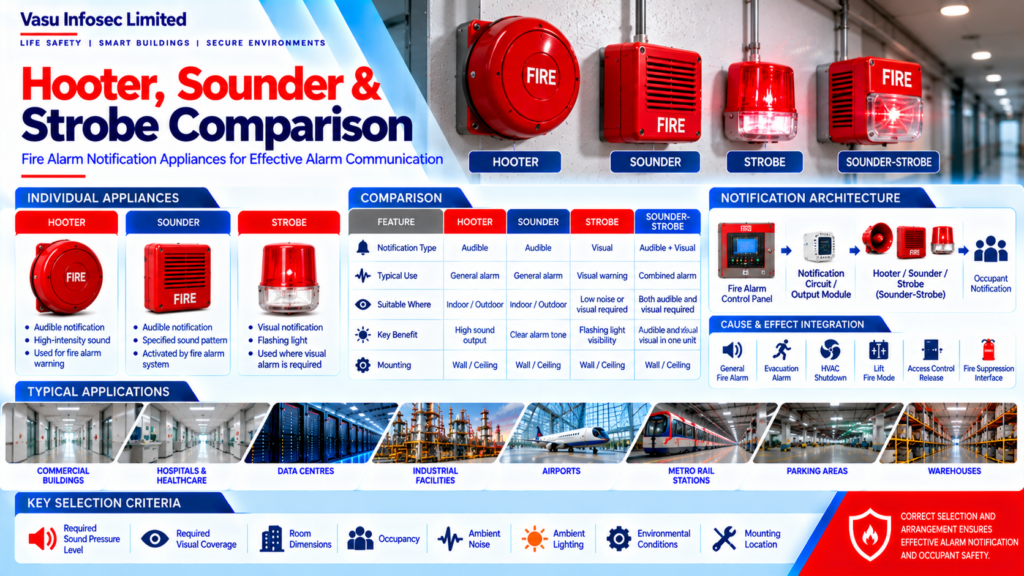
Hooter, Sounder & Strobe Comparison
Oct 2026
Direct Answer
Hooters and sounders provide audible fire alarm warnings, while strobes provide visual warnings through flashing light. A combined sounder-strobe can provide both functions in one appliance where permitted by the approved fire alarm design. Selection depends on required audibility and visibility, occupancy, ambient conditions, circuit capacity, environmental rating and project requirements.
1. Engineering Overview
Hooters, sounders and strobes are fire alarm notification appliances used to communicate alarm conditions to occupants and relevant personnel. Their selection and arrangement should be based on the approved fire alarm design, required notification strategy, environmental conditions, audibility / visibility requirements and applicable project specifications.
2. Notification Architecture
Fire Alarm Control Panel → Notification Circuit / Output Module → Hooter / Sounder / Strobe → Occupant Notification → Cause & Effect / Emergency Response
3. Hooter Working Principle
A hooter is an audible notification appliance that generates a high-intensity sound when energised by the fire alarm system. Its purpose is to provide an audible warning during a fire alarm condition.
4. Sounder Working Principle
A sounder is an audible fire alarm notification appliance designed to produce a specified warning tone or sound pattern. It is activated by the Fire Alarm Control Panel or associated notification circuit according to the approved Cause & Effect logic.
5. Strobe Working Principle
A strobe is a visual notification appliance that produces flashing light to communicate an alarm condition. It is particularly relevant where audible notification may not be sufficient or where visual alarm notification is required by the approved design.
6. Hooter vs Sounder
Hooters and sounders both provide audible notification. The actual acoustic output, tone characteristics, sound pressure level, current consumption, environmental rating and application suitability depend on the selected manufacturer and model.
7. Sounder vs Strobe
A sounder provides audible notification, whereas a strobe provides visual notification. In applications requiring both audible and visual warning, a combined sounder-strobe appliance may be selected where permitted by the approved design.
8. Sounder-Strobe Combination
A sounder-strobe combines audible and visual notification in one appliance. The combined device should be selected based on its individual acoustic and optical performance, mounting arrangement, environmental rating and approved application.
9. Selection Criteria
- Required sound pressure level
- Required visual coverage
- Room dimensions
- Occupancy
- Ambient noise
- Ambient lighting
- Ceiling / wall arrangement
- Environmental conditions
- Indoor / outdoor application
- Current consumption
- Circuit loading
- Mounting location
- Required sound pressure level
- Required visual coverage
- Room dimensions
- Occupancy
- Ambient noise
- Ambient lighting
- Ceiling / wall arrangement
- Environmental conditions
- Indoor / outdoor application
- Current consumption
- Circuit loading
- Mounting location
10. Audible Notification Coverage
Audible notification should be designed to provide adequate warning throughout the required protected areas in accordance with the approved fire alarm design and applicable requirements. Ambient background noise and building construction should be considered.
11. Visual Notification Coverage
Visual notification should be positioned to provide effective visibility within the required area. Obstructions, partitions, equipment and ambient lighting should be considered when determining the final arrangement.
12. Notification Circuit Architecture
Notification appliances may be connected through conventional notification circuits, addressable output modules or other approved interfaces depending on the selected fire alarm system. Engineering review should consider circuit capacity, voltage requirements, current consumption, end-of-line supervision and fault monitoring.
13. Cause & Effect Integration
Hooters, sounders and strobes should operate according to the approved Cause & Effect Matrix. Typical functions may include general fire alarm notification, zone-specific notification, evacuation alarm, interface-driven alarm and fire suppression alarm.
14. Indoor & Outdoor Applications
Notification appliances should have an enclosure and environmental protection suitable for their installation location. Outdoor or exposed locations may require weather-resistant or appropriately rated equipment.
15. Testing & Commissioning
Testing should verify correct operation and system integration. Testing may include audible output test, visual flash operation, circuit activation, alarm indication at panel, Cause & Effect verification, fault monitoring, interface testing and reset / restoration.
16. Inspection & Maintenance
Notification appliances should be periodically inspected and tested in accordance with the approved maintenance programme and manufacturer requirements. Activities may include visual inspection, physical condition check, functional test, wiring inspection, circuit fault review and cleaning where permitted.
17. Common Engineering Considerations
Engineering review should verify:
- Correct notification type
- Acoustic requirements
- Visual requirements
- Coverage
- Environmental suitability
- Circuit loading
- Power requirements
- Mounting location
- Cause & Effect operation
- Maintenance accessibility
18. Documentation
- Datasheets
• Notification appliance schedule
• Approved fire alarm layouts
• Circuit / loop information
• Sound pressure / visual coverage information
• Cause & Effect Matrix
• Testing records
• Commissioning records
• Maintenance records
• As-built documentation - Datasheets
- Notification appliance schedule
- Approved fire alarm layouts
- Circuit / loop information
- Sound pressure / visual coverage information
- Cause & Effect Matrix
- Testing records
- Commissioning records
- Maintenance records
- As-built documentation
19. Engineering Objective
Correct Notification Selection → Adequate Audible / Visual Coverage → Reliable Circuit Operation → Correct Cause & Effect → Clear Occupant Warning → Verified Testing → Maintainable Notification Appliances → Effective Fire Alarm Notification
Frequently Asked Questions
What is the difference between a hooter and a sounder?
Both provide audible notification. Their naming, tone characteristics and acoustic output can vary by manufacturer and model, so the approved datasheet and project specification should guide selection.
What is the difference between a sounder and a strobe?
A sounder provides audible warning; a strobe provides visual warning through flashing light. A combined sounder-strobe may be used where the approved design requires both functions.
How should notification appliances be selected?
Consider required sound pressure level and visual coverage, room dimensions, occupancy, ambient noise and lighting, mounting arrangement, environmental conditions, current consumption and circuit loading.
Can sounders and strobes be connected to the same fire alarm system?
Yes, where the selected fire alarm architecture and approved interfaces support them. Circuit capacity, voltage, current consumption, supervision and fault monitoring must be assessed.
How are hooters, sounders and strobes tested?
Testing may include audible output, visual flash, circuit activation, panel indication, Cause & Effect, fault monitoring, interfaces and reset/restoration, following approved procedures and manufacturer requirements.
SEO and CMS Recommendations
| SEO title | Hooter vs Sounder vs Strobe: Fire Alarm Notification Guide | Vasu Infosec |
| Meta description | Compare fire alarm hooters, sounders, strobes and combined sounder-strobes. Learn their functions, selection factors, coverage, circuit integration and testing considerations. |
| Suggested URL slug | /hooter-sounder-strobe-comparison/ |
| Primary keyword | hooter vs sounder vs strobe |
| Related keywords | fire alarm notification appliances; sounder-strobe; audible fire alarm; visual fire alarm notification; fire alarm circuit loading |
| Suggested internal links | Fire Alarm Control Panel Architecture; Fire Detection to Alarm Sequence; Manual Call Point: Components & Operation |
Technical Review and Pre-Publication Checklist
- Confirm manufacturer-specific sound pressure levels, tone patterns, flash characteristics, current consumption and environmental ratings from approved datasheets.
- Verify required audible and visual coverage against the approved design and applicable project requirements; do not publish generic numerical coverage values without supporting documentation.
- Confirm circuit voltage, loading, supervision, end-of-line arrangements and interfaces for the selected system architecture.
- Verify Cause & Effect functions and any external interfaces against the approved project matrix.
- Confirm applicable standards, editions and authority requirements for the specific project before making compliance statements.
- Keep project-specific obligations, testing responsibilities and deliverables within Vasu Infosec Limited’s approved contractual scope.