
Article
Smoke Detector: Working Principle & Selection
Oct 2026
Direct Answer
A smoke detector is an automatic fire detection device that senses smoke particles associated with combustion and sends an initiating signal to the Fire Alarm Control Panel (FACP). Correct selection depends on the expected fire characteristics, occupancy, ceiling and airflow conditions, environmental influences, nuisance-alarm risk, maintenance access and the approved fire detection strategy.
1. Engineering Overview
A smoke detector is an automatic fire detection device designed to identify smoke particles produced by combustion and transmit an initiating signal to the Fire Alarm Control Panel. Correct selection depends on the fire characteristics, occupancy, environmental conditions, ceiling configuration, nuisance-alarm risk and approved fire detection strategy.
2. Smoke Detection Architecture
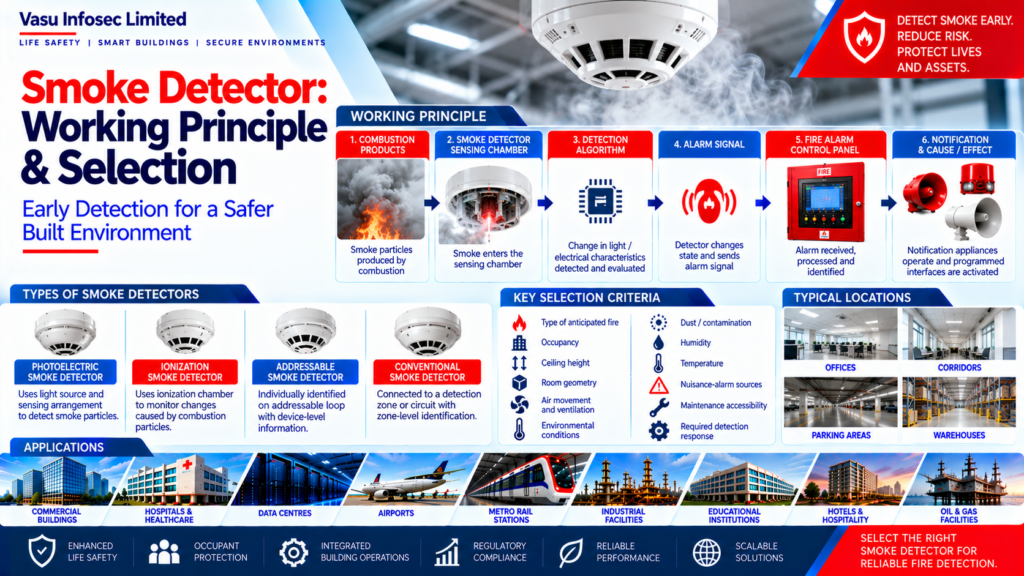
Combustion Products → Smoke Detector Sensing Chamber → Detection Algorithm / Threshold → Alarm Signal → Fire Alarm Control Panel → Notification & Cause / Effect Functions
| Stage | Function |
| Combustion products enter sensing area | Smoke or combustion particles reach the detector’s sensing chamber. |
| Sensing and evaluation | The detector evaluates the sensed condition against its operating criteria. |
| Alarm signal | When the programmed criteria are met, the detector changes state and sends an initiating signal. |
| FACP processing | The panel receives and identifies the signal according to the system architecture. |
| Notification and programmed actions | Approved notification and Cause & Effect functions operate where included in the project design. |
3. Smoke Detector Working Principle
Smoke detectors monitor the surrounding atmosphere for combustion products. When the detected smoke condition reaches the programmed operating criteria, the detector changes state and communicates an alarm condition to the fire alarm system.
4. Photoelectric Smoke Detection
Photoelectric smoke detectors generally use a light source and sensing arrangement to identify smoke particles entering the sensing chamber. Smoke alters the light received by the sensing element, allowing the detector to recognise a smoke condition.
5. Ionization Smoke Detection
Ionization smoke detectors use an ionization chamber to monitor changes caused by combustion particles. Changes in the chamber’s electrical characteristics are evaluated to identify a smoke condition. The suitability of this technology should be determined by the approved project requirements and applicable regulations.
6. Addressable Smoke Detectors
Addressable smoke detectors are individually identified on an addressable fire alarm loop. The Fire Alarm Control Panel can associate the alarm or fault condition with the specific programmed device location.
7. Conventional Smoke Detectors
Conventional smoke detectors are connected to a designated detection zone or circuit. When the detector operates, the Fire Alarm Control Panel identifies the affected zone rather than necessarily identifying the individual detector.
8. Detector Selection Criteria
Selection should consider:
- Type and characteristics of anticipated fire
- Occupancy
- Ceiling height
- Room geometry
- Air movement
- Ventilation
- Environmental conditions
- Dust / contamination
- Humidity
- Temperature
- Nuisance-alarm sources
- Maintenance accessibility
- Required detection response
9. Ceiling and Airflow Considerations
Smoke movement is affected by ceiling configuration, air movement, ventilation and thermal conditions. Detector positioning should therefore follow the approved design, manufacturer requirements and applicable standards rather than relying only on nominal room coverage.
10. Environmental Considerations
The detector environment should be assessed before selection. Potential influences include dust, steam, cooking aerosols, exhaust gases, humidity, temperature variation and other conditions that may create nuisance alarms or affect detector performance.
11. Detector Location
Detector locations should be coordinated with the approved fire alarm layout and site conditions. Review should consider:
- Ceiling obstructions
- Beams and structural elements
- HVAC air supply / return locations
- Light fittings and other services
- Access for maintenance
- Hazard locations
- Required separation / spacing
12. Addressing and Identification
For addressable systems, each detector should have a unique programmed address and clear location description. Identification should remain consistent across the device, loop drawing, device schedule, Cause & Effect Matrix and final as-built documentation.
13. Alarm and Fault Monitoring
The fire alarm system should monitor the detector for alarm and, where supported by the system architecture, relevant fault or abnormal conditions. Detector status should be correctly represented at the Fire Alarm Control Panel.
14. Testing and Commissioning
Smoke detector testing should verify correct operation and communication with the Fire Alarm Control Panel. Testing may include:
- Detector activation test
- Panel alarm indication
- Device identification
- Alarm notification
- Cause & Effect verification
- Fault monitoring
- Reset operation
Testing methods, acceptance criteria and responsibilities should follow approved project procedures, manufacturer instructions and the agreed scope. This list is indicative and does not itself establish certification or project acceptance.
15. Maintenance
Smoke detectors should be maintained in accordance with the approved inspection and maintenance programme and manufacturer requirements. Typical activities may include:
- Visual inspection
- Cleaning where permitted
- Functional testing
- Contamination assessment
- Device replacement where required
- Event / fault review
16. Common Engineering Considerations
Engineering review should verify:
- Correct detector technology
- Suitable environmental application
- Correct detector location
- Approved spacing / coverage
- Addressing / zoning
- Circuit compatibility
- Alarm response
- Maintenance accessibility
- Nuisance-alarm risk
- Documentation traceability
17. Documentation
Detector documentation should include, as applicable:
- Detector datasheet
- Detector schedule
- Approved fire alarm drawings
- Device addressing information
- Detection zoning
- Cause & Effect Matrix
- Testing records
- Commissioning records
- Maintenance records
- As-built documentation
18. Engineering Objective
Correct Smoke Detection Technology → Hazard-Suitable Selection → Appropriate Location → Reliable Smoke Sensing → Accurate Device Identification → Timely Alarm Transmission → Verified Cause & Effect → Maintainable Detection → Reliable Fire Alarm Performance
Frequently Asked Questions
What does a smoke detector do?
It senses smoke or combustion particles and sends an initiating signal to the fire alarm system when its operating criteria are met.
How does a photoelectric smoke detector work?
It uses a light source and sensing arrangement; smoke entering the chamber changes the light received by the sensing element.
What is the difference between addressable and conventional smoke detectors?
Addressable detectors can be identified individually by the panel, while conventional systems generally indicate the affected zone or circuit.
What factors affect smoke detector selection?
Expected fire characteristics, occupancy, ceiling height and geometry, airflow, ventilation, dust, humidity, temperature, nuisance-alarm sources, maintenance access and required response.
Can detectors be installed based only on room area?
No. Detector positioning should consider the approved design, ceiling and airflow conditions, manufacturer requirements and applicable standards.
What maintenance do smoke detectors need?
As specified by the approved maintenance programme and manufacturer, activities may include visual inspection, permitted cleaning, functional testing, contamination assessment, replacement where required and event/fault review.
Engineering and Publication Notes
This article presents general information based on the supplied source document. Detector technology, spacing, location, sensitivity, compatibility, testing methods and maintenance intervals must be confirmed against the selected manufacturer’s instructions, approved design, project specifications and applicable requirements.
No specific spacing, coverage value, code clause, certification or compliance status is asserted in this draft. Mention of detector types or interfaces does not establish that a particular type or function is suitable for every project or included in Vasu Infosec Limited’s scope.
SEO and CMS Metadata Suggestions
| Field | Suggested content |
| SEO title | Smoke Detector: Working Principle & Selection | Vasu Infosec |
| Meta description | Learn how smoke detectors work and how to select them based on fire characteristics, occupancy, ceiling and airflow conditions, environment and maintenance needs. |
| Suggested URL slug | /smoke-detector-working-principle-selection/ |
| Primary topic | Smoke detector working principle and selection |
| Related topics | Fire Alarm Control Panel architecture; addressable vs conventional fire alarm systems; fire detection-to-alarm sequence; detector commissioning and maintenance |
| Author / technical reviewer | To be assigned by Vasu Infosec Limited before publication |
| Review date | Enter the actual technical review date before publication |
| Standards and references | Add only standards, editions, clauses and references actually reviewed and applicable to the published content. |
Pre-Publication Checklist
- Assign a competent technical reviewer and enter the actual review date.
- Verify detector technology, installation guidance and applicable standards for the intended audience and jurisdiction.
- Do not add numerical spacing, coverage or sensitivity claims without a verified source and applicable design context.
- Confirm company credentials, project examples and responsibility statements are documented and authorised.
- Enter the SEO title, meta description and URL slug in the website CMS.
- Use structured data only where it accurately represents the published page and is supported by the CMS / search platform.