
Q&A
Access Control & Biometric Systems
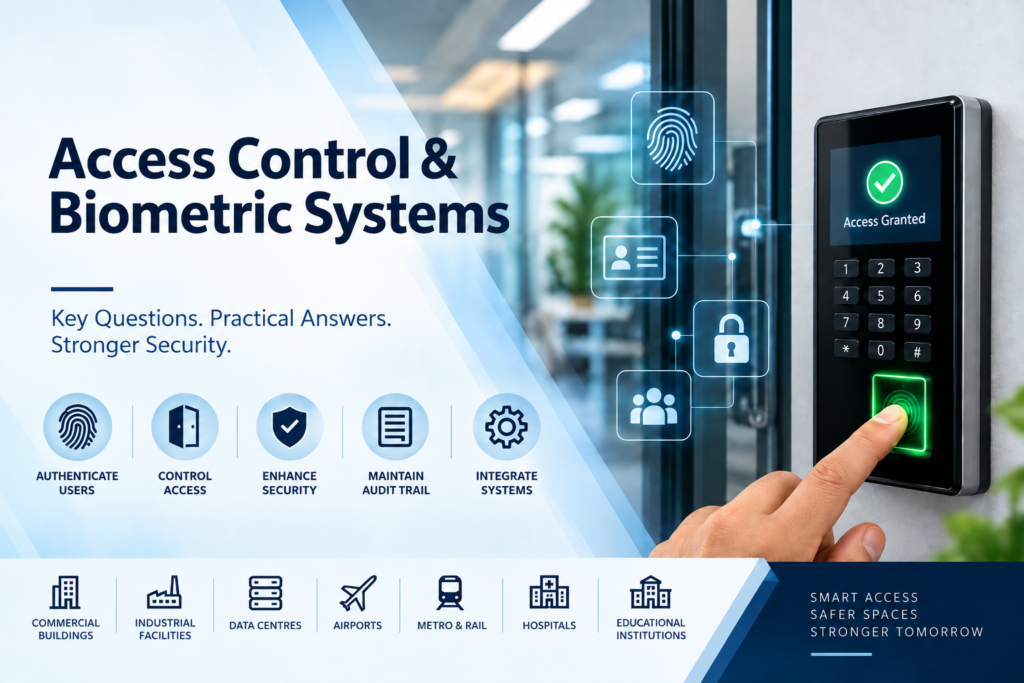
An Access Control System is an electronic security system that regulates and monitors entry to restricted areas by authenticating users and controlling door access. It records all access events to enhance security and accountability.
A Biometric Access Control System authenticates users using unique biological characteristics such as fingerprints, facial features, iris patterns, or palm veins. It provides higher security by eliminating the need for physical credentials.
Access Control Systems protect people, assets, and sensitive areas by preventing unauthorized entry, monitoring movement, and maintaining a complete audit trail. They enhance security while supporting efficient facility management.
The primary objectives are to authenticate users, restrict unauthorized access, monitor entry and exit activities, maintain audit logs, and integrate with other security systems for centralized security management.
Major components include card readers, biometric readers, access controllers, locking devices, request-to-exit devices, door position sensors, credentials, management software, servers, power supplies, and communication networks.
Physical access control protects buildings, rooms, and restricted areas through electronic door control, while logical access control secures digital resources such as computers, servers, applications, and enterprise networks.
Access Control Systems include standalone, networked, centralized, cloud-based, RFID card-based, biometric, mobile credential, and multi-factor authentication (MFA) systems. The selection depends on security requirements and facility size.
Integrated Access Control Systems provide centralized monitoring, improved security, automated reporting, remote management, audit trails, and seamless integration with CCTV, Fire Alarm, BMS, Visitor Management, and Time Attendance systems.
Challenges include network dependency, cybersecurity risks, credential management, interoperability between different manufacturers, environmental limitations for biometric devices, and the need for regular maintenance and software updates.
The System Integrator designs, installs, programs, tests, commissions, and integrates the Access Control System with other security and building systems. They ensure compliance with project specifications, cybersecurity requirements, and operational objectives.
Access Control Systems use authentication methods such as PIN codes, RFID smart cards, biometric credentials, mobile credentials, and multi-factor authentication (MFA). The selection depends on the required security level and operational requirements.
RFID readers communicate with contactless smart cards using radio frequency signals to read a unique credential. The controller verifies the credential against the database and grants or denies access based on predefined permissions.
RFID provides contactless card authentication over short distances, NFC enables secure short-range communication between compatible devices, while Bluetooth Low Energy (BLE) allows mobile devices to function as digital access credentials over longer ranges.
Fingerprint systems capture the unique ridge and valley patterns of a user's fingerprint and convert them into encrypted biometric templates. During authentication, the captured template is matched with the stored reference to verify identity.
Facial recognition systems analyze unique facial features using AI-based algorithms to create biometric templates. Live facial images are compared with stored templates to authenticate users quickly and without physical contact.
Iris recognition identifies users by analyzing the unique patterns of the iris, while retina recognition examines the blood vessel structure at the back of the eye. Both technologies provide highly accurate biometric authentication for high-security applications.
Palm vein recognition uses near-infrared light to capture the unique vein patterns beneath the skin of the palm. The internal biometric pattern is highly secure, difficult to duplicate, and suitable for critical security environments.
Multi-Factor Authentication (MFA) combines two or more independent authentication factors, such as a card, PIN, biometric, or mobile credential. MFA significantly increases security by reducing the risk of unauthorized access.
Mobile credential systems use smartphones or wearable devices as secure digital credentials through NFC, Bluetooth, or QR code technology. They eliminate physical cards while supporting remote credential management and enhanced user convenience.
Biometric templates are stored as encrypted mathematical representations rather than actual images. Secure encryption, access controls, secure communication protocols, and compliance with data protection regulations safeguard biometric information.
An Access Control System is designed by assessing security risks, occupancy, entry/exit points, user requirements, and life safety regulations. The design includes controller architecture, reader locations, locking devices, communication networks, and system integration.
Access levels are assigned based on organizational roles, departments, security zones, and operational requirements. User groups are configured to control access permissions according to predefined schedules and authorization policies.
Doors are classified based on security level, occupancy, emergency egress requirements, and fire ratings. The classification determines the type of locking hardware, access devices, and integration with Fire Alarm Systems.
Equipment is selected based on authentication technology, security level, environmental conditions, communication protocol, door type, and project specifications. Compatibility with other integrated systems is also considered.
EM Locks are selected according to holding force, door type, installation location, operating voltage, and fire safety requirements. Common holding forces range from 600 lbs to 1200 lbs, depending on the security application.
Electromagnetic locks secure doors by magnetic holding force and release upon power removal, while electric strikes release the door latch electronically without unlocking the entire door. Selection depends on door construction, security, and egress requirements.
Commercial Access Control Systems secure entrances, offices, server rooms, parking areas, and restricted zones using card readers, biometric devices, visitor management, and centralized monitoring integrated with CCTV and Fire Alarm Systems.
Data Centre Access Control uses multi-factor authentication, biometric verification, anti-tailgating measures, mantraps, redundant controllers, and comprehensive audit logging. The design prioritizes high security, continuous operation, and compliance with industry standards.
Airport and metro systems provide secure access to terminals, control rooms, depots, operational areas, and restricted zones. The design integrates Access Control with CCTV, SCADA, BMS, and emergency systems to ensure operational security.
Engineering calculations include power supply sizing, battery backup capacity, controller loading, cable sizing, voltage drop, network bandwidth, door hardware power consumption, and communication network capacity to ensure reliable system operation.
Access Control Systems interface with the Fire Alarm System to automatically release designated doors, unlock emergency exits, and disable access restrictions during fire emergencies. This integration ensures safe evacuation while complying with life safety regulations.
Access Control Systems exchange door status, occupancy, alarms, and event data with the BMS for centralized monitoring and automation. Integration improves security management, energy optimization, and operational efficiency.
Access events automatically trigger live video display, recording, and event tagging within the CCTV system. This enables operators to verify user identity, investigate incidents, and maintain synchronized video and access records.
Visitor Management Systems issue temporary credentials, register visitor details, and synchronize access permissions with the Access Control System. This streamlines visitor authorization while maintaining complete audit trails.
Employee access transactions are synchronized with Time Attendance software to automatically record attendance, working hours, shift schedules, and access history. This eliminates duplicate data entry and improves workforce management.
During emergencies, Access Control Systems coordinate with PA/VA systems to support evacuation by unlocking emergency exits and enabling location-specific voice announcements. Integration improves occupant safety and emergency response.
Anti-Passback is a security feature that prevents a credential from being used multiple times without a corresponding exit transaction. It reduces credential sharing, unauthorized entry, and improves access accountability.
A Cause-and-Effect Matrix defines the automatic response of the Access Control System to events such as fire alarms, forced doors, intrusion alarms, and emergency conditions. It specifies door release, alarm generation, and system interactions.
Access Control Systems protect critical assets, maintain secure access during normal operations, support emergency response, and provide complete audit trails. Redundant controllers and backup power improve system availability during failures.
AI enhances Access Control through facial recognition, behavioural analytics, anomaly detection, occupancy monitoring, and predictive security analysis. These technologies improve authentication accuracy, reduce security risks, and automate decision-making.
Commissioning includes reader functionality testing, controller verification, door lock operation, request-to-exit device testing, alarm verification, communication testing, battery backup validation, and integration testing with CCTV, Fire Alarm, and BMS.
Factory Acceptance Testing (FAT) verifies the performance of controllers, readers, biometric devices, software, locking hardware, and communication interfaces before shipment. It confirms compliance with project specifications and approved design requirements.
Site Acceptance Testing (SAT) validates the installed Access Control System under actual site conditions. It includes functional testing of all doors, user authentication, controller communication, alarm functions, and integrated system performance.
Access Control Systems should be periodically inspected for reader operation, lock performance, controller health, battery condition, cabling, software updates, database integrity, and communication network status. Preventive maintenance ensures reliable and secure operation.
Common faults include reader failure, controller malfunction, lock defects, power supply failure, communication loss, damaged cables, database synchronization errors, and software configuration issues. Regular diagnostics help identify and rectify these faults.
Cybersecurity risks are reduced through network segmentation, encrypted communication, strong authentication, role-based access control, firmware updates, firewall protection, multi-factor authentication, and continuous monitoring of system activity.
Access Control and Biometric Systems are designed in accordance with IEC 60839, ISO/IEC 19794, ISO/IEC 30107, ISO 27001, NBC India, and project-specific consultant specifications. Compliance with local life safety and data protection regulations is also essential.
Consultants typically require approved OEM authorization, door schedules, reader layouts, controller architecture, battery calculations, technical compliance statements, FAT/SAT procedures, commissioning methodology, cybersecurity measures, and evidence of similar project experience.
Interview questions commonly cover authentication technologies, RFID, biometrics, controller architecture, door hardware, EM Locks, anti-passback, battery sizing, system integration, commissioning procedures, cybersecurity, and troubleshooting of Access Control Systems.
Future Access Control Systems will leverage AI-based facial recognition, Digital Identity, mobile credentials, cloud-native platforms, behavioral analytics, Digital Twins, and IoT integration. These technologies will deliver touchless authentication, predictive security, and intelligent building access management.