
Q&A
Airport Fire & ELV Systems
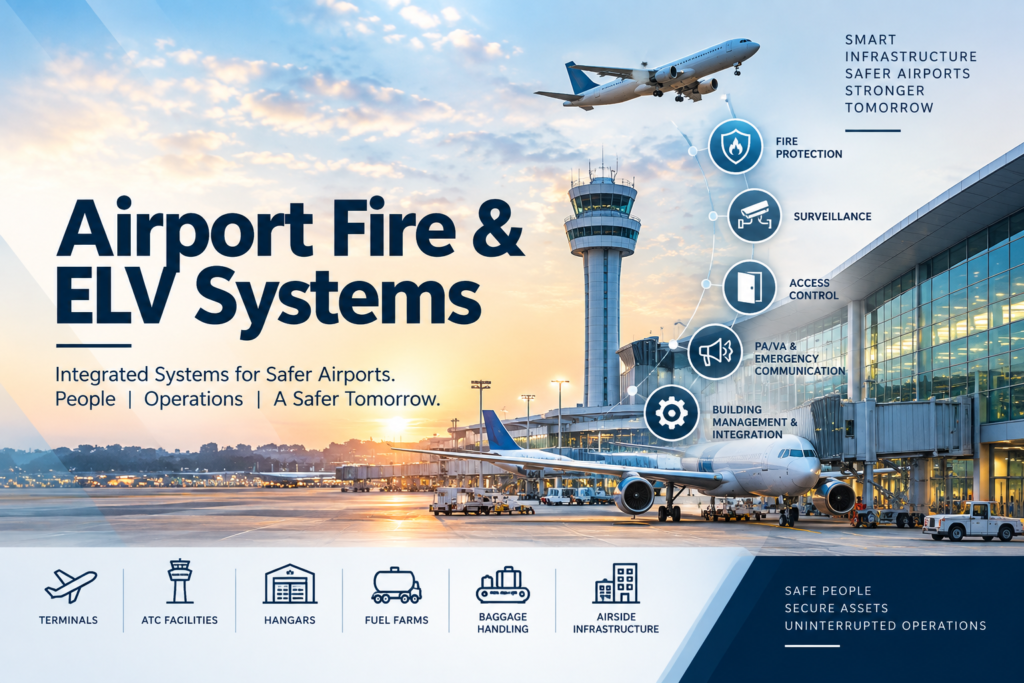
Airport Fire & ELV Systems are integrated life safety, security, communication, and automation systems that protect terminals, ATC facilities, hangars, cargo terminals, fuel farms, and airside infrastructure. They combine fire protection with intelligent building and airport operations.
These systems ensure passenger safety, protect critical aviation assets, support uninterrupted airport operations, and enable rapid emergency response. They also maintain regulatory compliance and operational continuity.
Major hazards include aircraft fuel, fuel farms, baggage handling systems, electrical equipment, commercial areas, kitchens, HVAC systems, lithium-ion batteries, cargo storage, and maintenance hangars.
The objectives are to detect fire at the earliest stage, suppress fire effectively, protect life and infrastructure, support safe evacuation, minimize operational disruption, and safeguard aviation assets.
Major ELV systems include Fire Alarm, CCTV, Access Control, PA/VA, Emergency Communication Systems (ECS), BMS/IBMS, SCADA, Baggage Handling System (BHS) interfaces, Flight Information Display Systems (FIDS), structured cabling, and network infrastructure.
Airport fire safety addresses large public spaces, aircraft operations, fuel hazards, baggage systems, high occupant density, and mission-critical facilities. It requires specialized fire engineering, smoke management, and integrated emergency response systems.
Major components include Fire Detection & Alarm Systems, sprinklers, hydrants, Water Mist, foam systems, Fire Pumps, CCTV, Access Control, PA/VA, Emergency Communication, SCADA, BMS, and airport operational systems.
An Airport Fire Safety Strategy defines the fire protection philosophy, hazard assessment, evacuation procedures, smoke control, emergency response, and integration of life safety systems to ensure safe airport operations.
Fire risk assessment evaluates occupancy, aircraft operations, fuel storage, passenger movement, hazardous materials, electrical systems, and critical infrastructure. The assessment forms the basis for system design and emergency planning.
Major incidents highlight the importance of early fire detection, effective smoke management, integrated Fire & ELV systems, emergency communication, redundant infrastructure, and coordinated emergency response to protect passengers and airport operations.
Fire Detection & Alarm Systems use addressable panels, smoke detectors, heat detectors, beam detectors, ASD/VESDA, and Manual Call Points (MCPs). The design is based on terminal occupancy, fire zoning, evacuation strategy, and applicable aviation standards.
Airports commonly use smoke detectors, heat detectors, beam detectors, multi-criteria detectors, ASD/VESDA, Linear Heat Detection (LHD), flame detectors, and video-based fire detection. Technology selection depends on ceiling height, occupancy, and operational environment.
ASD/VESDA provides very early smoke detection in ATC rooms, data centres, communication rooms, electrical rooms, baggage handling areas, and high-value equipment spaces. Continuous air sampling enables rapid identification of incipient fires.
LHD systems are installed along cable trays, baggage conveyors, tunnels, fuel handling areas, and service shafts. They provide continuous temperature monitoring and precise fire location in harsh or inaccessible environments.
Fire Alarm Systems are integrated with BMS, SCADA, HVAC, smoke control, PA/VA, Access Control, CCTV, lifts, escalators, and emergency lighting. Integration enables coordinated emergency response through the programmed Cause-and-Effect Matrix.
Sprinkler and hydrant systems are designed using hazard classification, hydraulic calculations, water demand analysis, and occupancy requirements. They provide automatic and manual fire protection for terminal buildings and support facilities.
Clean agent systems such as IG-541, IG-100, or FK-5-1-12 protect mission-critical facilities where water-based suppression could damage sensitive equipment. System design includes agent calculations, Room Integrity Testing, and automatic release controls.
Water Mist Systems are used in turbine rooms, electrical equipment areas, cable tunnels, and selected high-risk zones requiring efficient cooling and minimal water damage. High-pressure Water Mist provides rapid heat absorption and smoke suppression.
Foam systems protect aircraft hangars, fuel farms, hydrant pits, and fuel loading facilities against hydrocarbon fires. They use foam monitors, foam chambers, or foam-water sprinkler systems designed according to fire hazard classification.
Common challenges include large open terminal spaces, high ceilings, continuous passenger movement, aircraft fuel hazards, baggage handling systems, integration of multiple subsystems, and maintaining uninterrupted airport operations during emergencies.
Airport ELV systems include Fire Alarm, CCTV, Access Control, PA/VA, Emergency Communication Systems (ECS), BMS/IBMS, SCADA, Flight Information Display System (FIDS), Baggage Handling System (BHS) interfaces, structured cabling, and network infrastructure.
CCTV systems provide continuous monitoring of terminals, boarding gates, baggage claim areas, airside operations, cargo terminals, parking areas, and perimeter security. The design incorporates IP cameras, Video Management Systems (VMS), AI analytics, and redundant recording.
Access Control Systems secure ATC facilities, airside areas, baggage handling rooms, communication rooms, data centres, and operational areas using RFID, biometric authentication, and centralized access management integrated with CCTV and Fire Alarm Systems.
PA/VA Systems provide routine flight announcements and emergency evacuation messages through zoned loudspeakers, redundant amplifiers, emergency paging consoles, and networked controllers. They integrate with Fire Alarm Systems for automatic emergency messaging.
Emergency Communication Systems provide reliable two-way communication between airport operations, emergency responders, security personnel, and technical staff. They include emergency telephones, Help Points, paging systems, and command centre communication.
BMS/IBMS integrates HVAC, lighting, Fire Alarm, electrical systems, CCTV, Access Control, lifts, escalators, utilities, and energy management into a centralized monitoring and control platform.
SCADA monitors and controls electrical distribution, water supply, Fire Pumps, HVAC plants, fuel systems, utility networks, and Fire Protection Systems. It enables centralized supervision and automated response to operational events.
BHS interfaces with Fire Alarm, Access Control, CCTV, BMS, and emergency shutdown systems. During fire emergencies, conveyor systems are automatically stopped, affected zones are isolated, and emergency procedures are initiated.
A Cause-and-Effect Matrix defines the automatic interaction between Fire Alarm, HVAC, smoke control, PA/VA, CCTV, Access Control, BMS, SCADA, BHS, and emergency systems. It establishes the sequence of operations for each emergency scenario.
Integrated Fire & ELV Systems provide rapid fire detection, automated emergency response, centralized monitoring, secure access management, intelligent surveillance, and coordinated evacuation. This enhances passenger safety, airport security, and uninterrupted operations.
Airport Fire & ELV Systems are designed based on fire risk assessment, passenger capacity, terminal layout, operational requirements, and applicable aviation standards. The design integrates fire protection, security, communication, automation, and utility systems into a centralized platform.
Fire compartments and smoke zones are established based on terminal architecture, occupancy, evacuation routes, fire load, and HVAC design. Proper compartmentation limits fire spread and supports effective smoke management.
Smoke management systems use smoke exhaust fans, pressurization systems, fire dampers, and automatic HVAC shutdown. Operation is coordinated through the Fire Alarm System to maintain tenable evacuation conditions.
Evacuation strategies are developed using occupant load analysis, evacuation modelling, fire scenarios, smoke movement studies, and emergency response planning. The objective is to ensure safe and efficient movement of passengers to designated exits.
ELV infrastructure is planned with segregated cable routing, fire-rated penetrations, redundant communication paths, protected equipment rooms, and adequate accessibility for maintenance while maintaining fire compartment integrity.
High availability is achieved through redundant controllers, dual communication networks, loop-configured fire alarm systems, standby servers, backup power supplies, and fault-tolerant network architecture to eliminate single points of failure.
Cybersecurity is implemented using network segmentation, encrypted communication, secure authentication, firewalls, intrusion detection systems, role-based access control, and continuous monitoring of IT and OT networks.
The System Integrator coordinates engineering, installation, software configuration, testing, commissioning, and interoperability of Fire Alarm, CCTV, Access Control, PA/VA, BMS, SCADA, BHS, and communication systems to ensure seamless airport operations.
Integrated Fire & ELV Systems minimize operational disruption through early fire detection, automated emergency response, redundant infrastructure, centralized monitoring, and rapid restoration of airport services after incidents.
Engineering calculations include hydraulic calculations, smoke management analysis, cable sizing, voltage drop, battery backup capacity, network bandwidth, CCTV storage, speaker coverage, amplifier loading, and communication network availability.
Installation shall comply with approved IFC drawings, OEM instructions, airport authority specifications, and applicable standards. Equipment, cabling, piping, containment, controllers, and field devices shall be installed with proper segregation, earthing, redundancy, labeling, and accessibility.
FAT verifies Fire Alarm Panels, CCTV, Access Control, PA/VA, BMS, SCADA interfaces, suppression system controllers, network equipment, software configuration, and Cause-and-Effect logic before equipment dispatch.
SAT includes functional testing of field devices, Fire Alarm operation, suppression systems, CCTV, PA/VA, Access Control, BMS, SCADA, BHS interfaces, communication networks, and complete Cause-and-Effect verification under actual site conditions.
Commissioning includes point-to-point verification, subsystem testing, integrated system testing, emergency scenario validation, software configuration checks, operator training, documentation review, and final acceptance in accordance with approved commissioning procedures.
Preventive maintenance includes inspection and testing of Fire Alarm devices, sprinklers, hydrants, Water Mist and foam systems, Fire Pumps, CCTV cameras, Access Control equipment, PA/VA systems, BMS, SCADA, communication networks, batteries, and backup power systems.
Common failures include detector faults, communication network failures, controller malfunction, CCTV outages, PA/VA amplifier faults, Access Control failures, SCADA communication errors, power supply failures, and software configuration issues. Diagnosis is performed using system diagnostics, event logs, and functional testing.
Airport Fire & ELV Systems are designed in accordance with NFPA 72, NFPA 13, NFPA 15, NFPA 20, NFPA 2001, ICAO Annex 14, ICAO Airport Services Manual, IEC 60364, EN 54 Series, IS 2189, NBC India, and project-specific requirements issued by the Airports Authority of India (AAI) and airport consultants.
Consultants typically require approved OEM authorization, hydraulic calculations, smoke management analysis, Cause-and-Effect Matrix, system architecture drawings, FAT/SAT procedures, commissioning methodology, QA/QC documentation, compliance statements, and evidence of similar airport project experience.
Interview questions commonly cover Fire Alarm Systems, ASD/VESDA, Water Mist, foam systems, Fire Pumps, CCTV, Access Control, PA/VA, BMS, SCADA, BHS integration, Cause-and-Effect Matrix, ICAO requirements, commissioning procedures, and airport system integration.
Future Airport Fire & ELV Systems will leverage AI-based fire detection, Digital Twin technology, IoT-enabled asset monitoring, predictive maintenance, cloud-integrated command centres, intelligent video analytics, autonomous inspection, and smart airport platforms. These technologies improve passenger safety, operational efficiency, asset reliability, and real-time decision-making.