
Q&A
CCTV & Video Surveillance
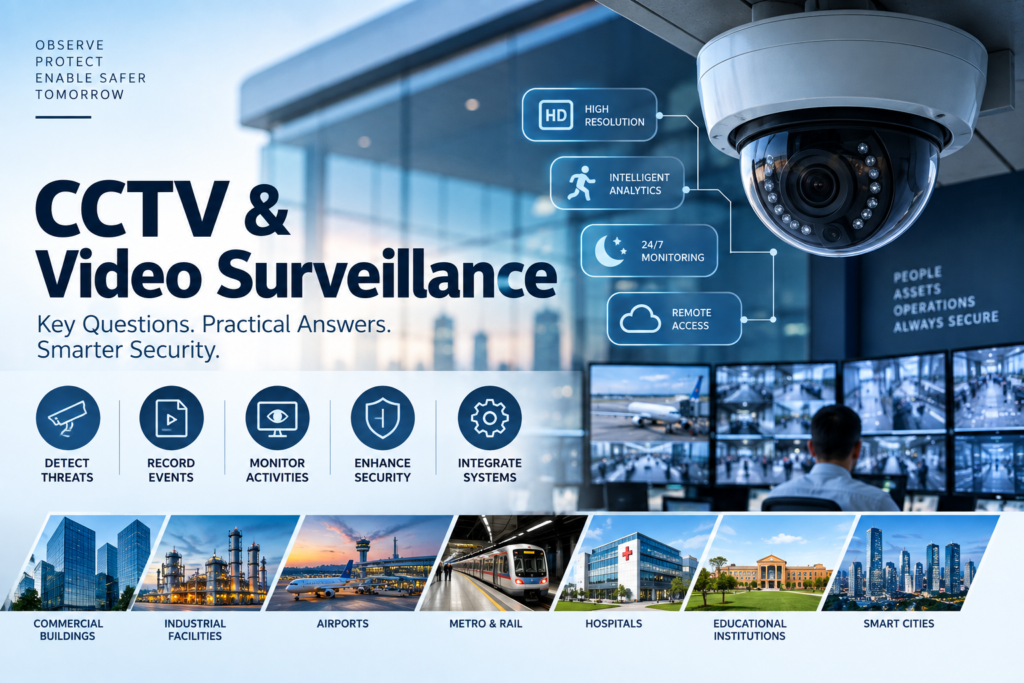
A CCTV & Video Surveillance System is an electronic security system that captures, records, transmits, and monitors video from designated locations. It enhances security by enabling real-time surveillance, event recording, and incident investigation.
CCTV systems improve security by deterring unauthorized activities, monitoring critical areas, supporting emergency response, and providing recorded evidence for investigations. They are essential for protecting people, assets, and infrastructure.
The primary objectives are to monitor activities, detect security threats, record events, support incident investigation, improve situational awareness, and integrate with other security systems for centralized management.
A CCTV system consists of cameras, Network Video Recorders (NVR) or Digital Video Recorders (DVR), Video Management System (VMS), network switches, storage devices, monitors, power supplies, and communication infrastructure.
Analog CCTV transmits video through coaxial cables to a DVR, while IP CCTV transmits digital video over Ethernet networks to an NVR or VMS. IP systems provide higher image quality, scalability, and advanced analytics.
Common CCTV cameras include dome, bullet, PTZ (Pan-Tilt-Zoom), box, fisheye, panoramic, thermal, explosion-proof, and ANPR cameras. Camera selection depends on the surveillance objective and environmental conditions.
Cameras capture video and transmit it to an NVR or VMS through a communication network. The system records, stores, displays, and analyzes video, allowing operators to monitor live events and review recorded footage.
IP-based systems provide high-resolution video, remote access, centralized management, intelligent analytics, easier scalability, and seamless integration with Access Control, BMS, Fire Alarm, and other security systems.
CCTV performance can be affected by poor lighting, network failures, limited storage capacity, environmental conditions, cybersecurity threats, and improper camera placement. Regular maintenance and proper design are essential for reliable operation.
The System Integrator designs, installs, configures, tests, and commissions the CCTV system while integrating it with other security and building systems. They ensure compliance with project specifications, performance requirements, and operational objectives.
Fixed cameras monitor a specific area, PTZ cameras provide remote pan, tilt, and zoom control, dome cameras offer discreet indoor surveillance with vandal resistance, and bullet cameras are designed for long-range outdoor monitoring with a visible deterrent effect.
Camera resolution represents the number of pixels used to form an image. Higher resolution provides greater image clarity, improved digital zoom capability, and better identification of people, vehicles, and objects.
HD cameras provide 1280×720 resolution, Full HD offers 1920×1080, 4MP cameras deliver approximately 2560×1440, while 8MP and 4K cameras provide 3840×2160 resolution. Higher resolutions improve image detail but require increased storage and network bandwidth.
Fixed lenses have a constant focal length and field of view, while varifocal lenses allow manual or motorized adjustment of focal length to optimize viewing angle and target coverage without changing the camera location.
Wide Dynamic Range (WDR) enables cameras to capture clear images in scenes containing both very bright and very dark areas. It improves visibility in challenging lighting conditions such as entrances, parking areas, and windows.
Low-Light or Starlight technology uses highly sensitive image sensors and advanced processing to produce clear colour images under extremely low illumination. It significantly improves surveillance performance during night-time and poor lighting conditions.
Infrared (IR) night vision uses built-in infrared LEDs to illuminate the scene in darkness, enabling cameras to capture monochrome images without visible light. IR technology provides continuous surveillance during nighttime conditions.
Thermal cameras detect infrared radiation emitted by objects to generate images based on temperature differences rather than visible light. They are widely used for perimeter security, industrial monitoring, airports, oil & gas facilities, and critical infrastructure.
Explosion-proof CCTV cameras are specially designed for hazardous environments containing flammable gases, vapours, or combustible dust. Their certified enclosures prevent internal sparks from igniting the surrounding atmosphere and comply with hazardous area standards.
Panoramic and fisheye cameras provide ultra-wide viewing angles, typically covering 180° or 360°, allowing large areas to be monitored with a single camera. Advanced image dewarping software converts distorted images into usable surveillance views.
A CCTV system is designed by assessing security risks, surveillance objectives, site layout, lighting conditions, and operational requirements. The design includes camera selection, placement, storage sizing, network architecture, and system integration.
Camera placement is determined based on the area to be monitored, critical access points, field of view, lighting conditions, mounting height, and potential blind spots. Proper positioning ensures complete coverage and effective surveillance.
Field-of-view calculations are based on the camera sensor size, focal length, mounting height, and distance to the target. These calculations ensure the required area is covered while maintaining the desired level of image detail.
Pixel density is calculated as the number of pixels covering one metre or foot of the target area. It determines whether the camera can detect, recognize, or identify people and objects in accordance with surveillance design standards.
Commercial building CCTV systems provide surveillance of entrances, exits, parking areas, lobbies, elevators, corridors, and critical rooms. The design integrates CCTV with Access Control, Fire Alarm, and Building Management Systems for centralized security.
Airport CCTV systems provide continuous monitoring of terminals, baggage handling, perimeter areas, runways, and restricted zones. The design emphasizes high availability, redundancy, intelligent analytics, and centralized video management.
Metro CCTV systems monitor stations, platforms, concourses, depots, tunnels, and passenger areas. They integrate with SCADA, PA/VA, Passenger Information Systems (PIS), Access Control, and operation control centres for real-time security management.
Data Centre CCTV systems provide continuous surveillance of server rooms, entrances, loading areas, and critical infrastructure. The design emphasizes redundancy, cybersecurity, high-resolution recording, and integration with Access Control and BMS.
Industrial CCTV systems monitor production areas, warehouses, hazardous zones, utility plants, and perimeter security. Cameras are selected based on environmental conditions, hazardous area classifications, and operational requirements.
CCTV network design includes calculations for bandwidth, storage capacity, PoE power requirements, network loading, cable lengths, switch capacity, and recording duration. These calculations ensure reliable video transmission and adequate storage performance.
A Video Management System (VMS) is software that centrally manages live video, recording, playback, alarms, user access, and video analytics from multiple IP cameras. It provides a unified platform for monitoring and managing surveillance systems.
A DVR records video from analog cameras, an NVR records digital video from IP cameras, while a VMS provides advanced centralized management, analytics, recording, and integration of multiple NVRs and surveillance devices.
CCTV integrates with Access Control Systems to automatically display live video and record events when access is granted, denied, or forced. This integration enhances security by linking video evidence with access events.
CCTV receives alarm signals from the Fire Alarm System to automatically display live video from affected areas, initiate event recording, and assist operators in verifying fire incidents and coordinating emergency response.
CCTV systems exchange alarm and status information with the BMS to enable centralized monitoring of security events and camera health. Integration improves situational awareness and coordinated building operations.
CCTV integrates with SCADA to provide live visual monitoring of industrial equipment, substations, utility plants, and critical infrastructure. Operators can view video alongside process alarms to improve incident assessment and operational control.
Video analytics uses intelligent software to automatically detect events such as intrusion, line crossing, loitering, object removal, and crowd formation. It improves surveillance by reducing manual monitoring and enabling faster incident detection.
AI-powered CCTV systems use deep learning algorithms for facial recognition, object classification, behaviour analysis, people counting, ANPR, and anomaly detection. These capabilities improve accuracy, reduce false alarms, and automate security operations.
A Cause-and-Effect Matrix defines how CCTV responds to events generated by Fire Alarm, Access Control, BMS, or other integrated systems. It specifies actions such as camera pop-up, video recording, PTZ positioning, and alarm notifications.
CCTV systems provide continuous monitoring, incident recording, remote access, and forensic evidence to minimize security risks and support rapid recovery after incidents. Their integration with other security systems enhances overall operational resilience.
CCTV commissioning includes camera alignment, image quality verification, network connectivity testing, recording and playback validation, storage verification, PoE testing, video analytics testing, and integration with other security systems.
Factory Acceptance Testing (FAT) verifies the performance of cameras, NVRs, VMS software, network switches, storage devices, and system configurations before dispatch. It ensures compliance with project specifications and functional requirements.
Site Acceptance Testing (SAT) confirms that the installed CCTV system operates correctly under actual site conditions. It includes camera coverage verification, recording tests, network performance checks, analytics validation, and system integration testing.
CCTV systems should be regularly inspected for camera focus, lens cleanliness, cable integrity, storage health, network performance, firmware updates, and recording functionality. Preventive maintenance ensures reliable long-term surveillance.
Common faults include camera failure, poor image quality, network communication issues, storage failure, power supply problems, cable damage, incorrect configuration, and firmware errors. Routine diagnostics help identify and resolve these issues.
Cybersecurity is improved through strong passwords, encrypted communication, network segmentation, firewalls, multi-factor authentication, firmware updates, role-based access control, and continuous monitoring of network activity.
CCTV systems are designed in accordance with IEC 62676, ONVIF specifications, ISO/IEC 27001, IS/IEC standards, NBC India, and project-specific consultant requirements. Cybersecurity and network standards are also considered for IP-based systems.
Consultants typically require approved OEM authorization, camera layout drawings, storage and bandwidth calculations, technical compliance statements, FAT/SAT procedures, VMS architecture, cybersecurity strategy, and evidence of similar project experience.
Interview questions commonly cover camera types, lens selection, field-of-view calculations, pixel density, storage sizing, PoE, VMS, video analytics, ONVIF, cybersecurity, system integration, and troubleshooting of CCTV systems.
Future CCTV systems will leverage AI-powered analytics, edge computing, cloud-based video management, Digital Twins, facial recognition, behavioural analysis, and predictive security monitoring. These technologies enhance real-time decision-making, operational efficiency, and intelligent surveillance.