
Q&A
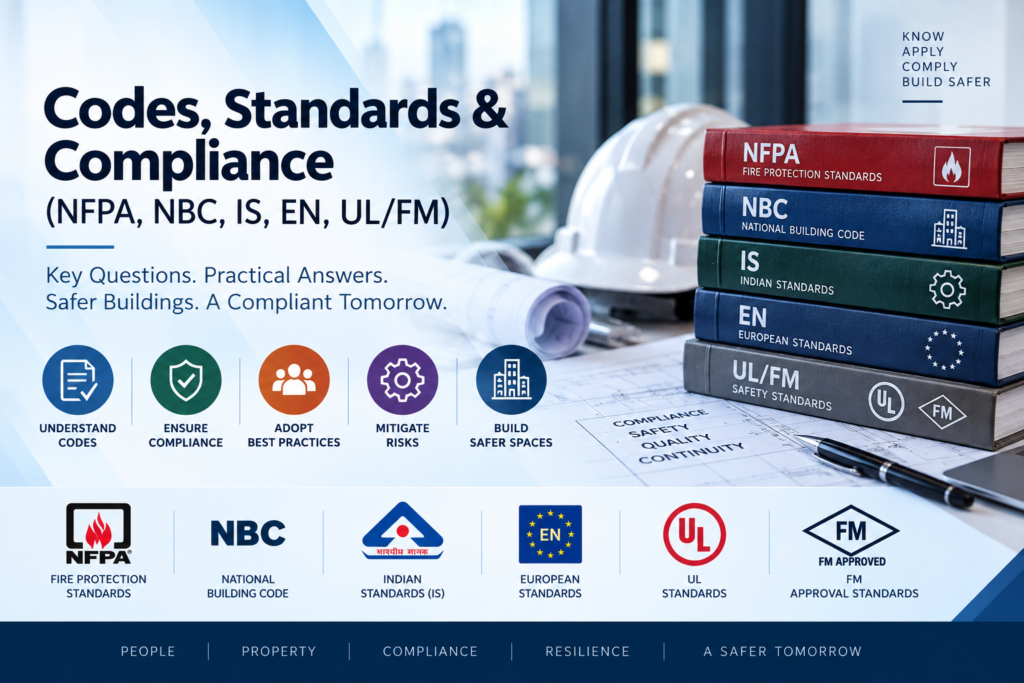
Codes, Standards & Compliance
Fire Protection Codes and Standards are published technical documents that establish minimum requirements for the design, installation, testing, inspection, and maintenance of fire protection systems to ensure life safety and property protection.
Codes and Standards ensure consistent engineering practices, regulatory compliance, system reliability, and safe operation. They also provide accepted design criteria for consultants, contractors, and authorities.
A Code specifies mandatory requirements, a Standard provides technical criteria, a Regulation is a legal requirement issued by authorities, and a Guideline offers recommended engineering practices without mandatory enforcement.
The hierarchy generally begins with statutory regulations, followed by national building codes, international fire protection standards, project specifications, consultant requirements, and OEM recommendations. The most stringent applicable requirement is normally adopted.
The objectives are to protect life, property, business continuity, and the environment by establishing minimum safety requirements for fire prevention, detection, suppression, evacuation, and emergency response.
Standards are developed by expert technical committees through research, industry consultation, public review, testing, and periodic revision to reflect technological advancements and emerging fire risks.
The Authority Having Jurisdiction (AHJ) reviews designs, verifies code compliance, grants approvals, conducts inspections, and authorizes occupancy or operation based on applicable regulations and standards.
Mandatory compliance is legally enforceable under applicable regulations or contract requirements, while recommended practices provide engineering guidance that may be adopted to improve safety and system performance.
Prescriptive codes specify fixed design requirements, whereas performance-based codes allow alternative engineering solutions that demonstrate equivalent or superior safety through analysis, modelling, and performance evaluation.
Fire Protection Codes establish standardized engineering requirements for detection, suppression, evacuation, smoke management, and emergency response, reducing fire risk while improving occupant safety and protecting critical infrastructure.
NFPA is an international organization that develops fire protection and life safety standards. Key standards include NFPA 13 (Sprinklers), NFPA 20 (Fire Pumps), NFPA 72 (Fire Alarm), NFPA 2001 (Clean Agent), NFPA 750 (Water Mist), and NFPA 130 (Transit Systems).
The National Building Code (NBC) of India provides comprehensive requirements for building planning, fire protection, life safety, structural design, and services. It is widely adopted by state authorities and consultants for building approvals.
Important Indian Standards include IS 2189 (Fire Detection & Alarm), IS 15105 (Sprinklers), IS 13039 (Hydrants), IS 15325 (Automatic Sprinkler Systems), IS 15683 (Portable Fire Extinguishers), and other BIS standards applicable to fire protection systems.
EN Standards establish European technical requirements for fire detection, alarm systems, emergency lighting, fire resistance, and life safety equipment. They are commonly specified in international EPC and infrastructure projects.
IEC Standards define international requirements for electrical installations, equipment safety, communication systems, hazardous areas, and functional safety. They ensure interoperability, reliability, and electrical safety of Fire & ELV systems.
UL Listed equipment is independently tested for compliance with safety standards, while FM Approved equipment is evaluated for performance, reliability, and suitability for fire protection applications. Many consultants require either UL/FM certification or both.
LPCB (Loss Prevention Certification Board) and VdS are internationally recognized certification bodies for fire protection equipment. Their approvals are commonly required in high-risk industrial, infrastructure, and international projects.
ISO develops international management and technical standards covering quality management, risk management, occupational safety, emergency management, and business continuity, supporting overall fire safety and organizational resilience.
ASHRAE Standards provide engineering requirements for HVAC systems, ventilation, indoor air quality, and smoke management. They support the integration of Fire Alarm Systems with HVAC shutdown and smoke control strategies.
ICAO governs airport fire safety, IMO applies to marine and offshore facilities, API covers oil and gas installations, OISD establishes safety standards for India's petroleum industry, and PESO regulates hazardous substances, explosives, and compressed gas installations.
Fire Detection & Alarm Systems are primarily governed by NFPA 72, IS 2189, EN 54 Series, UL 864, and relevant NBC India provisions. Project specifications may also require IEC and consultant-specific standards.
Gas Suppression Systems are governed by NFPA 2001, ISO 14520, EN 15004, IS 15493 (where applicable), and OEM design guidelines. These standards define agent selection, enclosure integrity, discharge time, and system performance.
Water Mist Systems are governed by NFPA 750, CEN/TS 14972, FM Approval Standards, IMO MSC Circulars for marine applications, and project-specific consultant specifications.
Sprinkler Systems are governed by NFPA 13, IS 15105, and FM Global Data Sheets, while Hydrant Systems are governed by NFPA 14, IS 13039, and relevant NBC India provisions.
Fire Pump Systems are designed in accordance with NFPA 20, IS 15301, NFPA 22 (Water Tanks), NBC India, and project-specific hydraulic design requirements.
ELV Systems comply with IEC 60364, IEC 61000, TIA/EIA Cabling Standards, ISO/IEC 11801, EN Standards, and applicable NBC India provisions. Additional requirements depend on the specific ELV subsystem.
CCTV Systems commonly follow IEC 62676, ONVIF, UL Standards, ISO 27001 for cybersecurity, and project-specific security guidelines. Airport, metro, and industrial projects may include additional authority specifications.
Access Control Systems comply with IEC, ISO/IEC 27001, ISO/IEC 19794 (Biometric Data), ONVIF Profile A, and applicable security standards specified by consultants or regulatory authorities.
PA/VA Systems are governed by EN 54-16, EN 54-24, IEC 60849 (superseded by ISO 7240-19 in many applications), ISO 7240 Series, NFPA 72, and relevant NBC India requirements.
These facilities follow sector-specific standards such as NFPA 130, NFPA 502, NFPA 72, NFPA 750, TIA-942, ICAO, API, OISD, IEC, EN, NBC India, and project specifications issued by authorities like DMRC, MMRDA, AAI, NHAI, and PESO.
Code compliance is demonstrated through design calculations, equipment selection, system layouts, specifications, compliance matrices, and engineering reports that reference applicable codes and standards.
Typical compliance documents include design drawings, hydraulic calculations, Design Basis Report (DBR), Fire Strategy Report, Material Test Certificates (MTCs), OEM approvals, compliance statements, FAT/SAT reports, commissioning records, and O&M manuals.
A Design Basis Report defines the engineering philosophy, applicable codes, design criteria, hazard assessment, system selection, and assumptions used during fire protection system design. It serves as the primary engineering reference document.
A Fire Strategy Report describes the overall fire safety approach, including evacuation strategy, smoke management, compartmentation, fire protection systems, and emergency response. It is typically required for large, complex, or performance-based projects.
Material Test Certificates verify that supplied materials comply with specified standards, material grades, and manufacturing requirements. They provide traceability and support quality assurance during inspection and project acceptance.
Factory Acceptance Testing verifies equipment performance, software functionality, communication interfaces, and Cause-and-Effect logic before dispatch. FAT confirms compliance with approved specifications and project requirements.
Site Acceptance Testing validates the installed system under actual site conditions by performing functional tests, integrated system testing, communication verification, and Cause-and-Effect validation before final handover.
Third-party inspection is an independent verification process conducted by an authorized inspection agency to confirm compliance with applicable codes, specifications, and contractual requirements. It is commonly required for government, infrastructure, and high-risk projects.
Consultants review engineering designs, verify calculations, approve equipment, witness FAT/SAT, inspect installations, monitor quality, and ensure that all systems comply with applicable codes, standards, and project specifications.
Common deficiencies include incomplete documentation, incorrect equipment selection, inadequate hydraulic calculations, improper detector spacing, non-compliant installation practices, missing test records, insufficient system integration, and deviations from approved drawings.
Tender specifications should clearly reference the applicable editions of codes and standards, define compliance requirements, specify approved equipment certifications, and state testing, inspection, commissioning, and documentation obligations.
Government tenders typically require compliance with NBC India, IS Codes, NFPA Standards, BIS certifications, OEM authorizations, QA/QC documentation, FAT/SAT reports, commissioning records, statutory approvals, and evidence of similar project experience.
Deviations are evaluated through engineering justification, risk assessment, consultant review, and approval by the Authority Having Jurisdiction (AHJ). Any alternative solution must provide an equivalent or higher level of safety.
The approval process includes submission of design drawings, calculations, compliance reports, equipment certifications, and technical documents for review. Final approval is granted after successful inspection, testing, and demonstration of code compliance.
International standards such as NFPA, IEC, EN, and ISO are adopted alongside NBC India and IS Codes. Where differences exist, statutory regulations and project specifications generally take precedence unless otherwise approved.
Consultants typically require a compliance matrix, approved OEM certifications, UL/FM or equivalent approvals, hydraulic calculations, Design Basis Report, Fire Strategy Report, Cause-and-Effect Matrix, FAT/SAT procedures, QA/QC documentation, and statutory approvals.
Interview questions commonly cover NFPA Standards, NBC India, IS Codes, EN Standards, UL/FM certifications, hydraulic calculations, Fire Alarm design, sprinkler systems, Fire Pumps, Gas Suppression Systems, and compliance documentation.
Codes and Standards establish design criteria for hydraulic calculations, detector spacing, sprinkler density, pump sizing, smoke management, fire resistance, evacuation, and system performance. They ensure consistent engineering and regulatory compliance.
Common challenges include design revisions, specification changes, material substitutions, documentation control, coordination between disciplines, installation quality, testing requirements, and maintaining compliance during commissioning and project handover.
Future developments include digital code management, AI-assisted compliance verification, Building Information Modelling (BIM) integration, Digital Twins, automated code checking, cloud-based documentation, and wider adoption of performance-based fire engineering for complex infrastructure projects.