
Q&A
ELV Systems
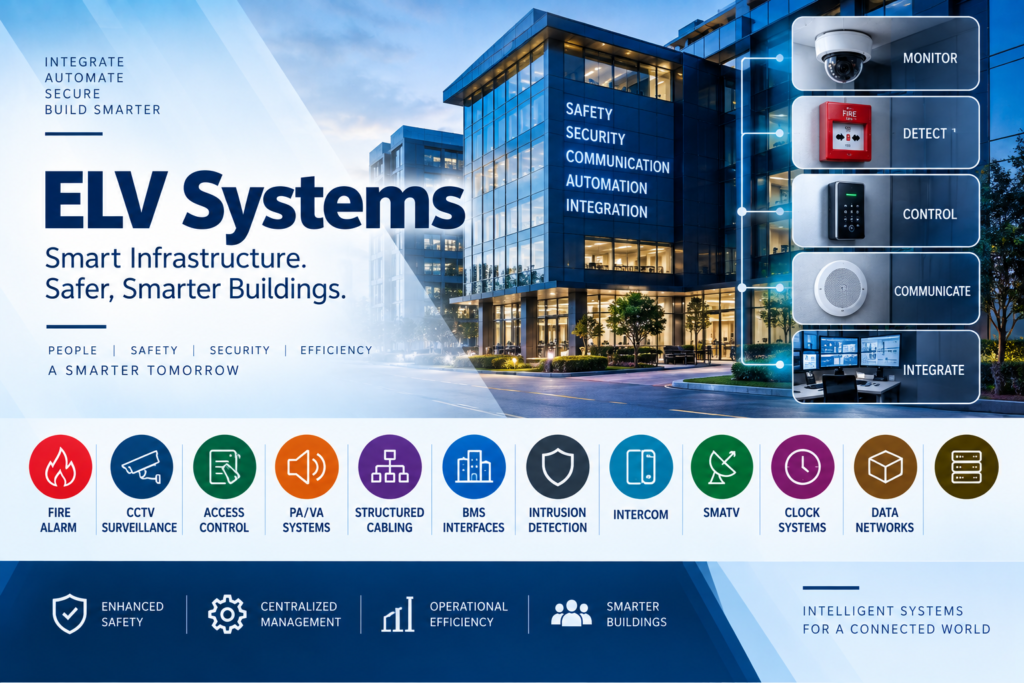
An Extra Low Voltage (ELV) System comprises electrical and electronic systems operating at voltages typically below 50V AC or 120V DC for communication, safety, security, and automation. It includes systems such as CCTV, Fire Alarm, Access Control, PA/VA, Data, and BMS.
ELV Systems enhance building safety, security, communication, and operational efficiency by integrating intelligent technologies. They support centralized monitoring, automation, and efficient management of building infrastructure.
Major ELV components include structured cabling, network switches, servers, CCTV cameras, Fire Alarm Systems, Access Control, PA/VA Systems, BMS interfaces, racks, UPS systems, and communication equipment.
ELV Systems operate at low voltages for communication and control applications, while Low Voltage (LV) systems distribute electrical power for lighting, equipment, and machinery. ELV focuses on information and safety rather than power distribution.
ELV Systems include Fire Detection & Alarm, CCTV, Access Control, Public Address & Voice Alarm (PA/VA), Structured Cabling, Building Management System (BMS), Intrusion Detection, SMATV, Intercom, Data Networks, and Clock Systems.
ELV integration enables different building systems to communicate and operate together through a centralized platform. This improves monitoring, automation, operational efficiency, safety, and facility management.
ELV Systems provide continuous monitoring, early incident detection, controlled access, emergency communication, and intelligent automation. They improve occupant safety while reducing operational costs and response time.
Integrated ELV Systems provide centralized control, faster incident response, improved security, reduced maintenance costs, better energy management, and enhanced operational efficiency through system interoperability.
ELV Systems require careful coordination among multiple disciplines, proper network design, cybersecurity protection, compatibility between different manufacturers, and skilled commissioning to ensure reliable operation.
The System Integrator designs, coordinates, installs, integrates, tests, and commissions multiple ELV subsystems into a single operational platform. They ensure interoperability, compliance with project specifications, and seamless system performance.
An ELV infrastructure typically includes Fire Alarm, CCTV, Access Control, PA/VA, Structured Cabling, Data Network, Telephone, BMS, Intrusion Detection, SMATV, Intercom, Master Clock, and Audio-Visual Systems. These subsystems work together to support building safety, security, and communication.
An integrated ELV architecture is designed using a centralized network that connects all ELV subsystems through common communication protocols. The design ensures interoperability, scalability, redundancy, and centralized monitoring.
Structured cabling is a standardized cabling infrastructure that supports voice, data, video, and control systems within a building. It consists of backbone cabling, horizontal cabling, patch panels, outlets, and communication racks.
Active components require electrical power to process or transmit signals, such as switches, servers, and controllers. Passive components, including cables, patch panels, connectors, and racks, provide the physical communication pathway without signal processing.
Backbone cabling connects equipment rooms, telecommunications rooms, and building floors, while horizontal cabling links telecommunications rooms to end-user outlets. Together, they form the complete structured cabling network.
ELV communication networks are designed based on bandwidth requirements, network topology, redundancy, communication protocols, and future expansion. Proper segmentation and network management ensure reliable and secure data transmission.
ELV equipment rooms should provide adequate space, environmental control, fire protection, security, proper cable management, grounding, UPS backup, and controlled access. They should also allow sufficient clearance for maintenance and future expansion.
ELV racks and cabinets should provide organized equipment mounting, cable management, ventilation, grounding, physical security, and adequate space for future expansion. Proper labeling and accessibility are essential for efficient maintenance.
ELV power supplies are designed with regulated DC outputs and supported by UPS systems to maintain uninterrupted operation during power failures. Backup capacity is determined based on connected loads, criticality, and required autonomy.
Critical ELV systems use redundant power supplies, communication networks, servers, storage devices, and controllers to eliminate single points of failure. Redundancy improves system availability, reliability, and business continuity in mission-critical facilities.
ELV systems for commercial buildings are designed based on occupancy, building layout, security requirements, communication needs, and fire safety regulations. The design integrates systems such as CCTV, Fire Alarm, Access Control, PA/VA, BMS, and structured cabling.
Data Centre ELV systems emphasize high availability, redundancy, cybersecurity, and continuous monitoring. They integrate Fire Alarm, Gas Suppression, CCTV, Access Control, BMS, DCIM, and structured cabling with redundant network architecture.
Airport ELV systems are designed for large-scale operations, integrating CCTV, Access Control, PA/VA, Flight Information Display Systems (FIDS), BMS, Fire Alarm, and security systems. The design prioritizes reliability, redundancy, and centralized monitoring.
Metro rail ELV systems integrate CCTV, PA/VA, SCADA, Fire Alarm, Access Control, Passenger Information Systems (PIS), telecom, and networking. The design ensures high availability, redundancy, and seamless communication across stations and control centres.
Hospital ELV systems focus on patient safety, emergency communication, and uninterrupted operation by integrating nurse call systems, Fire Alarm, CCTV, Access Control, BMS, medical communication, and structured cabling with redundant power supplies.
Industrial ELV systems are designed to support plant safety, security, process monitoring, and communication. They integrate Fire Alarm, CCTV, Access Control, SCADA, industrial networking, and emergency communication systems suitable for harsh environments.
ELV engineering calculations include cable sizing, voltage drop, bandwidth analysis, UPS sizing, network loading, rack space utilization, power consumption, and communication link calculations. These ensure reliable and efficient system performance.
Cable pathways are designed to provide adequate capacity, accessibility, mechanical protection, and segregation from power cables. Cable trays, conduits, and trunking should allow future expansion while complying with applicable installation standards.
ELV systems should be protected from Electromagnetic Interference (EMI) through proper cable separation, shielding, grounding, and routing. Electromagnetic Compatibility (EMC) ensures reliable communication and prevents interference between electrical and electronic systems.
Grounding and bonding protect ELV equipment from electrical faults, surges, and electromagnetic interference by providing a low-resistance path to earth. All racks, cabinets, cable trays, and equipment should be bonded to the building's earthing system.
ELV Systems interface with the Fire Alarm System to initiate emergency functions such as door release, elevator recall, CCTV event recording, PA/VA announcements, and HVAC shutdown. Integration is controlled through the approved Cause-and-Effect Matrix.
ELV Systems communicate with the BMS through protocols such as BACnet, Modbus, or OPC, enabling centralized monitoring, alarm management, equipment control, and operational reporting across the building.
ELV Systems exchange real-time data with SCADA systems for centralized monitoring, alarm handling, event logging, and control of critical infrastructure. SCADA integration is widely used in industrial plants, metro rail, airports, and utilities.
CCTV integrates with Access Control, Fire Alarm, Intrusion Detection, and Video Management Systems (VMS) to provide automatic event recording, live monitoring, alarm-triggered camera views, and forensic video analysis during incidents.
Access Control Systems integrate with Fire Alarm, CCTV, BMS, and HR databases to manage entry permissions, emergency door release, attendance monitoring, and security event logging through a centralized platform.
PA/VA Systems receive signals from the Fire Alarm System to broadcast emergency evacuation messages automatically. They also support routine announcements, zonal paging, and emergency communication throughout the facility.
A Cause-and-Effect Matrix defines how interconnected ELV systems respond to specific events, such as fire alarms or security breaches. It specifies the sequence of automatic actions for integrated building systems during normal and emergency conditions.
ELV Systems provide the communication backbone for smart buildings by integrating automation, security, energy management, occupancy monitoring, and intelligent control systems. They enable centralized operation and data-driven facility management.
ELV Systems enhance operational resilience through redundant communication networks, continuous monitoring, rapid fault detection, and integrated emergency response. They minimize downtime and ensure uninterrupted operation of critical building services.
IoT devices collect real-time operational data, AI analyzes system performance for predictive maintenance and intelligent decision-making, while cloud platforms enable remote monitoring, centralized management, and advanced analytics across multiple facilities.
ELV commissioning includes cable continuity testing, insulation testing (where applicable), network performance testing, device functional testing, system integration verification, Cause-and-Effect validation, and end-to-end operational testing before handover.
Factory Acceptance Testing (FAT) verifies the functionality, performance, configuration, and compliance of ELV equipment at the manufacturer's facility before dispatch. It ensures the equipment meets project specifications and approved design requirements.
Site Acceptance Testing (SAT) confirms that all installed ELV systems operate correctly under actual site conditions. It includes subsystem testing, interface verification, integrated functionality, and performance validation with other building systems.
ELV Systems should be periodically inspected for equipment health, cable integrity, power supply status, network performance, software updates, and device functionality. Preventive maintenance improves reliability and extends system life.
Common faults include cable damage, network communication failures, power supply issues, device malfunction, software configuration errors, and hardware failures. Routine diagnostics and preventive maintenance help identify and rectify these issues.
Cybersecurity risks are minimized through network segmentation, firewalls, encrypted communication, multi-factor authentication, regular firmware updates, access control policies, and continuous network monitoring. These measures protect ELV infrastructure from unauthorized access and cyber threats.
ELV Systems are governed by IEC 60364, ISO/IEC 11801, TIA-568, NFPA 72, EN 54, IS 732, IS 2189, the National Building Code (NBC) of India, and project-specific consultant specifications.
Consultants typically require approved OEM authorizations, system architecture drawings, network diagrams, technical compliance statements, product certifications, FAT/SAT procedures, commissioning methodology, QA/QC documents, and evidence of similar project experience.
Interview questions commonly cover ELV architecture, structured cabling, CCTV, Fire Alarm integration, Access Control, BMS, SCADA, networking fundamentals, commissioning procedures, standards, and troubleshooting of integrated ELV systems.
Future ELV systems will leverage AI, IoT, cloud computing, digital twins, edge computing, and predictive analytics to enable intelligent automation, remote diagnostics, enhanced cybersecurity, and fully integrated smart building management.