
Q&A
Emergency Communication Systems (ECS)
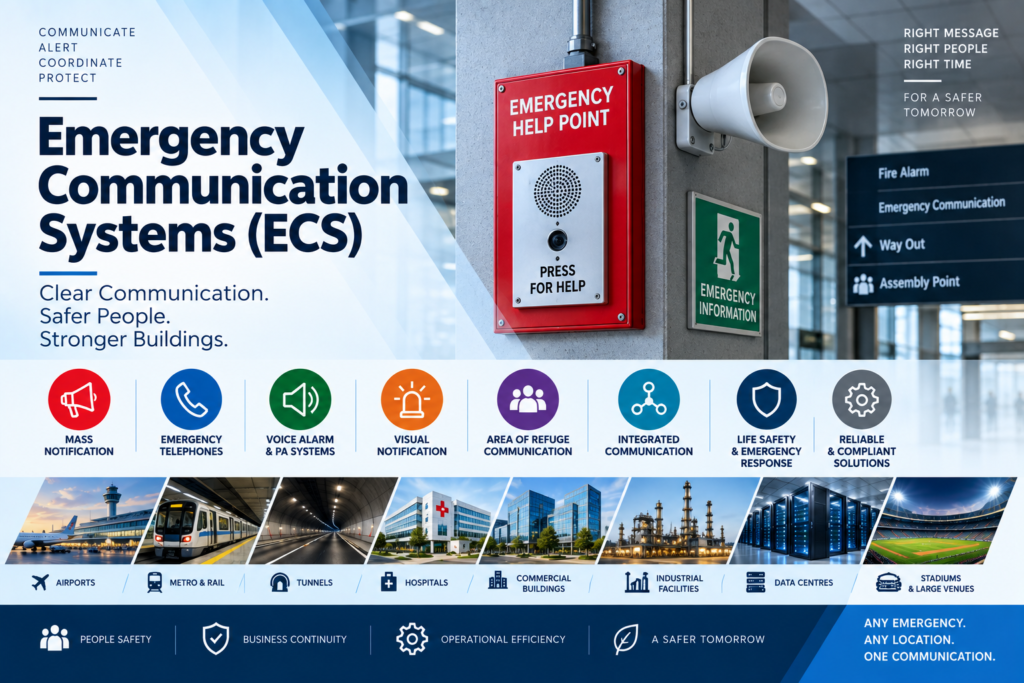
An Emergency Communication System (ECS) is an integrated life safety system that delivers emergency notifications through voice, visual, text, and digital communication channels. It enables rapid dissemination of instructions during fire, security, medical, or disaster emergencies.
Emergency Communication Systems provide timely and accurate instructions that improve occupant awareness, support orderly evacuation, reduce panic, and assist emergency responders in managing incidents effectively.
The primary objectives are to provide reliable emergency notification, coordinate evacuation, improve situational awareness, support incident management, and ensure uninterrupted communication during emergencies.
Major components include emergency communication controllers, paging consoles, emergency telephones, loudspeakers, visual notification devices, call stations, communication networks, servers, backup power supplies, and monitoring software.
Emergency Communication Systems include Mass Notification Systems (MNS), Emergency Voice Communication Systems (EVCS), Firefighter Telephone Systems, Area of Refuge Communication Systems, Emergency Intercom Systems, and SOS Help Point Systems.
PA Systems provide routine announcements, Voice Alarm Systems broadcast emergency evacuation messages during fire incidents, while Emergency Communication Systems integrate multiple communication technologies to manage various emergency scenarios beyond fire events.
Emergency Communication Systems are used in commercial buildings, airports, metro rail systems, tunnels, hospitals, industrial facilities, campuses, stadiums, data centres, and critical infrastructure requiring coordinated emergency response.
They provide real-time communication between occupants, emergency responders, and control centres through automated alerts, live announcements, emergency call stations, and integrated notification systems, enabling faster and more effective incident management.
Emergency Communication Systems minimize operational disruption by enabling rapid incident notification, coordinated evacuation, efficient emergency response, and timely restoration of normal operations after an emergency.
Common challenges include achieving reliable coverage, maintaining speech intelligibility, ensuring system redundancy, integrating multiple subsystems, addressing cybersecurity risks, and complying with applicable life safety standards.
A Mass Notification System (MNS) delivers emergency alerts simultaneously through voice announcements, text messages, emails, mobile applications, visual displays, and sirens. It rapidly notifies occupants of emergencies and provides real-time safety instructions.
An Emergency Voice Communication System (EVCS) enables two-way voice communication between occupants, emergency responders, and the control room during emergencies. It supports evacuation management, firefighter coordination, and life safety operations.
A Firefighter Telephone System provides dedicated two-way communication between the Fire Command Centre and remote locations such as staircases, equipment rooms, and refuge areas. It enables firefighters to coordinate rescue and firefighting activities during emergencies.
Area of Refuge Communication Systems provide emergency communication facilities for occupants unable to use evacuation routes during emergencies. They establish direct voice communication with the control room to coordinate rescue assistance.
Emergency Help Points and SOS Call Stations allow users to establish immediate communication with emergency operators using voice, video, or data communication. They are commonly installed in airports, metro stations, tunnels, campuses, and public spaces.
Emergency Intercom Systems provide dedicated two-way communication between field locations and control centres during emergencies. They are widely used in hospitals, tunnels, industrial plants, correctional facilities, and transportation infrastructure.
Emergency Communication Systems use fibre optic cables, Ethernet networks, copper cables, wireless communication, radio networks, cellular networks, and IP-based communication platforms. The selected medium depends on reliability, redundancy, and project requirements.
IP-based Emergency Communication Systems transmit voice, video, and emergency notifications over standard IP networks. They provide centralized management, scalability, remote monitoring, and seamless integration with enterprise communication infrastructure.
Redundancy is achieved using dual controllers, redundant servers, fibre optic ring topology, backup communication links, redundant power supplies, and automatic failover mechanisms. These features ensure continuous system availability during component failures.
Components are selected based on system capacity, reliability, communication protocol, environmental conditions, redundancy requirements, interoperability, applicable standards, and compatibility with other integrated life safety systems.
An Emergency Communication System is designed by evaluating occupancy, hazard assessment, evacuation strategy, communication requirements, and applicable standards. The design includes zoning, controller architecture, communication networks, redundancy, and integration with life safety systems.
Communication zones are established based on fire compartments, building occupancy, evacuation strategy, operational requirements, and public address coverage. Proper zoning enables selective paging and targeted emergency notifications.
Loudspeaker coverage is designed to provide uniform sound pressure levels while achieving the required Speech Transmission Index (STI). Speaker type, spacing, mounting height, room acoustics, and ambient noise are considered during design.
Paging consoles and control stations are located in Fire Command Centres, Security Control Rooms, and Emergency Operation Centres for immediate operator access. They are designed with priority override, zone selection, redundancy, and supervised communication circuits.
Commercial building ECS integrates Mass Notification, PA/VA, Fire Alarm, Area of Refuge communication, and emergency paging systems. The design supports phased evacuation, centralized monitoring, and reliable communication throughout the facility.
Hospital ECS provides emergency communication for patients, medical staff, operation theatres, ICUs, and public areas. The design emphasizes uninterrupted operation, redundant communication paths, and integration with nurse call, Fire Alarm, and BMS.
Data Centre ECS supports emergency notification, evacuation messaging, and communication with operations personnel during fire, power failure, or security incidents. The system integrates with Fire Alarm, Gas Suppression, BMS, and security systems while maintaining high availability.
Metro and tunnel ECS integrates emergency telephones, PA/VA, Help Points, Firefighter Telephones, SCADA, CCTV, and tunnel ventilation systems. The design ensures reliable communication under harsh environmental conditions with redundant network architecture.
Airport and industrial ECS provides centralized emergency communication across terminals, production areas, hazardous zones, and control rooms. The design incorporates redundant communication networks, emergency paging, Help Points, and integration with safety and security systems.
Engineering calculations include loudspeaker coverage, sound pressure level (SPL), Speech Transmission Index (STI), amplifier loading, battery backup capacity, cable voltage drop, network bandwidth, communication latency, and system availability to ensure reliable emergency communication.
Emergency Communication Systems receive alarm signals from the Fire Alarm System to automatically initiate emergency notifications, evacuation messages, and responder communication. Integration follows the approved Cause-and-Effect Matrix and emergency operating procedures.
ECS integrates with PA/VA Systems to broadcast live or pre-recorded emergency announcements across designated zones. Message priority and automatic switching ensure that emergency communications override routine announcements.
ECS exchanges alarms, equipment status, and operational data with the BMS for centralized monitoring and coordinated control. Integration improves situational awareness and supports emergency response management.
SCADA and Command & Control Systems provide centralized supervision of emergency communication equipment, alarms, and field devices. Operators can initiate notifications, monitor system health, and coordinate emergency operations from a single control platform.
CCTV integration enables operators to verify incidents visually while emergency messages are broadcast to affected areas. Live video supports decision-making, evacuation monitoring, and coordination with emergency responders.
ECS coordinates with Access Control Systems to unlock emergency exits, control occupant movement, and provide voice instructions during evacuation. This integration enhances life safety and ensures controlled emergency egress.
A Cause-and-Effect Matrix defines the sequence of automatic actions between Emergency Communication Systems and integrated building systems during emergencies. It specifies alarm priorities, message activation, equipment control, and communication workflows.
ECS provides clear voice instructions, zone-specific announcements, emergency call facilities, and real-time communication between occupants and emergency responders. This improves evacuation efficiency and reduces confusion during emergencies.
The System Integrator is responsible for engineering, installation, configuration, integration, testing, commissioning, and documentation of the Emergency Communication System. They ensure interoperability with Fire Alarm, PA/VA, BMS, SCADA, CCTV, and Access Control Systems.
ECS maintains reliable communication during emergencies through redundant controllers, backup power supplies, resilient communication networks, and centralized monitoring. These capabilities support rapid incident response, business continuity, and disaster recovery.
Installation should follow approved drawings, equipment manufacturer guidelines, and applicable standards. Communication cables, controllers, loudspeakers, emergency stations, and power supplies should be installed with proper segregation, labeling, redundancy, and environmental protection.
Factory Acceptance Testing (FAT) verifies the operation of controllers, paging consoles, emergency telephones, Help Points, communication interfaces, software, and redundancy features. It confirms compliance with project specifications before equipment dispatch.
Site Acceptance Testing (SAT) includes functional testing of communication devices, voice quality verification, network communication, emergency call stations, loudspeaker operation, integration with Fire Alarm and PA/VA Systems, and end-to-end system performance.
Commissioning includes point-to-point verification, Cause-and-Effect testing, integrated system testing, communication redundancy checks, operator training, and validation of all emergency communication scenarios before final system acceptance.
Preventive maintenance includes inspection of controllers, emergency telephones, Help Points, paging consoles, loudspeakers, communication networks, batteries, software updates, and fault monitoring. Routine testing ensures reliable operation during emergencies.
Common failures include communication network faults, controller malfunction, amplifier failure, microphone defects, power supply issues, battery degradation, and software configuration errors. Diagnosis is performed using system diagnostics, event logs, communication monitoring, and functional testing.
Emergency Communication Systems are designed in accordance with NFPA 72, ISO 7240-19, IEC 60849 (where applicable), EN 54 series, IS 2189, NBC India, and project-specific consultant specifications. Compliance with local fire authority requirements is mandatory.
Consultants typically require approved OEM authorization, system architecture drawings, communication zoning, Cause-and-Effect Matrix, Speech Intelligibility (STI) calculations, battery backup calculations, FAT/SAT procedures, commissioning methodology, and evidence of similar project experience.
Interview questions commonly cover Mass Notification Systems (MNS), Emergency Voice Communication Systems (EVCS), Firefighter Telephone Systems, Area of Refuge communication, Help Points, communication protocols, redundancy, Fire Alarm integration, commissioning procedures, and applicable standards.
Future Emergency Communication Systems will leverage AI-driven incident management, IoT-enabled monitoring, cloud-based mass notification, Digital Twin technology, mobile emergency alerts, GIS integration, and unified emergency management platforms. These technologies will improve real-time decision-making, communication reliability, and coordinated emergency response.