
Q&A
Engineering Design, Tendering & Estimation
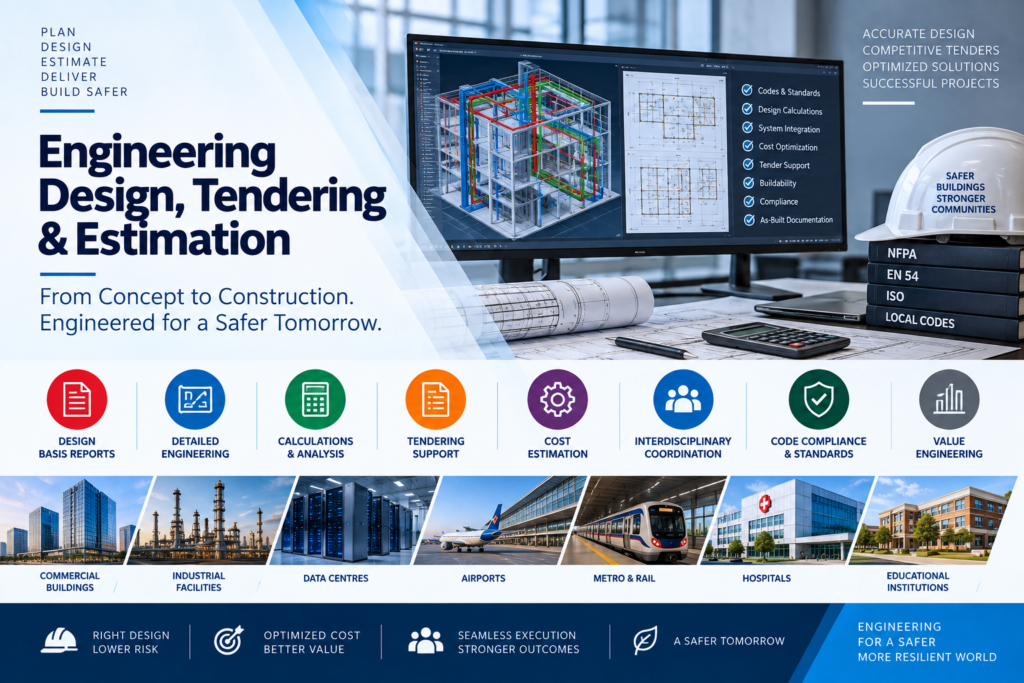
Engineering Design is the process of planning, analyzing, and developing Fire Protection and ELV systems to meet project requirements, applicable standards, safety objectives, and operational needs before construction begins.
Proper engineering design ensures technical accuracy, code compliance, constructability, cost optimization, and seamless coordination between multiple disciplines, reducing project risks and execution delays.
The objectives are to develop safe, reliable, code-compliant, cost-effective, and maintainable systems that satisfy client requirements while supporting efficient installation, testing, and long-term operation.
The design process includes requirement analysis, site assessment, concept design, detailed engineering, design calculations, drawing preparation, consultant review, construction support, and final as-built documentation.
A Design Basis Report defines the project scope, applicable codes, design assumptions, engineering criteria, system philosophy, and calculation methods. It serves as the foundation for all subsequent engineering activities.
Required inputs include architectural, structural, and MEP drawings, client specifications, applicable codes, occupancy details, fire risk assessment, utility information, and consultant design requirements.
Fire risk assessment identifies fire hazards, ignition sources, combustible materials, occupancy characteristics, and potential consequences. The assessment determines the appropriate fire protection strategy and system selection.
Design criteria are established using applicable codes, consultant specifications, client requirements, hazard classification, occupancy type, environmental conditions, and engineering best practices.
Performance-Based Fire Engineering uses engineering analysis, fire modelling, and performance evaluation to develop alternative fire safety solutions for complex buildings where prescriptive codes alone may not be sufficient.
Common mistakes include incorrect hazard classification, inadequate design calculations, poor interdisciplinary coordination, improper equipment selection, insufficient system integration, and non-compliance with applicable standards.
Engineering calculations include hydraulic calculations, fire water demand, sprinkler density, hydrant flow, Water Mist discharge, Fire Pump sizing, storage tank capacity, smoke management analysis, battery backup, and cable sizing.
Hydraulic calculations determine flow rate, pressure loss, pipe sizing, nozzle performance, and pump requirements using the applicable design standards and hydraulic modeling software to ensure adequate system performance.
Fire water demand is calculated based on the required simultaneous operation of fire protection systems, design flow rates, and discharge duration. Storage tank capacity is determined to meet the total firefighting water requirement.
Fire Pump capacity is selected based on hydraulic calculations, required system flow, design pressure, friction losses, elevation differences, and the most hydraulically demanding fire protection scenario.
Fire Alarm Systems are engineered by selecting appropriate detectors, alarm devices, control panels, communication networks, battery capacity, zoning, loop configuration, and Cause-and-Effect logic in accordance with applicable standards.
Gas Suppression Systems are engineered using room volume calculations, enclosure integrity assessment, agent concentration, discharge time, cylinder sizing, nozzle placement, and release control logic.
ELV engineering includes system architecture, equipment selection, network topology, cable routing, power requirements, rack layouts, communication protocols, and coordination with architectural, electrical, and mechanical services.
Drawings are prepared using engineering calculations, equipment dimensions, installation requirements, clash detection, and multidisciplinary coordination. Shop drawings provide detailed installation information for site execution.
Building Information Modelling (BIM) enables 3D visualization, clash detection, multidisciplinary coordination, quantity extraction, construction sequencing, and improved collaboration throughout the project lifecycle.
Required documents include approved shop drawings, Design Basis Report, hydraulic calculations, equipment datasheets, material submittals, Method Statements, Inspection & Test Plans (ITPs), QA/QC procedures, risk assessments, and construction schedules.
The tendering process includes tender identification, downloading bid documents, reviewing the NIT/RFP, technical and commercial evaluation, bid preparation, obtaining OEM authorizations, document compilation, online submission, and post-bid clarifications.
The NIT/RFP should be reviewed for project scope, eligibility criteria, technical specifications, financial requirements, bid submission instructions, completion period, payment terms, approved makes, and statutory obligations.
Eligibility is evaluated by verifying technical experience, similar work completion, financial turnover, net worth, solvency, statutory registrations, OEM authorizations, certifications, and mandatory compliance documents against tender requirements.
Similar work is assessed by comparing the scope of work, project value, execution period, client category, completion certificates, and technical similarity with the qualification criteria specified in the tender.
Financial evaluation includes verification of average annual turnover, net worth, solvency certificate, audited financial statements, GST compliance, income tax returns, and other financial documents required by the tender.
Technical bids generally include company profile, OEM authorization, technical compliance statement, work experience certificates, completion certificates, QA/QC documents, statutory registrations, methodology, drawings, and technical datasheets.
Consultants commonly require compliance with NFPA, NBC, IS Codes, approved OEM products, UL/FM certifications where specified, hydraulic calculations, Cause-and-Effect Matrix, FAT/SAT procedures, QA/QC plans, commissioning methodology, and project-specific technical documentation.
OEM authorizations, product certifications, compliance certificates, test reports, and technical datasheets are obtained from approved manufacturers, verified against tender requirements, and included in the technical bid package.
Technical deviations should be identified through a clause-by-clause review of the specification. Each deviation must be clearly documented with technical justification and submitted only where permitted by the tender conditions.
Common reasons include failure to meet eligibility criteria, incomplete documentation, missing OEM authorizations, non-compliant technical offers, incorrect financial submissions, unsigned forms, and late bid submission. A structured bid review checklist helps minimize these risks.
Engineering cost estimation is the systematic process of calculating the total project cost by evaluating material quantities, equipment costs, labour, installation, testing, commissioning, overheads, contingencies, and project risks before bid submission.
A BOQ is prepared from approved drawings, specifications, and design calculations by measuring quantities of materials and equipment. Verification involves cross-checking with drawings, technical specifications, and scope of work to eliminate omissions.
Material quantities are estimated using approved layouts, equipment schedules, piping and cable routing, hydraulic calculations, BIM models where available, and standard measurement practices. Site allowances and wastage factors are also considered.
Costs are estimated based on productivity norms, project complexity, installation methods, manpower requirements, equipment usage, testing procedures, commissioning activities, and project duration. Local labour rates and statutory requirements are also included.
Project schedules are developed using the work breakdown structure (WBS), procurement timelines, engineering deliverables, construction sequencing, commissioning milestones, and critical path analysis to ensure timely project completion.
Procurement planning identifies long-lead equipment, supplier manufacturing periods, inspection schedules, transportation time, customs clearance (if applicable), and delivery milestones to align material availability with the construction schedule.
Value engineering optimizes design, material selection, installation methods, and system configuration while maintaining full compliance with applicable codes, project specifications, performance requirements, and life safety objectives.
Risks are identified through technical reviews, site assessments, contract analysis, constructability studies, procurement evaluations, and schedule reviews. Risk mitigation plans address technical, commercial, operational, and regulatory challenges.
Accurate engineering and estimation reduce design changes, avoid cost overruns, improve procurement planning, enhance execution efficiency, minimize contractual disputes, and support profitable project delivery while ensuring client satisfaction.
The Tender Executive manages bid preparation and compliance, the Design Engineer develops technical solutions and engineering documentation, and the Project Manager oversees procurement, execution, quality, schedule, cost, commissioning, and client coordination throughout the project lifecycle.
Engineering design and tendering are governed by NBC India, NFPA Standards, IS Codes, IEC Standards, EN Standards, ISO Standards, consultant specifications, contract conditions, and project-specific statutory requirements.
Consultant comments are reviewed through a comment resolution matrix, engineering revisions are incorporated into drawings and calculations, and responses are documented until all observations are closed with consultant approval.
Common conditions include technical compliance, approved OEMs, warranty obligations, project completion period, payment terms, liquidated damages, performance guarantees, statutory approvals, insurance, taxes, and defect liability requirements.
Key deliverables include design reports, shop drawings, material submittals, procurement schedules, Method Statements, Inspection & Test Plans (ITPs), QA/QC documents, FAT/SAT reports, commissioning records, as-built drawings, and O&M manuals.
Project close-out includes completion of punch points, submission of as-built drawings, test certificates, warranties, training records, O&M manuals, statutory approvals, and final handover documentation to the client.
Common mistakes include incorrect quantity estimation, inadequate scope review, omission of mandatory documents, non-compliant equipment selection, unrealistic schedules, poor coordination, inaccurate costing, and failure to identify contractual risks.
Interview questions commonly cover engineering calculations, hydraulic design, Fire Alarm engineering, BOQ preparation, tender evaluation, OEM management, cost estimation, project planning, QA/QC documentation, and EPC project execution.
AI and BIM improve design coordination, automate quantity take-offs, detect design clashes, enhance document management, optimize engineering calculations, and support intelligent tender evaluation with greater accuracy and efficiency.
Digital quantity take-off and BIM-based costing provide accurate material quantities, reduce manual calculation errors, improve cost forecasting, accelerate bid preparation, and enable real-time updates when design changes occur.
Future trends include AI-assisted bid preparation, automated compliance checking, Digital Twin-enabled design validation, predictive cost and schedule analytics, cloud-based collaboration, robotic quantity extraction, and integrated digital EPC platforms. These technologies improve engineering quality, bidding accuracy, execution efficiency, and project profitability.