
Q&A
Fire Detection & Alarm Systems (FAS)
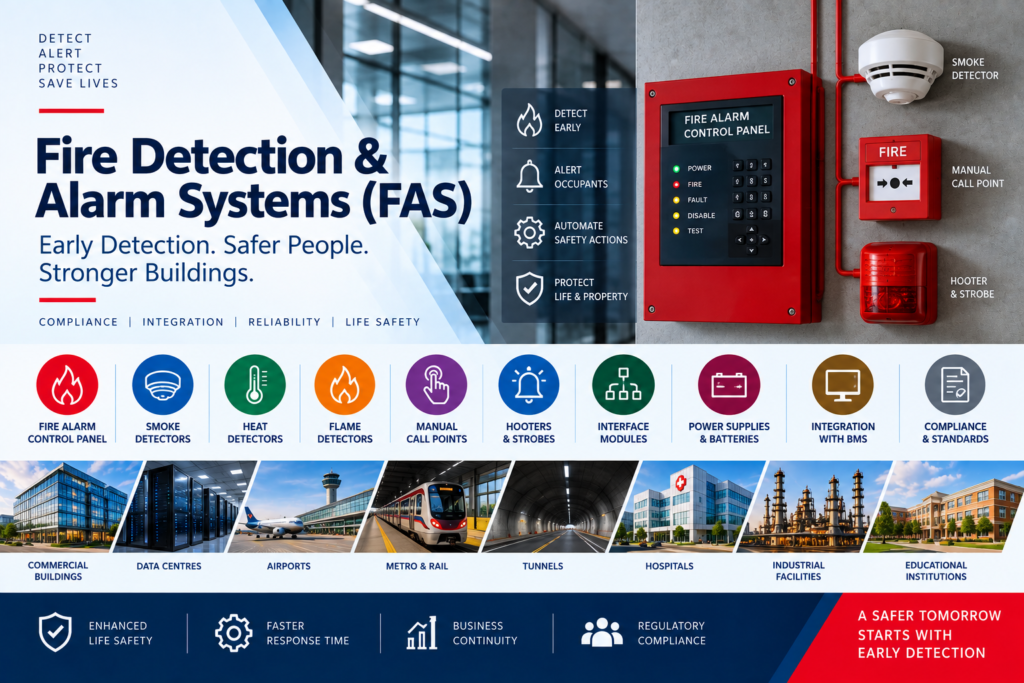
A Fire Detection & Alarm System (FAS) is an integrated life safety system that detects fire at an early stage, alerts occupants, and automatically initiates emergency actions such as alarm notification, HVAC shutdown, elevator recall, and suppression system interfaces to protect life and property.
Early fire detection enables timely evacuation, rapid emergency response, and automatic activation of fire protection systems before the fire spreads. It minimizes casualties, property damage, operational downtime, and business interruption.
The system continuously monitors smoke, heat, flame detectors, and manual call points through the Fire Alarm Control Panel (FACP). When a fire condition is detected, the panel processes the signal, activates alarms, and executes programmed Cause-and-Effect actions.
The major components include the Fire Alarm Control Panel (FACP), smoke detectors, heat detectors, flame detectors, manual call points, hooters, strobes, interface modules, power supplies, batteries, and communication networks. Together, they detect, process, and communicate fire emergencies.
Fire detection systems identify smoke, heat, or flame and generate alarms, while fire suppression systems extinguish or control the fire using water, clean agents, foam, or inert gases. Detection initiates the suppression sequence through programmed control logic.
The primary objectives are to detect fire early, warn occupants, support safe evacuation, protect property, activate fire protection systems, assist emergency responders, and maintain business continuity while complying with fire safety regulations.
Fire Alarm Systems are classified as Conventional, Addressable, Intelligent, Wireless, and Hybrid systems. The selection depends on building size, occupancy, operational requirements, and the level of monitoring and integration required.
Fire detection has evolved from manual alarms and conventional detectors to intelligent addressable systems with multi-criteria sensors, aspirating smoke detection, IoT connectivity, and AI-based analytics, providing faster detection and fewer false alarms.
Intelligent fire detection uses microprocessor-based detectors that analyze multiple fire indicators such as smoke, heat, and carbon monoxide using advanced algorithms. This improves detection accuracy, reduces nuisance alarms, and supports predictive maintenance.
The Fire Alarm Control Panel (FACP) is the central control unit of the Fire Detection & Alarm System that monitors all field devices, processes alarm signals, displays event information, and controls integrated systems such as HVAC, suppression, BMS, and emergency notifications.
Smoke detectors continuously monitor the air for smoke particles using optical or ionization sensing technology. When smoke concentration exceeds the preset threshold, the detector sends an alarm signal to the Fire Alarm Control Panel (FACP).
Ionization smoke detectors respond quickly to fast-flaming fires by detecting changes in ionized air, while photoelectric detectors detect light scattered by smoke particles and are more effective for slow, smoldering fires. Photoelectric detectors are widely preferred due to their lower false alarm rate.
Heat detectors should be used in areas where smoke detectors may cause nuisance alarms due to dust, steam, or fumes, such as kitchens, boiler rooms, generator rooms, and parking areas. They operate when a fixed temperature or rapid temperature rise is detected.
Rate-of-Rise (ROR) heat detectors activate when the ambient temperature increases rapidly, typically around 6.7°C to 8.3°C per minute, even if the preset temperature has not been reached. They also include a fixed-temperature element for added reliability.
Flame detectors identify the ultraviolet (UV) or infrared (IR) radiation emitted by flames, enabling very rapid fire detection without relying on smoke or heat buildup. They are ideal for high-risk industrial and hazardous environments.
UV detectors sense ultraviolet radiation, IR detectors detect infrared radiation, and UV/IR detectors combine both technologies to improve detection accuracy while minimizing false alarms. IR3 detectors provide the highest reliability for hazardous applications.
Multi-criteria detectors combine multiple sensing technologies, such as smoke, heat, and carbon monoxide, with intelligent algorithms to improve fire detection accuracy. They significantly reduce nuisance alarms and adapt to changing environmental conditions.
Aspirating Smoke Detection (ASD), commonly known as VESDA, continuously draws air through a network of sampling pipes into a highly sensitive laser detector. It provides very early warning by detecting microscopic smoke particles before visible smoke is present.
Linear Heat Detection (LHD) uses a heat-sensitive cable that continuously monitors temperature along its entire length. It is ideal for long distances and harsh environments where conventional point detectors are impractical.
Gas detectors monitor combustible, toxic, or oxygen-deficient gases to prevent fire and explosion hazards before ignition occurs. They are commonly integrated with Fire & Gas Systems in oil & gas facilities, chemical plants, battery energy storage systems, and industrial process areas.
Detector selection depends on occupancy type, fire risk, environmental conditions, ceiling height, and ventilation. Smoke detectors are generally used in occupied areas, while heat, flame, or gas detectors are selected for industrial or hazardous environments.
Detector spacing is determined by applicable standards, ceiling height, room layout, airflow, and detector type. Proper spacing ensures complete coverage and timely fire detection without leaving unprotected areas.
Higher ceilings delay the movement of smoke and heat to detectors, reducing response time. High-rise spaces may require beam detectors, Aspirating Smoke Detection (ASD), or revised detector spacing to maintain effective coverage.
Airflow from HVAC systems can dilute or divert smoke, delaying detector activation or causing nuisance alarms. Detector placement should be coordinated with airflow patterns to ensure reliable smoke detection.
Data Centres require multi-layer detection using Aspirating Smoke Detection (ASD), ceiling-mounted smoke detectors, underfloor detection, and integration with clean agent suppression systems. The design should account for raised floors, airflow, and critical equipment protection.
Tunnel fire detection typically uses Linear Heat Detection (LHD), Beam Smoke Detectors, Flame Detectors, and Gas Detectors to provide continuous monitoring. The system is integrated with tunnel ventilation, SCADA, CCTV, and emergency communication systems.
Warehouse detector selection depends on storage height, commodity classification, and ceiling configuration. High-bay warehouses commonly use Beam Smoke Detectors or ASD, while hazardous storage areas may require heat or flame detectors.
Fire Alarm Zones are established based on building layout, fire compartments, occupancy, and evacuation strategy. Proper zoning enables quick identification of fire location, simplifies maintenance, and supports phased evacuation.
Addressable loop design connects intelligent field devices to the Fire Alarm Control Panel using a communication loop where each device has a unique address. It enables precise alarm identification, faster fault diagnosis, and simplified system expansion.
Common design mistakes include incorrect detector selection, improper spacing, poor zoning, ignoring HVAC airflow, inadequate Cause-and-Effect programming, and insufficient coordination with other building systems. These issues can lead to delayed detection, nuisance alarms, and non-compliance.
The Fire Alarm System integrates with the Building Management System (BMS) through communication protocols such as BACnet or Modbus to provide centralized monitoring, event logging, and automatic control of building services. During a fire, the FACP remains the primary life safety controller.
FAS communicates with SCADA systems to provide real-time monitoring, alarm management, and control of fire protection equipment across large facilities. This integration enables centralized supervision, remote diagnostics, and faster emergency response.
Upon fire detection, the Fire Alarm System sends commands to shut down AHUs, operate smoke and fire dampers, activate smoke extraction fans, and start staircase pressurization systems. This helps prevent smoke spread and maintains safe evacuation routes.
FAS activates smoke exhaust fans, smoke dampers, pressurization fans, and ventilation controls based on the programmed Cause-and-Effect Matrix. This controls smoke movement, improves visibility, and supports safe evacuation and firefighting operations.
The Fire Alarm System uses cross-zoning to confirm a fire before initiating clean agent discharge. It activates alarms, starts the discharge delay timer, shuts down HVAC systems, and releases the extinguishing agent while monitoring all release and abort functions.
After confirming a fire condition, the Fire Alarm System starts the Water Mist pump or opens the deluge valve through programmed control logic. It also interfaces with alarms, HVAC systems, and monitoring platforms to ensure coordinated fire suppression.
A Cause-and-Effect Matrix is a programming document that defines the relationship between fire inputs and system outputs. It specifies how the Fire Alarm System, HVAC, suppression systems, elevators, and other equipment respond during different fire scenarios.
The Sequence of Operation ensures all fire protection systems respond in the correct order during an emergency, including alarms, HVAC shutdown, smoke control, suppression, and evacuation. Proper sequencing improves life safety and prevents system conflicts.
FAS minimizes business interruption by detecting fires early, protecting critical assets, reducing equipment damage, and enabling rapid emergency response. Integration with suppression systems and remote monitoring further enhances operational resilience.
The System Integrator is responsible for engineering, installation, programming, testing, commissioning, and integrating the Fire Alarm System with BMS, SCADA, HVAC, suppression systems, and other building services. They ensure the complete system complies with project specifications and statutory standards.
FAS commissioning verifies that all devices, control panels, interfaces, and Cause-and-Effect logic operate according to approved drawings and specifications. It includes functional testing, integrated system testing, documentation, and client training before final handover.
Factory Acceptance Testing (FAT) verifies equipment performance before dispatch, while Site Acceptance Testing (SAT) confirms correct installation and system integration at site. Both include alarm simulation, loop testing, interface verification, and Cause-and-Effect validation.
Preventive maintenance includes scheduled inspection, testing, cleaning, calibration, and servicing of Fire Alarm System components to maintain reliability and compliance. Regular maintenance minimizes false alarms, prevents equipment failures, and extends system life.
Common faults include open and short circuits, earth faults, detector contamination, communication failures, power supply issues, battery failures, and module faults. Prompt fault diagnosis and corrective maintenance are essential to ensure continuous system availability.
False alarms can be minimized by selecting the correct detector type, installing devices at suitable locations, performing regular maintenance, and using intelligent detectors with drift compensation and multi-criteria sensing. Proper HVAC coordination and detector cleaning also improve system reliability.
Cybersecurity is achieved through secure network architecture, user authentication, encrypted communication, firmware updates, network segmentation, and continuous monitoring. These measures protect the Fire Alarm System from unauthorized access while maintaining reliable life safety operations.
Fire Detection & Alarm Systems are designed, installed, tested, and maintained in accordance with standards such as NFPA 72, IS 2189, EN 54, NBC India, NFPA 70, NFPA 2001, and NFPA 750, depending on the project scope and statutory requirements.
Consultants evaluate FAS based on technical compliance, approved OEMs, product certifications, engineering calculations, system architecture, project experience, QA/QC procedures, commissioning methodology, and compliance with tender specifications and applicable standards.
Interview questions typically cover detector selection, Fire Alarm Control Panels, addressable systems, Cause-and-Effect logic, commissioning, troubleshooting, HVAC integration, suppression systems, and applicable standards. Practical project experience and problem-solving skills are also assessed.
AI-enabled Fire Alarm Systems use machine learning, IoT, cloud connectivity, and predictive analytics to improve fire detection accuracy, reduce false alarms, and support predictive maintenance. Future systems will provide intelligent monitoring, remote diagnostics, and seamless integration with smart buildings.