
Q&A
Fire Pumps & Water Storage
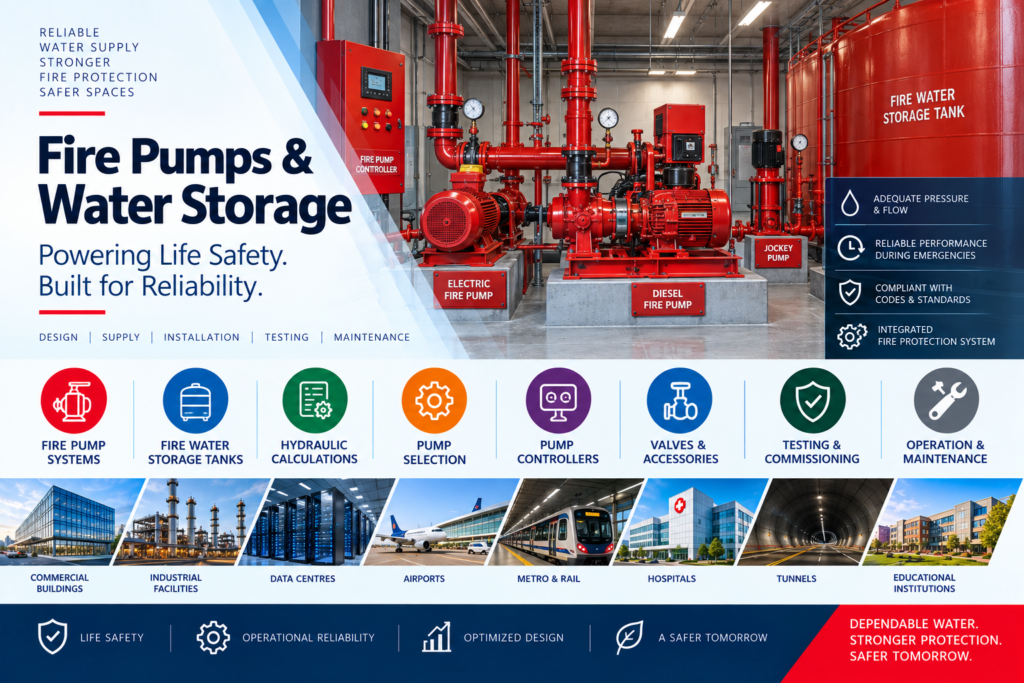
A Fire Pump System is a critical component of a fire protection system that supplies water at the required pressure and flow to sprinklers, hydrants, hose reels, and water-based suppression systems when the available water pressure is inadequate.
Fire Pumps provide the necessary water pressure and flow to ensure fire protection systems operate effectively during an emergency. They compensate for insufficient municipal water supply or pressure losses within the system.
A Fire Water Storage System stores dedicated water for firefighting purposes and ensures an uninterrupted water supply during fire emergencies. It typically includes underground tanks, overhead tanks, reservoirs, and associated piping.
Fire Pumps automatically start when system pressure drops due to sprinkler or hydrant operation, delivering the required water flow and pressure to control or extinguish the fire effectively.
A Fire Pump System consists of the fire pump, electric or diesel driver, jockey pump, pump controller, suction and discharge piping, valves, pressure gauges, flow meter, relief valve, and Fire Water Storage Tank.
Common Fire Pump types include Horizontal Split-Case, End-Suction, Vertical Turbine, Vertical In-Line, and Multistage Pumps. The selection depends on water source, required capacity, pressure, and installation conditions.
Electric Fire Pumps are powered by electricity, diesel pumps provide backup operation during power failures, and jockey pumps maintain system pressure by compensating for minor pressure losses without starting the main fire pumps.
The jockey pump maintains normal system pressure by automatically compensating for small pressure drops caused by minor leaks or temperature changes. This prevents unnecessary operation of the main fire pump.
Fire Water Storage Tanks provide a dedicated and reliable water supply for firefighting systems, ensuring adequate water is available throughout the required fire duration, even if the municipal supply fails.
Fire Water Storage Tanks may be underground, overhead, sectional, concrete, steel, GRP, or bolted-panel tanks, depending on project requirements, available space, and applicable fire protection standards.
A centrifugal Fire Pump uses a rotating impeller to convert mechanical energy into hydraulic energy, increasing the water pressure and flow rate. It continuously supplies water to the fire protection system once activated.
Horizontal split-case pumps are suitable for high-flow applications and easy maintenance, end-suction pumps are compact and economical for moderate capacities, while vertical turbine pumps are used where water is drawn from underground tanks, wells, or reservoirs.
Fire Pump selection is based on the required flow rate, system pressure, water source, hazard classification, building height, and applicable fire protection standards. Hydraulic calculations determine the final pump capacity and operating point.
Fire Pump rated capacity is the designed water flow delivered by the pump at its rated pressure under standard operating conditions. It is generally expressed in LPM (Litres Per Minute) or GPM (Gallons Per Minute).
Rated pressure is determined by calculating the total pressure required to overcome elevation, pipe friction losses, and the operating pressure needed at the most remote fire protection device. The selected pump must satisfy these design requirements.
Churn pressure is the maximum pressure produced by a Fire Pump when operating with no water flow. According to NFPA 20, it should generally not exceed 140% of the pump's rated pressure.
Fire Pump performance curves illustrate the relationship between flow rate, pressure, power consumption, and efficiency. They help engineers select a pump that operates efficiently under the required design conditions.
Net Positive Suction Head (NPSH) is the minimum suction pressure required to prevent cavitation within the pump. Adequate NPSH ensures stable operation, protects the impeller, and extends the service life of the Fire Pump.
Suction piping should be short, straight, and sized to minimize friction losses and prevent air pockets, while discharge piping is designed to maintain the required flow and pressure. Proper supports, valves, and fittings ensure reliable pump performance.
Fire Pump selection requires hydraulic calculations, flow demand analysis, pressure loss calculations, NPSH evaluation, suction pipe sizing, discharge pipe sizing, and power requirements. These calculations ensure the pump meets the system's fire protection performance criteria.
Fire Water Storage capacity is calculated based on the required fire water demand, system flow rate, and duration of firefighting as specified by applicable codes. The storage volume must be sufficient to support all connected fire protection systems during the design fire scenario.
Underground Fire Water Tanks are designed considering storage capacity, structural loading, groundwater conditions, compartmentation, accessibility, and suction arrangements. They should provide a reliable and protected water source for fire pumps.
Overhead Fire Water Tanks are designed to provide gravity-fed water supply and maintain adequate pressure where required. Structural stability, seismic loading, overflow arrangements, and dedicated fire water capacity are key design considerations.
Fire water demand depends on occupancy type, hazard classification, building area, sprinkler and hydrant requirements, hose stream demand, fire duration, and applicable standards. These factors determine the required storage capacity and pump sizing.
A dedicated Fire Water Storage System stores water exclusively for firefighting, while a combined system supplies both domestic and fire protection requirements. Dedicated systems provide greater reliability and are commonly specified for critical facilities.
Fire tanks are replenished through municipal water supply, bore wells, reservoirs, or other approved water sources using automatic float valves or level control systems. The replenishment rate should restore the required storage capacity within the prescribed time.
Compartmentalized tanks are divided into two or more sections, allowing one compartment to remain operational while the other is cleaned or repaired. This ensures continuous availability of fire water without interrupting system operation.
Suction pits are designed to maintain adequate water depth, prevent vortex formation, and provide uninterrupted water flow to the Fire Pump. Their dimensions and pipe arrangements should ensure proper Net Positive Suction Head (NPSH) under all operating conditions.
Fire water reservoirs provide large-capacity water storage for industrial plants, airports, refineries, power stations, and other high-hazard facilities. They ensure a dependable water supply for prolonged firefighting operations.
Water quality is maintained through periodic inspection, cleaning, circulation, filtration, and corrosion control to prevent sediment buildup, biological growth, and pipe blockages. Good water quality improves the reliability and service life of fire protection equipment.
A Fire Pump Room should provide adequate space for installation, operation, maintenance, and emergency access. It must be protected against flooding, equipped with proper lighting, drainage, ventilation, and comply with NFPA 20 and local fire regulations.
Fire Pump Rooms require sufficient ventilation to maintain acceptable operating temperatures and remove heat generated by pumps and diesel engines. Diesel pump rooms should also provide combustion air and exhaust ventilation for safe operation.
Fire Pump installations require a reliable dedicated power supply, properly sized cables, automatic transfer arrangements where applicable, grounding, and fire-rated wiring. Electrical installations should comply with NFPA 20, NFPA 70, and applicable electrical codes.
Diesel Fire Pumps are supplied from dedicated fuel tanks sized to provide the minimum operating duration specified by NFPA 20 or project requirements. Fuel tanks should include level indicators, vents, drain valves, and leak prevention measures.
Fire Pumps start automatically when system pressure falls below the preset value due to sprinkler or hydrant operation. Dedicated Fire Pump Controllers monitor pressure, control pump operation, and ensure automatic starting without manual intervention.
Fire Pumps interface with the Fire Alarm System to transmit signals such as pump running, fault, power failure, and controller status. This integration enables centralized alarm monitoring and improves emergency response.
Integration with BMS allows real-time monitoring of pump status, system pressure, alarms, faults, fuel levels, and controller operation. Communication is typically established through BACnet, Modbus, or other approved protocols.
The Cause-and-Effect Matrix defines the automatic sequence of pump operation following a pressure drop or fire alarm. It includes jockey pump operation, main pump start, diesel backup operation, alarm indication, and monitoring of system status.
Fire Pumps ensure continuous water supply for firefighting, protecting critical assets and minimizing operational downtime during fire emergencies. Reliable pump operation supports uninterrupted protection in data centres, airports, hospitals, and industrial facilities.
The System Integrator coordinates engineering, pump controls, Fire Alarm interfaces, BMS integration, testing, commissioning, and documentation. They ensure all components operate together as an integrated fire protection system and comply with project specifications.
Fire Pump commissioning includes hydrostatic pressure testing, pump performance testing, flow testing, controller functional testing, automatic start verification, pressure switch calibration, and integrated testing with the fire protection system.
Factory Acceptance Testing (FAT) verifies the Fire Pump's performance, rated flow, pressure, motor or engine operation, controller functionality, and compliance with project specifications before shipment from the manufacturer.
Site Acceptance Testing (SAT) confirms that the installed Fire Pump System operates correctly under actual site conditions. It includes flow tests, pressure verification, automatic operation, alarm monitoring, and integration with Fire Alarm and BMS systems.
Fire Pumps should be inspected regularly for pump operation, controller status, pressure readings, lubrication, battery condition, fuel level, valves, and piping. Preventive maintenance should be performed in accordance with NFPA 25 and manufacturer recommendations.
Common failures include power supply interruption, diesel engine faults, battery failure, pump cavitation, controller malfunction, suction blockage, valve misalignment, and inadequate preventive maintenance. Routine inspections help prevent unexpected failures.
Reliability can be improved through regular testing, preventive maintenance, redundant power supplies, proper suction conditions, routine controller inspections, and periodic verification of pump performance underload.
Fire Pump and Water Storage Systems are governed by NFPA 20, NFPA 22, NFPA 24, NFPA 25, IS 15105, IS 13039, IS 3844, and the National Building Code (NBC) of India, along with project specifications.
Consultants typically require approved OEM authorization, pump performance curves, hydraulic calculations, controller details, compliance statements, FAT/SAT procedures, product certifications, and evidence of similar project experience.
Interview questions commonly cover pump selection, pump curves, jockey pump operation, NPSH, churn pressure, hydraulic calculations, water storage sizing, applicable standards, testing procedures, and troubleshooting of Fire Pump Systems.
Future developments include IoT-enabled pump monitoring, AI-based predictive maintenance, smart controllers, digital twins, energy-efficient pump systems, and remote performance diagnostics. These technologies enhance reliability, operational efficiency, and lifecycle management.