
Q&A
Industrial Fire Protection
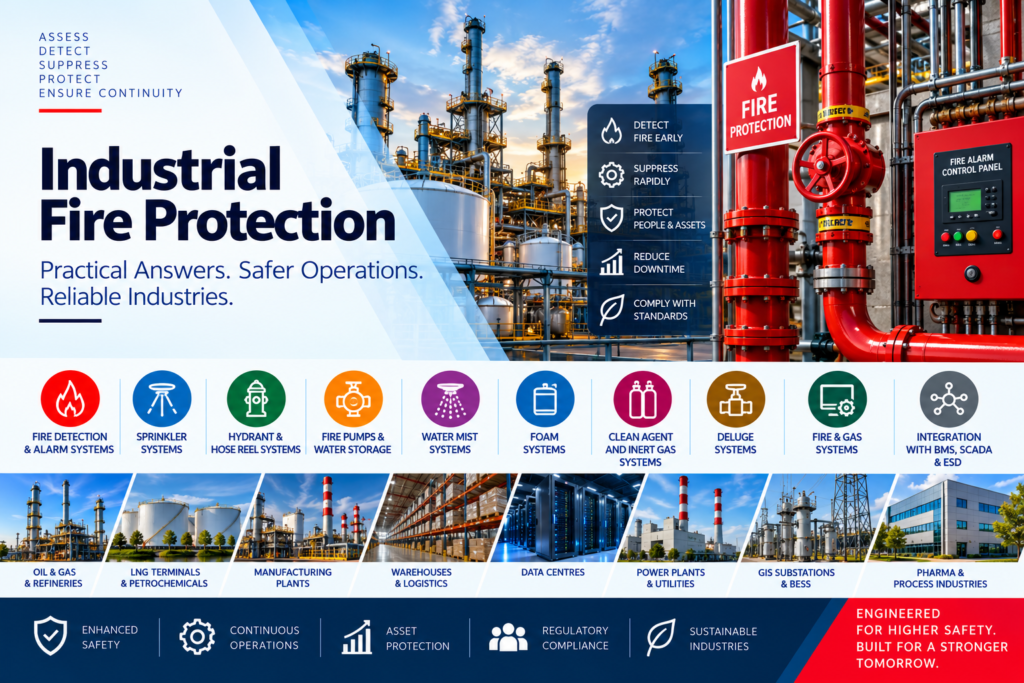
Industrial Fire Protection is an integrated engineering system that detects, controls, and suppresses fires in manufacturing plants, warehouses, process industries, and utilities while protecting personnel, assets, and production continuity.
Industrial facilities contain combustible materials, hazardous chemicals, electrical equipment, and high-energy processes that present significant fire risks. Effective fire protection minimizes injuries, property damage, and production downtime.
Primary hazards include flammable liquids and gases, combustible dust, electrical faults, hot work, process equipment failures, chemical reactions, machinery overheating, and combustible storage materials.
The objectives are to detect fire early, suppress fire rapidly, prevent escalation, protect personnel and equipment, maintain business continuity, and comply with applicable fire safety regulations.
Major components include Fire Detection & Alarm Systems, sprinkler systems, hydrants, Fire Pumps, Water Mist, foam systems, clean agent systems, deluge systems, Fire & Gas Systems, emergency communication, and smoke management systems.
Industrial Fire Protection addresses process hazards, hazardous materials, combustible dust, flammable liquids, high fire loads, and specialized production equipment. It requires hazard-specific suppression systems and risk-based engineering.
Fire risk assessment identifies ignition sources, combustible materials, process hazards, fire load, and potential consequences. The assessment establishes the fire protection philosophy and system design requirements.
Industrial occupancies are classified based on process hazards, fire load, combustible materials, storage arrangements, and operational risks. Hazard classification determines the required detection and suppression systems.
Common causes include electrical faults, equipment failure, combustible dust, flammable liquid leaks, hot work, static electricity, overheating machinery, chemical reactions, and inadequate maintenance practices.
Major incidents emphasize the importance of hazard identification, reliable fire detection, automatic suppression, preventive maintenance, emergency planning, process safety management, and integrated fire protection systems.
Fire Detection & Alarm Systems are designed using addressable fire alarm panels, smoke detectors, heat detectors, flame detectors, gas detectors, Linear Heat Detection (LHD), and manual call points. The design is based on hazard analysis, process layout, occupancy, and applicable standards.
Industrial facilities commonly use smoke detectors, heat detectors, flame detectors (UV/IR/MSIR), beam detectors, Linear Heat Detection (LHD), Aspirating Smoke Detection (ASD/VESDA), and multi-criteria detectors. Detector selection depends on environmental conditions and process hazards.
Smoke detectors are selected based on ceiling height, airflow, dust levels, humidity, ambient temperature, and fire characteristics. Photoelectric, beam, or aspirating smoke detectors are commonly used depending on the application.
Heat detectors are installed where smoke detectors may generate false alarms due to dust, steam, or process emissions. Fixed-temperature and rate-of-rise heat detectors are selected according to the expected ambient temperature.
Flame detectors provide rapid detection of open flames in hazardous areas containing flammable liquids or gases. UV, IR, UV/IR, and Multi-Spectrum IR (MSIR) detectors are selected according to fuel type and environmental conditions.
Gas detection systems continuously monitor combustible gases and toxic gases such as H₂S, CO, NH₃, and Cl₂. Detector placement is based on gas density, ventilation, process equipment, and hazardous area classification.
Linear Heat Detection (LHD) continuously monitors temperature along the entire cable length and provides precise fire location. It is widely used on cable trays, conveyors, tunnels, warehouses, transformers, and process equipment.
ASD/VESDA systems provide very early smoke detection in clean rooms, control rooms, electrical panels, server rooms, cable galleries, and high-value manufacturing areas. Continuous air sampling enables early intervention before fire escalation.
Fire Alarm Systems interface with SCADA, Distributed Control Systems (DCS), Emergency Shutdown (ESD), HVAC, smoke control, suppression systems, and emergency communication systems. Integration enables automated emergency response through predefined Cause-and-Effect logic.
Common challenges include dust, steam, vibration, high ambient temperatures, corrosive atmospheres, airflow, large open spaces, hazardous areas, and maintaining reliable detection while minimizing false alarms.
Industrial facilities use sprinkler systems, hydrant systems, High-Pressure Water Mist, foam systems, clean agent systems, dry chemical powder (DCP), deluge systems, fire monitors, and portable extinguishers. System selection depends on the hazard classification and process risk.
Sprinkler systems are designed based on occupancy hazard classification, storage configuration, design density, operating area, water demand, and hydraulic calculations. System design complies with applicable fire protection standards.
Fire Hydrant Systems are designed to provide complete coverage of process units, warehouses, utilities, and production areas. The design includes hydrant spacing, flow requirements, operating pressure, ring main layout, and hydraulic analysis.
High-Pressure Water Mist Systems protect turbines, generators, machinery spaces, cable tunnels, electrical equipment, and specialized manufacturing processes. They provide rapid cooling, radiant heat reduction, and efficient fire suppression with minimal water usage.
Foam systems are designed based on hazard area, foam application density, discharge duration, foam concentrate type, and hydraulic calculations. They are commonly used for chemical storage, fuel handling areas, process vessels, and bunded tank farms.
Clean agent systems such as IG-541, IG-100, or FK-5-1-12 protect control rooms, MCC rooms, electrical panels, substations, server rooms, and communication rooms where water-based suppression could damage critical equipment.
Dry Chemical Powder (DCP) systems rapidly suppress flammable liquid and gas fires by interrupting the combustion process. They are commonly installed in fuel handling facilities, gas plants, chemical processing units, and high-risk industrial areas.
Fire Pump Systems are designed using hydraulic demand calculations and typically include electric, diesel, and jockey pumps. Fire Water Storage Tanks are sized to provide the required firefighting water for the specified duration.
Deluge systems discharge large volumes of water through open nozzles upon activation by Fire Detection Systems. They protect transformers, reactors, process vessels, conveyors, cable galleries, and other high-risk industrial equipment.
Common mistakes include incorrect hazard classification, inadequate hydraulic calculations, improper nozzle selection, insufficient water supply, poor zoning, lack of redundancy, and inadequate integration with Fire Alarm and process control systems.
The system is designed using fire risk assessment, hazard classification, fire load analysis, process evaluation, and applicable standards. It integrates detection, suppression, emergency communication, process shutdown, and life safety systems into a coordinated fire protection strategy.
Hazard assessments identify combustible materials, ignition sources, process hazards, and occupancy risks. Fire load calculations evaluate the potential heat release to determine the required fire resistance, suppression capacity, and firefighting water demand.
Fire Protection Systems interface with BMS to control HVAC shutdown, smoke extraction, fire dampers, emergency ventilation, and building utilities. The BMS provides centralized monitoring of alarms, faults, and system status.
SCADA and DCS receive fire alarms, supervisory signals, and equipment status for centralized monitoring and automated control. Integration supports emergency shutdown, process isolation, and coordinated response during fire incidents.
Fire Protection Systems transmit confirmed fire or gas alarms to the ESD System, which automatically isolates hazardous processes, shuts down equipment, closes emergency valves, and activates suppression systems according to the Cause-and-Effect Matrix.
Fire Alarm Systems automatically stop HVAC equipment, operate smoke extraction fans, control pressurization systems, and close or open fire dampers to limit smoke spread and support safe evacuation.
A Cause-and-Effect Matrix defines the automatic sequence of actions following fire detection, including alarm activation, suppression release, HVAC shutdown, ESD operation, ventilation control, emergency communication, and equipment isolation.
The System Integrator is responsible for engineering, installation, programming, testing, commissioning, and integration of Fire Alarm, suppression systems, SCADA, DCS, BMS, ESD, and emergency communication systems to ensure reliable plant-wide operation.
Industrial Fire Protection Systems minimize equipment damage, reduce production downtime, protect critical processes, and enable rapid recovery after fire incidents. Redundant system architecture improves reliability and operational resilience.
Engineering calculations include hydraulic calculations, fire water demand, fire load assessment, sprinkler density, pump sizing, storage tank capacity, foam calculations, battery backup capacity, cable sizing, and Cause-and-Effect verification.
Installation shall comply with approved IFC drawings, OEM instructions, project specifications, and applicable standards. Equipment, piping, detectors, cabling, suppression systems, and control panels shall be installed with proper segregation, earthing, labeling, corrosion protection, and accessibility.
FAT verifies Fire Alarm Panels, suppression system controllers, Fire Pumps, detectors, valves, communication interfaces, software configuration, and Cause-and-Effect logic. All equipment is tested for compliance before shipment.
SAT includes functional testing of detectors, suppression systems, Fire Pumps, hydrants, communication networks, SCADA/DCS integration, Emergency Shutdown (ESD), and complete Cause-and-Effect validation under actual site conditions.
Commissioning includes point-to-point verification, loop checks, detector calibration, suppression testing, Fire Pump performance testing, integrated system testing, operator training, documentation review, and final acceptance.
Preventive maintenance includes inspection and testing of Fire Alarm devices, sprinklers, hydrants, Fire Pumps, Water Mist systems, foam systems, clean agent systems, valves, batteries, detectors, communication networks, and emergency power supplies.
Common failures include detector contamination, communication faults, valve malfunction, pump failure, controller errors, battery degradation, pipe corrosion, software configuration issues, and power supply failures. Diagnosis is performed using system diagnostics, event logs, calibration, and functional testing.
Industrial Fire Protection Systems are designed in accordance with NFPA 13, NFPA 15, NFPA 20, NFPA 24, NFPA 30, NFPA 72, NFPA 750, NFPA 2001, IEC 60079, IEC 61511, IS 2189, NBC India, and project-specific consultant or industry standards.
Consultants typically require approved OEM authorization, hydraulic calculations, fire water demand calculations, hazard classification, Cause-and-Effect Matrix, system architecture drawings, FAT/SAT procedures, commissioning methodology, QA/QC documentation, compliance statements, and evidence of similar industrial project experience.
Interview questions commonly cover Fire Alarm Systems, sprinklers, hydrants, Fire Pumps, Water Mist, foam systems, clean agent systems, Fire & Gas Systems, SCADA/DCS integration, Emergency Shutdown (ESD), Cause-and-Effect Matrix, NFPA standards, and commissioning procedures.
Future Industrial Fire Protection will leverage AI-based fire prediction, Industrial IoT (IIoT) sensors, Digital Twin technology, predictive maintenance, robotic inspection, autonomous firefighting support, and cloud-based monitoring platforms. These technologies improve safety, asset reliability, operational efficiency, and business continuity.