
Q&A
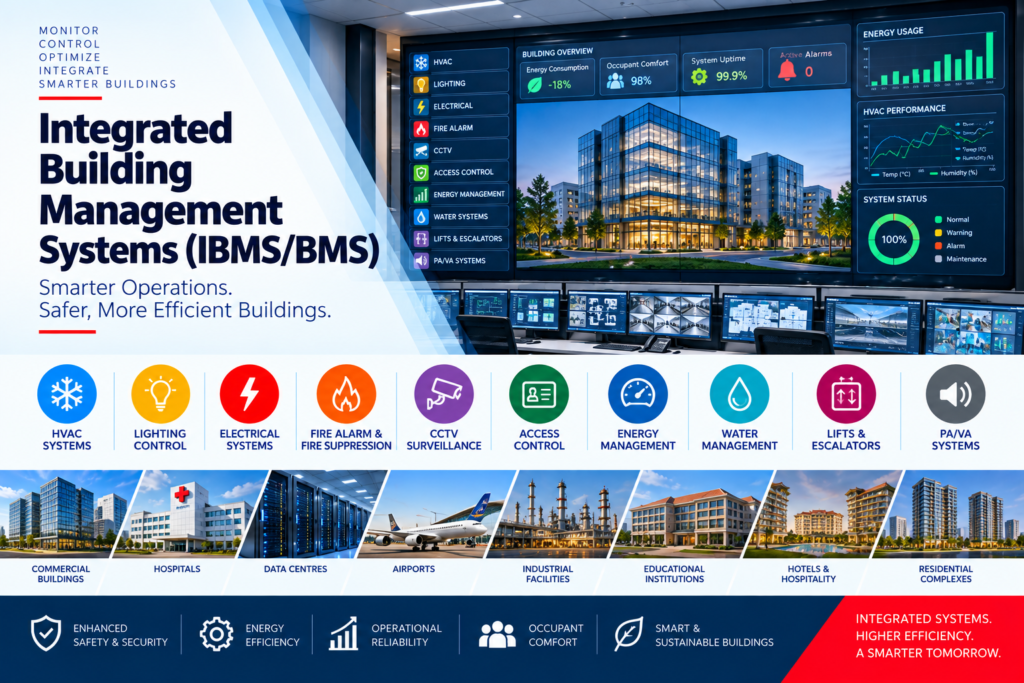
Integrated Building Management Systems (IBMS/BMS)
A Building Management System (BMS) is a centralized automation system that monitors and controls building services such as HVAC, lighting, electrical systems, water systems, and energy consumption. It improves operational efficiency, occupant comfort, and equipment performance.
An Integrated Building Management System (IBMS) combines the BMS with safety, security, and communication systems such as Fire Alarm, CCTV, Access Control, PA/VA, and Energy Management into a single centralized monitoring and control platform.
A BMS primarily controls mechanical and electrical building services, whereas an IBMS integrates multiple building systems, including safety, security, and automation, to provide centralized operation and intelligent decision-making.
BMS and IBMS improve energy efficiency, occupant comfort, operational reliability, and emergency response by automating building services and enabling centralized monitoring of all critical systems.
The primary objectives are to optimize energy usage, automate equipment operation, improve occupant comfort, enhance equipment reliability, reduce maintenance costs, and provide centralized monitoring and control.
Major components include supervisory servers, Building Automation Controllers (BAC), field controllers, sensors, actuators, Human Machine Interfaces (HMI), communication networks, workstations, databases, and integration gateways.
An IBMS can integrate HVAC, Fire Alarm, Fire Suppression, CCTV, Access Control, Lighting Control, Electrical Systems, DG Sets, UPS, Water Management, Energy Monitoring, Elevators, and PA/VA systems.
IBMS continuously monitors building performance, automates equipment operation, optimizes energy consumption, detects faults, and enables predictive maintenance, resulting in lower operating costs and improved system reliability.
IBMS provides centralized monitoring, improved energy efficiency, enhanced safety, better asset management, reduced operational costs, faster incident response, and seamless integration of multiple building systems.
Challenges include high initial investment, system integration complexity, interoperability between different OEMs, cybersecurity requirements, skilled manpower, and ongoing maintenance to ensure reliable operation.
A Building Management System is designed in a hierarchical architecture comprising field devices, field controllers, Building Automation Controllers (BAC), supervisory servers, operator workstations, and communication networks. This structure enables centralized monitoring and distributed control.
Building Automation Controllers (BAC) collect data from field devices, execute control logic, and communicate with supervisory systems. They automate HVAC, lighting, and utility equipment while ensuring reliable local control.
Field controllers directly control equipment such as AHUs, pumps, and valves, while supervisory controllers coordinate multiple field controllers, manage system-wide operations, and communicate with the central BMS server.
SCADA is primarily used for industrial process monitoring and control over large geographical areas, whereas BMS focuses on building automation and facility management. SCADA emphasizes process control, while BMS emphasizes building operations and occupant comfort.
Common BMS communication protocols include BACnet, Modbus, KNX, OPC, LonWorks, MQTT, and Ethernet/IP. These protocols enable seamless communication and interoperability between building automation devices.
BACnet is an open communication protocol specifically developed for building automation and control systems. It supports interoperability between different manufacturers, making it the preferred protocol for modern BMS and IBMS projects.
Modbus is a widely used industrial communication protocol for connecting controllers, meters, PLCs, and field devices. It is commonly used for integrating electrical panels, energy meters, HVAC equipment, and utility systems into the BMS.
KNX is an international building automation protocol used for controlling lighting, HVAC, blinds, energy management, and room automation. It provides decentralized intelligence and supports efficient smart building operations.
OPC (Open Platform Communications) is a standardized communication interface that enables secure data exchange between different automation systems. It simplifies integration between BMS, SCADA, PLCs, and enterprise software platforms.
Network redundancy is achieved using redundant servers, controllers, communication rings, dual network switches, backup power supplies, and failover communication paths. This ensures continuous system operation even if a network component fails.
An IBMS for commercial buildings is designed by integrating HVAC, lighting, electrical systems, Fire Alarm, CCTV, Access Control, and energy management into a centralized platform. The design focuses on energy efficiency, occupant comfort, and operational reliability.
Hospital IBMS integrates HVAC, medical gas monitoring, Fire Alarm, nurse call, CCTV, Access Control, UPS, and critical power systems. The design emphasizes redundancy, continuous monitoring, infection control, and uninterrupted operation of life-critical services.
Airport IBMS integrates HVAC, lighting, Fire Alarm, CCTV, Access Control, baggage handling interfaces, electrical systems, and utility monitoring. It provides centralized supervision for large-scale operations while ensuring high availability and passenger safety.
Metro rail IBMS integrates station HVAC, tunnel ventilation, Fire Alarm, SCADA, CCTV, Access Control, PA/VA, lifts, escalators, and power systems. The design supports real-time monitoring, redundancy, and centralized operation from the control centre.
Data Centre IBMS integrates cooling systems, UPS, DG sets, Fire Alarm, Gas Suppression, environmental monitoring, energy management, and DCIM platforms. The design prioritizes redundancy, continuous monitoring, and high system availability.
Industrial IBMS integrates HVAC, utility systems, Fire Alarm, SCADA, electrical distribution, process monitoring, and energy management. The design improves plant efficiency, equipment reliability, and operational safety in demanding environments.
BMS engineering includes calculations for controller capacity, network loading, sensor accuracy, cable sizing, power supply sizing, UPS backup, communication bandwidth, and I/O point schedules to ensure reliable system performance.
Control panels and field devices are selected based on the number of I/O points, communication protocols, environmental conditions, equipment compatibility, and project specifications. Scalability and future expansion are also considered during selection.
Sensors are selected according to measurement range, accuracy, environmental conditions, response time, mounting location, and compatibility with the BMS controller. Proper sensor selection ensures reliable monitoring and control.
HVAC control strategies are developed using occupancy schedules, temperature and humidity requirements, energy efficiency objectives, and equipment operating sequences. Control logic is programmed to optimize comfort while minimizing energy consumption.
IBMS interfaces with the Fire Alarm System to receive alarm, fault, and supervisory signals while initiating predefined actions such as HVAC shutdown, smoke control, elevator recall, and emergency notifications. Integration follows the approved Cause-and-Effect Matrix.
IBMS continuously monitors and controls HVAC equipment, including AHUs, FCUs, chillers, cooling towers, pumps, and VAV systems. It optimizes temperature, humidity, air quality, and energy consumption through automated control strategies.
IBMS monitors the status of clean agent, water mist, sprinkler, and hydrant systems, including alarms, valve positions, cylinder pressure, and pump operation. It provides centralized supervision without overriding life safety functions.
IBMS coordinates smoke extraction fans, pressurization fans, dampers, and HVAC shutdown during fire emergencies. It ensures proper smoke control in accordance with the programmed fire strategy and Cause-and-Effect Matrix.
IBMS receives events from CCTV and Video Management Systems (VMS) to display live camera feeds, alarm-triggered recordings, and incident locations. This enables operators to assess emergencies and respond more effectively.
IBMS exchanges information with Access Control Systems to monitor door status, occupancy, alarms, and emergency door releases. Integration improves security management and supports safe evacuation during emergencies.
IBMS interfaces with PA/VA systems to monitor system status and coordinate emergency announcements triggered by the Fire Alarm System. This integration ensures timely communication and controlled evacuation during incidents.
A Cause-and-Effect Matrix defines the logical relationship between input events and automated system responses across integrated building systems. It serves as the basis for programming, testing, and commissioning all emergency and operational sequences.
IBMS continuously monitors energy consumption, optimizes equipment scheduling, controls lighting and HVAC operation, and analyzes utility data. These functions reduce energy usage, operating costs, and carbon emissions while improving building sustainability.
IBMS enhances operational resilience through continuous monitoring, fault diagnostics, predictive maintenance, redundant system architecture, and centralized control of critical building services. This minimizes downtime and ensures uninterrupted building operations.
IBMS commissioning includes point-to-point I/O testing, controller functional testing, communication verification, graphics validation, alarm testing, Cause-and-Effect verification, integrated system testing, and operator training before final handover.
Factory Acceptance Testing (FAT) verifies the performance of controllers, software, operator workstations, communication gateways, and control panels at the manufacturer's facility. It ensures compliance with project specifications before equipment dispatch.
Site Acceptance Testing (SAT) confirms that the installed IBMS functions correctly under actual operating conditions. It includes subsystem testing, communication checks, control sequence verification, and integration with all connected building systems.
IBMS should be regularly inspected for controller performance, sensor calibration, communication network health, server operation, software updates, backups, and alarm functionality. Preventive maintenance ensures reliable long-term operation.
Common faults include sensor failures, controller malfunction, communication loss, software configuration errors, network failures, power supply issues, and incorrect control logic. Routine diagnostics and maintenance help prevent operational disruptions.
Cybersecurity risks are mitigated through network segmentation, firewalls, encrypted communication, role-based access control, multi-factor authentication, regular software updates, and continuous monitoring of network activity.
BMS and IBMS are governed by ASHRAE Guideline 13, BACnet (ASHRAE 135), IEC 60364, ISO 16484, NFPA 72, IS 2189, NBC India, and project-specific consultant specifications.
Consultants typically require approved OEM authorization, system architecture drawings, control philosophy, I/O schedules, network diagrams, compliance statements, FAT/SAT procedures, commissioning methodology, cybersecurity strategy, and similar project experience.
Interview questions commonly cover BMS architecture, communication protocols, HVAC control strategies, BACnet, Modbus, controller programming, system integration, Cause-and-Effect logic, commissioning procedures, and troubleshooting of integrated building systems.
The future of IBMS includes AI-driven predictive maintenance, IoT-enabled real-time monitoring, Digital Twins for virtual building simulation, cloud-based analytics, and autonomous building optimization. These technologies improve energy efficiency, operational resilience, and intelligent facility management.