
Q&A
Oil & Gas Fire Protection
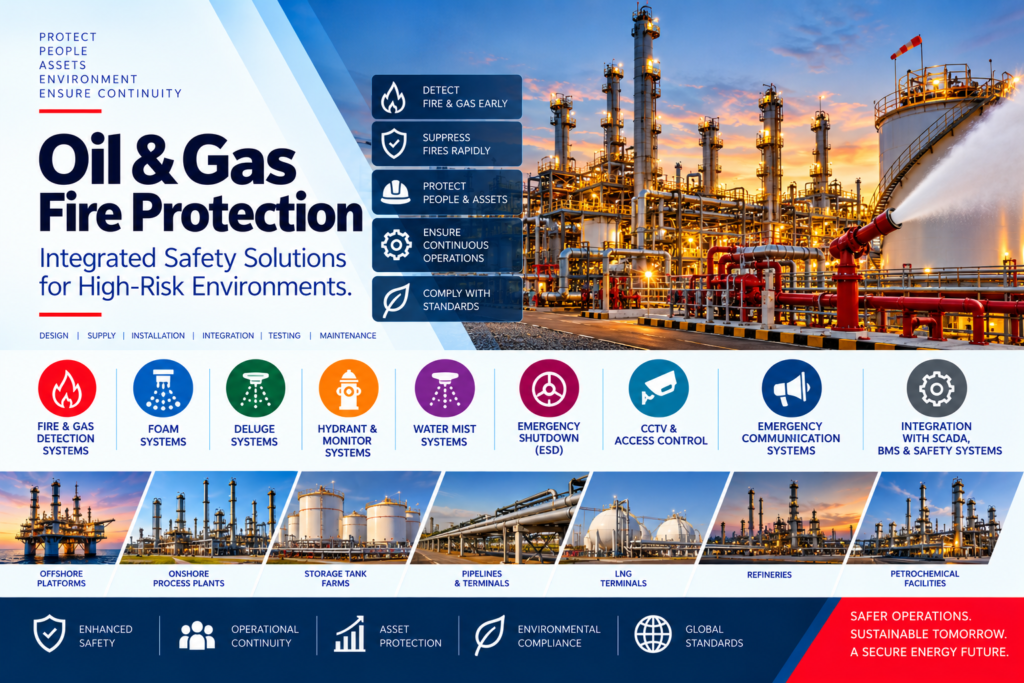
Oil & Gas Fire Protection is an integrated safety engineering system that detects, controls, and suppresses fires and gas hazards in upstream, midstream, and downstream facilities while protecting personnel, assets, and the environment.
Oil & Gas facilities handle flammable hydrocarbons, combustible gases, and high-energy processes that present significant fire and explosion risks. Effective fire protection minimizes loss of life, environmental impact, and production downtime.
Primary hazards include hydrocarbon leaks, vapor cloud explosions, pressurized gas releases, pool fires, jet fires, flash fires, electrical faults, hot work activities, and equipment failures in process plants.
The objectives are to detect fire and gas hazards at the earliest stage, suppress fires, prevent escalation, protect critical process equipment, support safe evacuation, and maintain operational continuity.
Major components include Fire & Gas (F&G) Systems, flame detectors, gas detectors, Fire Alarm Systems, foam systems, deluge systems, Water Mist, hydrants, monitors, fire pumps, clean agent systems, Emergency Shutdown (ESD), and emergency communication systems.
Active fire protection includes detection, alarm, suppression, and firefighting systems that operate during an incident, while passive fire protection includes fireproofing, fire-rated barriers, blast walls, and compartmentation to limit fire spread and structural damage.
Upstream facilities focus on wellhead, drilling, and offshore platform protection; midstream facilities protect pipelines, terminals, and LNG storage; downstream facilities emphasize refinery, petrochemical, storage tank, and process unit fire protection using risk-based engineering.
Fire risk assessments evaluate hazardous inventories, ignition sources, process conditions, equipment layout, consequence analysis, and emergency response requirements. The results determine fire protection philosophy and system design.
Common causes include hydrocarbon leakage, equipment failure, corrosion, overpressure, electrical faults, static electricity, hot work, human error, process upsets, and inadequate maintenance of safety systems.
Major incidents emphasize the importance of robust Fire & Gas detection, process safety management, Emergency Shutdown Systems, fireproofing, effective maintenance, operator training, and integrated emergency response to prevent catastrophic losses.
Fire Detection Systems are designed using flame detectors, heat detectors, smoke detectors, and Fire Alarm Panels based on hazard analysis, equipment layout, process conditions, and applicable safety standards. Detector selection depends on the specific fire risks in each process area.
Common flame detectors include UV, IR, UV/IR, and Multi-Spectrum IR (MSIR) detectors. The selection depends on fuel type, environmental conditions, response time, and the probability of false alarms.
UV detectors respond rapidly to ultraviolet radiation, IR detectors detect infrared energy from flames, and UV/IR detectors combine both technologies to improve detection reliability and reduce false alarms in hazardous environments.
Combustible gas detection systems use catalytic, infrared, or semiconductor sensors positioned near potential leak sources. Detector placement is based on gas density, ventilation patterns, equipment configuration, and hazardous area classification.
Toxic gas detection systems monitor hazardous gases such as H₂S, CO, NH₃, and Cl₂ using electrochemical or infrared sensors. Detector locations are selected based on process hazards, personnel exposure, and regulatory requirements.
Point gas detectors monitor gas concentration at a specific location, while open-path gas detectors measure gas presence over a long optical path between a transmitter and receiver. Open-path detectors provide wider area coverage for leak detection.
Fire & Gas Systems integrate fire detectors, gas detectors, Fire Alarm Panels, Emergency Shutdown (ESD), deluge systems, ventilation, SCADA, and Distributed Control Systems (DCS). Integration enables automatic emergency response based on predefined Cause-and-Effect logic.
Fire Alarm Systems transmit confirmed fire or gas alarms to the ESD System, which automatically isolates process equipment, closes emergency shutdown valves, stops pumps and compressors, and initiates fire suppression where required.
Detector locations are determined using hazard analysis, gas dispersion studies, Fire & Gas Mapping, equipment layout, prevailing wind direction, ventilation, leak sources, and hazardous area classification to achieve optimum detection coverage.
Common mistakes include incorrect detector placement, inadequate coverage, poor Fire & Gas Mapping, insufficient redundancy, improper hazardous area classification, lack of integration with ESD systems, and failure to perform regular testing and calibration.
Oil & Gas facilities use foam systems, deluge systems, Water Mist, sprinkler systems, dry chemical powder (DCP), clean agent systems, hydrant systems, fire monitors, and fixed firefighting systems. Selection depends on the hazard type and process risk.
Foam systems are designed based on hazard area, foam application rate, discharge duration, foam concentrate type, and hydraulic calculations. They are widely used for storage tanks, loading bays, bund areas, and hydrocarbon process units.
AFFF is used for hydrocarbon fuel fires, AR-AFFF is suitable for both hydrocarbon and polar solvent fires, while fluorine-free foam (F3) provides environmentally sustainable fire suppression without fluorinated compounds.
Water Mist Systems provide cooling, radiant heat attenuation, and fire suppression in turbines, machinery spaces, offshore platforms, engine rooms, cable tunnels, and electrical equipment areas while minimizing water consumption.
Deluge systems use open nozzles connected to dry piping and are activated by Fire & Gas Systems. Hydraulic calculations, nozzle density, water demand, zoning, and equipment exposure determine the system design.
Clean agent systems such as IG-541, IG-100, or FK-5-1-12 protect control rooms, substations, telecom rooms, MCC rooms, and server rooms. They extinguish fire without damaging sensitive electronic equipment.
Dry Chemical Powder (DCP) systems rapidly suppress flammable liquid and gas fires by interrupting the combustion process. They are commonly installed at loading terminals, LPG facilities, helipads, and hazardous process areas.
Fire Water Pump Systems are designed using hydraulic demand calculations and typically include electric pumps, diesel pumps, and jockey pumps. They provide reliable water supply to hydrants, monitors, deluge systems, sprinklers, and foam systems.
Hydrant and monitor systems are designed to ensure complete coverage of process units, storage tanks, and hazardous areas. Design includes hydrant spacing, monitor flow rates, operating pressure, accessibility, and hydraulic network analysis.
Common challenges include protecting high-risk process units, ensuring adequate water supply, corrosion resistance, hazardous area compliance, environmental conditions, redundancy, and integration with Fire & Gas and Emergency Shutdown Systems.
The design is based on hazard identification (HAZID), fire risk assessment, process safety requirements, and consequence analysis. It integrates Fire & Gas (F&G), suppression systems, Emergency Shutdown (ESD), SCADA/DCS, emergency communication, and passive fire protection.
Hazardous areas are classified according to the probability and duration of flammable gas or vapor presence. Classification is typically defined as Zone 0, Zone 1, and Zone 2 in accordance with IEC and ATEX standards.
Fire & Gas Mapping determines the optimum location and coverage of flame and gas detectors using hazard analysis and software modelling. It ensures effective detection while minimizing blind spots and false alarms.
Fire Protection Systems transmit confirmed fire or gas signals to the ESD System, which automatically isolates process equipment, shuts down critical operations, closes emergency valves, and initiates suppression systems based on Cause-and-Effect logic.
SCADA and DCS receive alarms, equipment status, and supervisory signals from Fire Protection Systems for centralized monitoring and automatic control. Integration enables coordinated emergency response and process shutdown.
Fire Protection Systems interface with BMS to control HVAC shutdown, smoke extraction, fire dampers, emergency ventilation, and building utilities. Integration improves operational coordination during fire emergencies.
A Cause-and-Effect Matrix defines the automatic sequence of actions following fire or gas detection, including alarm activation, ESD initiation, suppression release, ventilation control, equipment shutdown, and emergency notifications.
Emergency response strategies are developed through hazard analysis, escape route planning, emergency assembly areas, fire scenario modelling, and coordination with plant emergency response procedures to ensure safe personnel evacuation.
The System Integrator is responsible for engineering, installation, software configuration, testing, commissioning, and integration of Fire & Gas Systems, SCADA, DCS, ESD, suppression systems, and emergency communication to achieve seamless operation.
Fire Protection Systems minimize equipment damage, prevent process escalation, reduce production downtime, and enable rapid recovery after incidents. Redundant system architecture and automated emergency response improve overall plant reliability.
Installation shall comply with approved engineering drawings, OEM instructions, hazardous area requirements, and project specifications. Equipment, cabling, piping, detectors, and control panels shall be installed with proper earthing, segregation, accessibility, and corrosion protection.
FAT verifies Fire & Gas Controllers, flame and gas detectors, Fire Alarm Panels, ESD interfaces, suppression logic, communication protocols, software configuration, and Cause-and-Effect sequences before equipment dispatch.
SAT includes detector calibration, functional testing, gas simulation, flame detector verification, suppression system operation, communication checks, ESD integration, SCADA/DCS interfaces, and complete Cause-and-Effect validation under site conditions.
Commissioning includes point-to-point verification, loop checks, detector calibration, Cause-and-Effect testing, integrated ESD validation, suppression system testing, operator training, and documentation before final system acceptance.
Preventive maintenance includes inspection and calibration of flame and gas detectors, Fire Alarm Panels, suppression systems, fire pumps, hydrants, monitors, valves, batteries, communication networks, and periodic functional testing in accordance with maintenance schedules.
Common failures include detector contamination, sensor drift, communication faults, valve malfunction, pump failure, controller faults, power supply issues, and software configuration errors. Diagnosis is performed using diagnostics, event logs, calibration tests, and functional verification.
Oil & Gas Fire Protection Systems are designed in accordance with NFPA 11, NFPA 15, NFPA 16, NFPA 20, NFPA 24, NFPA 30, NFPA 72, NFPA 2001, API 2001, API 2030, API 2218, IEC 60079, IEC 61511, OISD Standards, PESO Regulations, IS 2189, and NBC India, along with project-specific consultant specifications.
Consultants typically require approved OEM authorization, Fire & Gas Mapping reports, hazardous area classification drawings, hydraulic calculations, foam system calculations, Cause-and-Effect Matrix, FAT/SAT procedures, commissioning methodology, QA/QC documentation, compliance statements, and evidence of similar project experience.
Interview questions commonly cover Fire & Gas Systems, flame and gas detectors, hazardous area classification, foam systems, deluge systems, Water Mist, ESD integration, Fire & Gas Mapping, API/NFPA standards, commissioning procedures, and Cause-and-Effect Matrix.
Future Oil & Gas Fire Protection will leverage AI-based hazard detection, Digital Twin simulation, IoT-enabled Fire & Gas monitoring, predictive maintenance, autonomous inspection, hydrogen safety systems, carbon capture facility protection, and intelligent emergency response platforms to improve safety, reliability, and operational efficiency.