
Q&A
Public Address & Voice Alarm (PA/VA) Systems
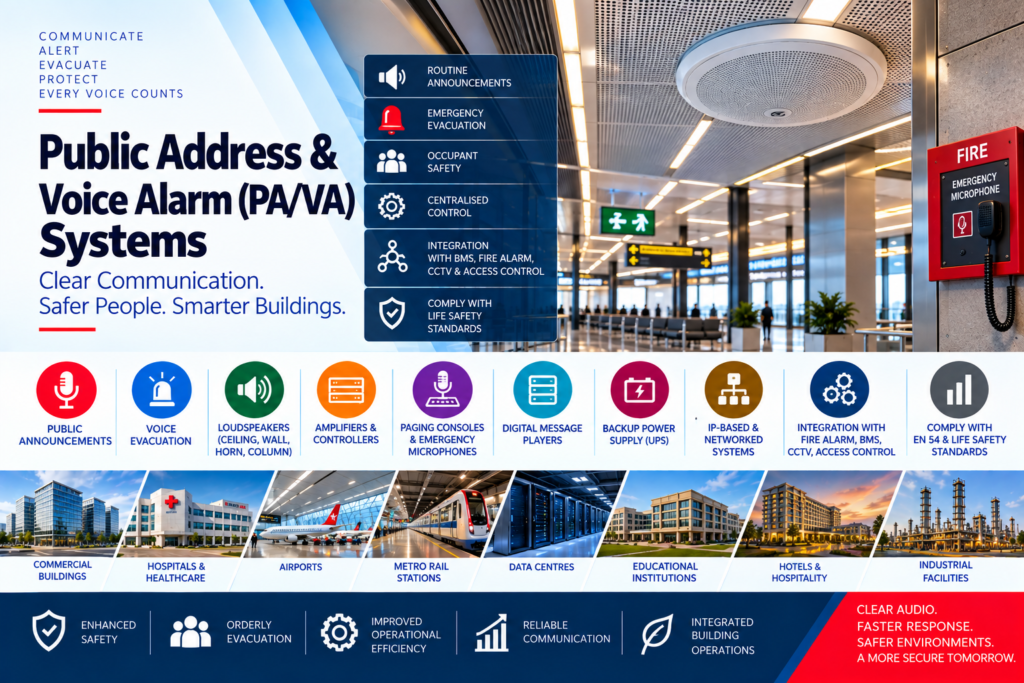
A Public Address & Voice Alarm (PA/VA) System is an integrated communication system used to broadcast routine announcements and emergency voice messages. It provides clear audio communication for occupant information, evacuation, and life safety.
PA/VA Systems enable rapid dissemination of emergency instructions, improve occupant safety, support orderly evacuation, and provide centralized communication during normal operations and emergency situations.
A Public Address (PA) System is primarily used for routine announcements, while a Voice Alarm (VA) System is specifically designed to broadcast pre-recorded or live emergency evacuation messages. VA Systems are integrated with Fire Alarm Systems and comply with life safety standards.
The primary objectives are to provide clear voice communication, support emergency evacuation, deliver routine announcements, improve occupant safety, and integrate with other building systems for coordinated emergency response.
Major components include amplifiers, loudspeakers, emergency microphones, paging consoles, digital message players, controllers, network switches, backup power supplies, monitoring modules, and communication interfaces.
Upon receiving a signal from the Fire Alarm System, the PA/VA System automatically broadcasts pre-recorded evacuation messages or enables live announcements through emergency microphones. Message priority is managed according to the programmed emergency sequence.
PA/VA Systems include conventional analog systems, digital voice evacuation systems, IP-based networked systems, distributed audio systems, and fully integrated emergency communication systems. Selection depends on building size and operational requirements.
Integrated PA/VA Systems provide centralized monitoring, automated emergency messaging, flexible zoning, remote operation, improved speech intelligibility, and seamless integration with Fire Alarm, BMS, CCTV, and Access Control Systems.
Challenges include maintaining speech intelligibility in noisy environments, ensuring system redundancy, minimizing network latency, managing large distributed systems, and complying with applicable life safety standards.
The System Integrator designs, installs, configures, tests, commissions, and integrates the PA/VA System with Fire Alarm, BMS, CCTV, and other building systems. They ensure compliance with project specifications and emergency communication requirements.
Amplifiers increase low-level audio signals from microphones or message players to a power level sufficient to drive loudspeakers. They provide clear audio distribution while continuously monitoring output performance and fault conditions.
Common loudspeakers include ceiling speakers, wall-mounted speakers, horn speakers, column speakers, projector speakers, and cabinet speakers. The selection depends on the application, acoustic environment, and coverage requirements.
Ceiling speakers are used for indoor areas with uniform sound distribution, wall-mounted speakers for corridors and rooms, horn speakers for high-noise outdoor or industrial environments, and column speakers for long, narrow spaces requiring controlled sound dispersion.
Speaker coverage is the area effectively served by a loudspeaker while maintaining the required sound pressure level and intelligibility. It is calculated based on speaker characteristics, mounting height, room acoustics, and coverage angle.
Speech intelligibility measures how clearly spoken messages are understood by listeners. High intelligibility is essential during emergencies to ensure occupants receive and follow evacuation instructions correctly.
The Speech Transmission Index (STI) is an internationally recognized parameter that evaluates speech intelligibility on a scale from 0 to 1, where higher values indicate clearer speech. It is widely used to verify Voice Alarm System performance.
EN 54 is the European standard governing Fire Detection and Voice Alarm Systems. Components such as amplifiers, loudspeakers, microphones, and controllers must comply with applicable EN 54 parts to ensure reliable emergency operation.
Loudspeaker line monitoring continuously supervises speaker circuits for open circuits, short circuits, earth faults, and impedance changes. It ensures faults are detected immediately without interrupting system operation.
Backup amplifiers automatically replace failed amplifiers, while redundant controllers maintain system operation if the primary controller becomes unavailable. These redundancy features improve system availability and compliance with life safety requirements.
Emergency microphones and paging consoles are designed with priority override capability, supervised communication circuits, programmable zone selection, and fault monitoring. They enable authorized personnel to broadcast live announcements during emergencies.
A PA/VA System is designed by evaluating building occupancy, evacuation strategy, acoustic conditions, zoning requirements, and applicable standards. The design includes speaker layout, amplifier sizing, cable routing, system redundancy, and integration with Fire Alarm Systems.
Speaker layouts are based on room dimensions, occupancy, ceiling height, ambient noise, and required sound coverage. Zoning is established according to fire compartments, evacuation strategy, and operational requirements for selective announcements.
Amplifier capacity is calculated by summing the power ratings of all connected loudspeakers within a zone and adding a design margin, typically 20–25%, to accommodate future expansion and ensure reliable operation.
Cable sizes are selected based on speaker load, cable length, permissible voltage drop, and conductor resistance. Proper sizing ensures consistent audio output and minimizes power loss across the 100V distribution network.
Commercial PA/VA Systems provide zoned announcements for offices, lobbies, retail spaces, parking areas, and emergency exits. They integrate with Fire Alarm, BMS, and Access Control Systems to support routine communication and emergency evacuation.
Airport PA/VA Systems provide high speech intelligibility across terminals, boarding gates, baggage areas, and public spaces. The design incorporates redundant controllers, distributed amplifiers, IP networking, and multilingual announcement capability.
Metro PA/VA Systems serve stations, platforms, concourses, depots, and tunnels using distributed audio architecture. They integrate with SCADA, Fire Alarm, Passenger Information Systems (PIS), and Operation Control Centres for coordinated emergency communication.
Tunnel PA/VA Systems use weatherproof, high-output horn or column speakers designed to overcome high ambient noise and long reverberation times. The system integrates with tunnel ventilation, SCADA, Fire Alarm, and emergency response systems.
Industrial PA/VA Systems use horn speakers and rugged equipment suitable for harsh environments with high background noise. The design emphasizes reliability, redundancy, hazardous area compatibility where required, and integration with plant emergency systems.
Engineering calculations include speaker coverage, sound pressure level (SPL), Speech Transmission Index (STI), amplifier loading, cable voltage drop, battery backup capacity, network loading, and system availability to ensure compliance with design standards.
PA/VA Systems receive alarm signals from the Fire Alarm System to automatically broadcast pre-recorded evacuation messages or enable live emergency announcements. Integration follows the approved Cause-and-Effect Matrix and emergency sequence of operation.
PA/VA Systems exchange operational status, fault indications, and alarm information with the BMS for centralized monitoring. This integration enables operators to supervise emergency communication systems from a single interface.
CCTV integration allows operators to verify incidents visually while broadcasting emergency announcements to affected areas. Live video assists in assessing evacuation progress and coordinating emergency response.
PA/VA Systems coordinate with Access Control Systems during emergencies by broadcasting evacuation instructions while designated doors are automatically released. This supports orderly occupant movement and emergency egress.
SCADA and Command Centres monitor PA/VA system health, alarm status, amplifier conditions, and paging activities. Operators can initiate live announcements, monitor faults, and manage emergency communications from a centralized control room.
Phased evacuation is a strategy where occupants are evacuated in predefined zones rather than simultaneously. PA/VA Systems broadcast zone-specific evacuation messages based on the programmed fire scenario and Cause-and-Effect Matrix.
A Cause-and-Effect Matrix defines the sequence of automatic actions between the Fire Alarm System and PA/VA System, including message selection, zone activation, live paging priority, and emergency announcements for different fire scenarios.
PA/VA Systems provide clear, intelligible voice instructions that reduce panic, guide occupants toward safe exits, and support coordinated evacuation. Voice messages are more effective than conventional alarm tones in directing emergency response.
PA/VA Systems enable rapid emergency communication, minimize evacuation time, and assist in restoring normal operations after an incident. Redundant system architecture and fault monitoring ensure continuous availability during critical events.
AI enhances PA/VA Systems through intelligent message routing, adaptive evacuation strategies, multilingual announcements, predictive fault diagnostics, and integration with smart building platforms. These capabilities improve emergency communication efficiency and operational reliability.
Commissioning includes loudspeaker functional testing, amplifier performance verification, microphone testing, speech intelligibility (STI) measurement, zoning verification, battery backup testing, fault monitoring, and integrated Cause-and-Effect testing with the Fire Alarm System.
Factory Acceptance Testing (FAT) verifies the performance of controllers, amplifiers, loudspeakers, paging consoles, emergency microphones, software, and network interfaces before dispatch. It confirms compliance with project specifications and OEM requirements.
Site Acceptance Testing (SAT) validates the installed PA/VA System under actual site conditions. It includes functional testing, zoning verification, live and prerecorded announcements, speech intelligibility measurements, and integration with Fire Alarm and BMS.
PA/VA Systems should be periodically inspected for amplifier health, loudspeaker operation, microphone functionality, cable integrity, battery condition, software updates, and communication network status. Preventive maintenance ensures reliable emergency operation.
Common faults include amplifier failure, loudspeaker line faults, microphone malfunction, cable damage, controller communication errors, power supply failures, battery degradation, and software configuration issues. Continuous system monitoring enables early fault detection.
Cybersecurity risks are minimized through network segmentation, encrypted communication, secure authentication, role-based access control, firewall protection, firmware updates, and continuous monitoring of IP network traffic.
PA/VA Systems are designed in accordance with EN 54-16, EN 54-24, IEC 60849 (superseded by ISO 7240-19 where applicable), IS 2189, NBC India, and project-specific consultant specifications. Compliance with local fire authority requirements is also essential.
Consultants typically require approved OEM authorization, speaker layout drawings, amplifier calculations, Speech Intelligibility (STI) calculations, battery backup calculations, Cause-and-Effect Matrix, FAT/SAT procedures, commissioning methodology, and evidence of similar project experience.
Interview questions commonly cover amplifier sizing, speaker selection, 100V line systems, Speech Transmission Index (STI), EN 54 compliance, zoning, battery calculations, Fire Alarm integration, commissioning procedures, and troubleshooting of PA/VA Systems.
Future PA/VA Systems will leverage IP-based audio distribution, AI-assisted emergency communication, cloud-based management, Digital Twins, IoT connectivity, and predictive diagnostics. These technologies will improve scalability, speech intelligibility, operational resilience, and intelligent emergency response.