
Q&A
Tunnel Fire Safety
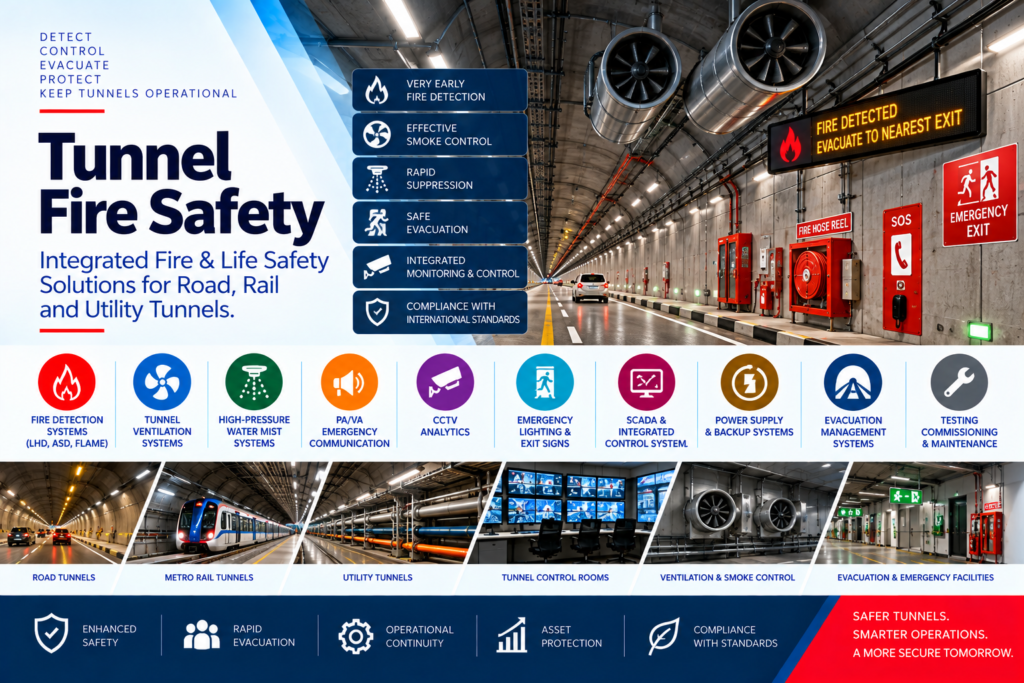
Tunnel Fire Safety is the engineering discipline that protects road, rail, and utility tunnels from fire hazards through integrated fire detection, smoke control, suppression, emergency communication, evacuation, and life safety systems.
Tunnel fires generate high temperatures, rapid smoke propagation, and limited evacuation routes. Effective fire safety systems protect occupants, infrastructure, and ensure continuity of transportation services.
The objectives are to detect fires early, control smoke movement, facilitate safe evacuation, support emergency responders, minimize structural damage, and restore tunnel operations with minimal downtime.
Major hazards include vehicle collisions, fuel spills, electrical faults, overheating equipment, hazardous cargo, cable fires, mechanical failures, and stationary vehicle fires that can generate significant heat release rates.
Tunnel fires produce confined heat and smoke, limited ventilation, restricted access for firefighters, and prolonged evacuation distances. These conditions require specialized smoke control, suppression, and emergency response strategies.
Major components include Fire Detection Systems, Linear Heat Detection (LHD), CCTV analytics, Fire Alarm Systems, tunnel ventilation, High-Pressure Water Mist, SCADA, PA/VA Systems, Emergency Communication Systems, and emergency lighting.
Performance-Based Fire Engineering (PBFE) evaluates fire scenarios, smoke movement, evacuation, and structural performance using engineering analysis and simulations. It optimizes tunnel safety beyond prescriptive code requirements.
Fire scenarios are developed by considering tunnel geometry, vehicle types, traffic density, heat release rates, ventilation performance, evacuation time, and emergency response objectives. These scenarios define the design basis for all fire safety systems.
Fire growth is influenced by fuel type, vehicle load, ventilation velocity, tunnel geometry, combustible materials, ambient conditions, and the effectiveness of fire detection and suppression systems.
Major incidents have demonstrated the importance of very early fire detection, effective smoke control, reliable emergency communication, rapid suppression, integrated control systems, and well-planned evacuation strategies to minimize casualties and infrastructure damage.
Tunnel Fire Detection Systems are designed using a combination of Linear Heat Detection (LHD), Aspirating Smoke Detection (ASD), flame detectors, CCTV analytics, and addressable Fire Alarm Systems. The design is based on tunnel length, ventilation, traffic density, and fire risk assessment.
Common detectors include Linear Heat Detection (LHD) cables, Aspirating Smoke Detection (ASD/VESDA), flame detectors (UV/IR), spot heat detectors, smoke detectors in equipment rooms, and video image detection systems for rapid fire identification.
Linear Heat Detection (LHD) continuously monitors temperature along the entire tunnel length using heat-sensitive cables. It provides fast fire location, high reliability, and excellent performance in dusty, humid, and harsh tunnel environments.
ASD/VESDA systems continuously sample air to detect very low smoke concentrations before visible fire develops. They are commonly used in tunnel control rooms, equipment rooms, cable galleries, and enclosed technical spaces.
Flame detectors identify ultraviolet (UV), infrared (IR), or combined UV/IR radiation emitted by flames. They are installed in tunnel portals, hazardous equipment rooms, fuel handling areas, and locations requiring rapid flame detection.
Intelligent CCTV systems use AI-based video analytics to detect smoke, flames, stopped vehicles, wrong-way driving, pedestrians, and traffic incidents. These systems provide rapid incident detection and improve tunnel operational safety.
Fire Alarm Systems interface with SCADA, tunnel ventilation, Water Mist Systems, PA/VA, Emergency Communication, CCTV, traffic management, and emergency lighting systems. Integration ensures coordinated emergency response according to the approved Cause-and-Effect Matrix.
Detector spacing and zoning are determined by tunnel length, ventilation characteristics, fire load, traffic flow, equipment locations, and applicable standards. Proper zoning enables rapid fire localization and selective emergency response.
Common challenges include high airflow, dust, humidity, vehicle exhaust emissions, vibration, long cable distances, temperature variations, and maintaining reliable detection in harsh operating environments.
False alarms are minimized through multi-sensor detection, intelligent alarm verification, proper detector selection, optimized sensitivity settings, AI-based video analytics, regular maintenance, and effective system integration.
Smoke management controls the movement of hot gases and smoke to maintain tenable conditions for evacuation and firefighter access. It improves visibility, reduces toxic gas exposure, and limits heat accumulation during tunnel fires.
Tunnel ventilation systems include longitudinal, transverse, semi-transverse, and point extraction ventilation. The selection depends on tunnel length, traffic type, fire scenarios, and ventilation performance requirements.
Longitudinal ventilation uses jet fans to move air and smoke along the tunnel axis toward the portal or exhaust point. It is commonly used in short and medium-length road tunnels with unidirectional or bidirectional traffic.
Transverse ventilation supplies and exhausts air through dedicated ducts along the tunnel length, while semi-transverse systems use either distributed supply or exhaust with localized airflow. These systems are preferred for long tunnels with high traffic volumes.
Jet fans are selected based on tunnel geometry, traffic conditions, fire heat release rate (HRR), required Critical Ventilation Velocity (CVV), pressure losses, and Computational Fluid Dynamics (CFD) analysis. Their arrangement ensures effective smoke movement during fire events.
Critical Ventilation Velocity (CVV) is the minimum airflow required to prevent smoke back-layering upstream of a tunnel fire. Maintaining CVV ensures clear evacuation routes and improves firefighter access to the incident location.
Computational Fluid Dynamics (CFD) simulations model fire growth, smoke propagation, temperature distribution, airflow patterns, and evacuation conditions. They validate ventilation design, smoke control strategies, and overall tunnel fire safety performance.
High-Pressure Water Mist Systems are designed based on tunnel geometry, fire hazard analysis, nozzle spacing, operating pressure, hydraulic calculations, zoning, and activation logic. They provide rapid cooling, smoke suppression, and radiant heat reduction with minimal water consumption.
Water Mist uses significantly less water while providing efficient cooling, smoke suppression, radiant heat attenuation, and reduced water damage. It is particularly effective in confined tunnel environments where drainage and visibility are critical.
Tunnel suppression design considers heat release rate, tunnel dimensions, nozzle arrangement, hydraulic calculations, water supply reliability, system redundancy, activation sequence, drainage, ventilation interaction, and integration with Fire Alarm and SCADA systems.
Tunnel evacuation strategies are developed based on tunnel geometry, occupancy, traffic volume, fire scenarios, evacuation time analysis, and smoke movement. The objective is to provide safe egress routes and minimize occupant exposure to heat and smoke.
Emergency exits provide direct escape routes, cross passages connect parallel tunnels or escape routes, and refuge areas offer temporary safe locations until evacuation or rescue is completed. Their spacing is determined by tunnel design standards and risk assessment.
PA/VA Systems broadcast live or pre-recorded emergency messages to guide occupants during evacuation. They provide zone-specific instructions and integrate with Fire Alarm and SCADA systems for coordinated emergency response.
Emergency Communication Systems integrate emergency telephones, SOS call stations, Help Points, Firefighter Telephones, and control room communication. They provide reliable two-way communication between tunnel users, operators, and emergency responders.
Fire Detection Systems transmit alarm, fault, and supervisory signals to SCADA for centralized monitoring and automatic control of ventilation, Water Mist, traffic signals, lighting, and emergency communication systems.
Fire alarms automatically trigger CCTV camera display, video recording, and incident verification, while ITS activates lane control signs, traffic barriers, variable message signs (VMS), and traffic diversion measures to protect tunnel users.
A Cause-and-Effect Matrix defines the sequence of automatic actions initiated during a tunnel fire, including fire detection, ventilation control, Water Mist activation, PA/VA announcements, traffic management, emergency lighting, and SCADA responses.
Tunnel Fire Safety Systems minimize infrastructure damage, reduce traffic disruption, improve incident response, and enable faster restoration of tunnel operations through integrated monitoring, suppression, and emergency management.
The System Integrator coordinates the design, installation, integration, testing, and commissioning of Fire Alarm, Water Mist, ventilation, SCADA, CCTV, PA/VA, ITS, and Emergency Communication Systems to ensure seamless operation and compliance.
Emergency response should be coordinated through the Tunnel Control Centre using integrated SCADA, Fire Alarm, CCTV, PA/VA, Emergency Communication, and ITS systems. Predefined emergency procedures and coordinated communication ensure rapid incident management and safe evacuation.
Installation shall comply with approved drawings, OEM instructions, and project specifications. Fire detection devices, Water Mist piping, ventilation equipment, SCADA interfaces, PA/VA systems, and communication networks shall be installed with proper protection, labeling, redundancy, and accessibility.
FAT verifies the operation of Fire Alarm Panels, Linear Heat Detection, Water Mist controllers, ventilation control logic, SCADA interfaces, communication systems, and software functions. It confirms compliance with approved design documents before dispatch.
SAT includes detector functional testing, Water Mist activation verification, ventilation control testing, SCADA communication, CCTV integration, PA/VA operation, Emergency Communication Systems, and complete Cause-and-Effect validation under site conditions.
Commissioning includes point-to-point verification, functional testing of all subsystems, integrated Cause-and-Effect testing, emergency scenario validation, operator training, and documentation to ensure the entire tunnel fire safety system operates as designed.
Preventive maintenance includes inspection of Fire Alarm devices, Linear Heat Detection cables, Water Mist pumps and nozzles, jet fans, SCADA equipment, PA/VA systems, emergency communication devices, batteries, and communication networks. Regular testing ensures continuous operational readiness.
Common failures include detector faults, LHD cable damage, Water Mist pump failures, ventilation malfunction, SCADA communication loss, power supply failure, controller faults, and software configuration errors. Diagnosis is performed using event logs, system diagnostics, and functional testing.
Tunnel Fire Safety is governed by NFPA 502, NFPA 72, NFPA 750, PIARC Tunnel Guidelines, ITA Guidelines, EN 54 Series, IEC 61508, IS 2189, NBC India, and project-specific specifications issued by authorities such as MMRDA, DMRC, NHAI, and MoRTH.
Consultants typically require approved OEM authorization, hydraulic calculations, CFD analysis, ventilation calculations, Water Mist design calculations, Cause-and-Effect Matrix, FAT/SAT procedures, commissioning methodology, compliance statements, and evidence of similar tunnel project experience.
Interview questions commonly cover Linear Heat Detection (LHD), Critical Ventilation Velocity (CVV), CFD modelling, Water Mist Systems, jet fan design, smoke management, SCADA integration, Cause-and-Effect Matrix, tunnel evacuation, commissioning procedures, and applicable international standards.
Future Tunnel Fire Safety systems will leverage AI-based fire detection, Digital Twin simulation, IoT-enabled monitoring, predictive analytics, autonomous inspection systems, intelligent ventilation control, and cloud-integrated SCADA platforms. These technologies improve fire prediction, operational resilience, and emergency response efficiency.