
Q&A
Water Mist Fire Suppression
A Water Mist Fire Suppression System uses fine water droplets, typically less than 1000 microns, to extinguish fires by cooling the flame, displacing oxygen locally, and reducing radiant heat. It provides efficient fire suppression with significantly less water than conventional sprinkler systems.
Water Mist suppresses fire by rapidly absorbing heat, converting water into steam, reducing oxygen concentration around the flame, and blocking radiant heat. These combined mechanisms interrupt the fire triangle and extinguish the fire quickly.
Water Mist uses high-pressure fine droplets with low water consumption, while conventional sprinklers discharge large volumes of water at lower pressure. Water Mist provides faster cooling, reduced water damage, and improved protection for sensitive equipment.
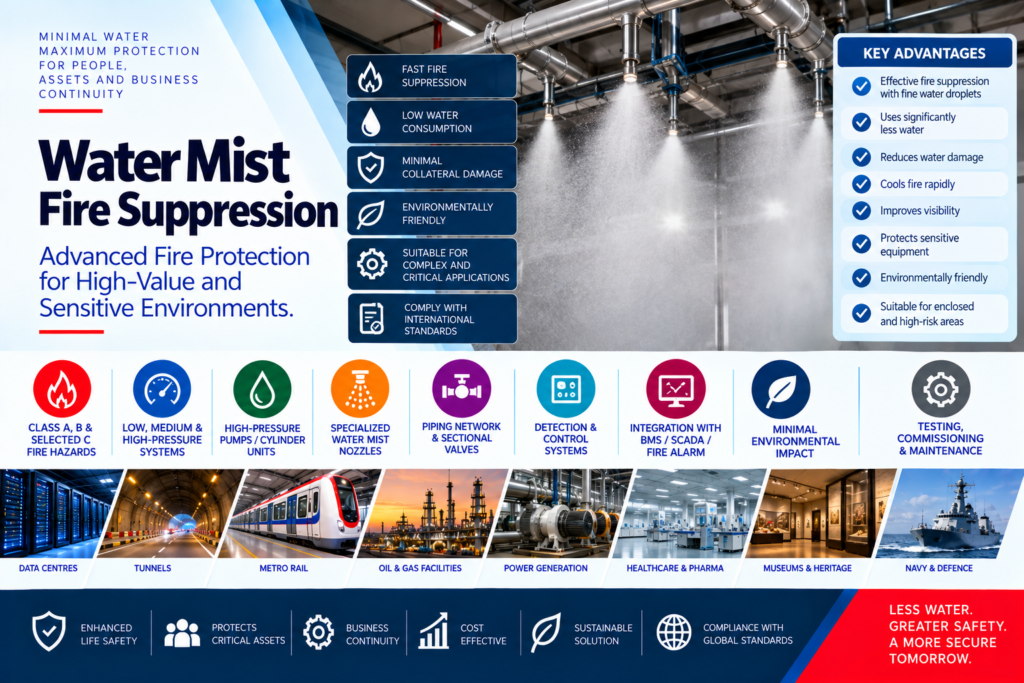
Water Mist provides effective fire suppression using minimal water while reducing collateral damage, improving firefighter visibility, and protecting sensitive equipment. Its performance-based design makes it suitable for complex and high-value applications.
Water Mist systems are classified as Low-Pressure, Medium-Pressure, and High-Pressure systems based on their operating pressure. Each type is selected according to the hazard, application, and performance requirements.
Low-pressure systems operate below 12.5 bar, medium-pressure systems operate between 12.5 and 35 bar, and high-pressure systems operate above 35 bar, often up to 140–200 bar. Higher pressure produces finer droplets and improved suppression efficiency.
Water Mist systems are effective for Class A, Class B, and selected Class C fire hazards where permitted by applicable standards and manufacturer approvals. System selection depends on hazard classification and fire test certification.
Water Mist uses significantly less water, minimizes water damage, cools fires rapidly, improves visibility, and is environmentally friendly. It is particularly suitable for protecting sensitive equipment and confined spaces.
Water Mist performance depends on nozzle design, operating pressure, enclosure conditions, and ventilation. It is not suitable for every fire hazard and should only be applied where supported by full-scale fire testing and approved standards.
A Water Mist system consists of a water supply, high-pressure pumps or cylinder units, piping network, discharge nozzles, sectional valves, control panels, detection system, pressure gauges, filters, and monitoring devices that operate together to detect and suppress fire.
Smaller water droplets provide a larger surface area, allowing faster heat absorption and steam generation. This improves cooling efficiency, suppresses flames more rapidly, and reduces overall water consumption.
Water Mist absorbs large amounts of heat as droplets evaporate, reducing the fire temperature below its ignition point. This cooling effect is the primary mechanism for suppressing most Class A and Class B fires.
As water droplets convert into steam, they expand rapidly and locally displace oxygen around the flame. This reduces the oxygen available for combustion while enhancing the cooling effect.
Fine water droplets absorb and scatter radiant heat energy, reducing heat transfer to nearby combustible materials. This limits fire spread and protects adjacent equipment and structural components.
During evaporation, water expands into steam, creating a localized reduction in oxygen concentration around the fire. This assists in suppressing combustion without significantly affecting oxygen levels throughout the entire room.
Higher operating pressure produces finer water droplets with greater surface area, resulting in improved heat absorption, better steam generation, and more effective fire suppression. The required pressure depends on the nozzle design and hazard application.
Nozzle design determines droplet size, spray pattern, discharge density, and coverage area. Proper nozzle selection ensures uniform water distribution and effective suppression for the specific fire hazard.
Strong ventilation can disperse water mist and steam, reducing suppression efficiency and increasing extinguishment time. Ventilation systems should be coordinated with the fire strategy to maintain effective mist concentration during discharge.
Room size, ceiling height, obstructions, and ventilation influence water mist distribution and fire suppression performance. Proper hydraulic design and nozzle placement are essential to achieve complete hazard coverage.
Suppression time depends on fire size, hazard type, nozzle arrangement, operating pressure, water flow rate, ventilation conditions, and system response time. Correct engineering design ensures rapid and reliable fire control.
A Water Mist system is designed by assessing the fire hazard, occupancy, enclosure dimensions, operating pressure, water demand, and applicable standards. The design includes hydraulic calculations, nozzle layout, pump selection, piping network, and integration with fire detection systems.
Nozzles are selected based on hazard classification, discharge characteristics, operating pressure, droplet size, spray pattern, and manufacturer fire test approvals. The selected nozzle must provide complete coverage and meet the required suppression performance.
Hydraulic calculations determine pipe sizes, flow rates, pressure losses, nozzle discharge pressure, and pump capacity. OEM-approved hydraulic software is used to ensure uniform water distribution and compliance with the system design criteria.
Pump selection is based on the required operating pressure, total flow demand, number of simultaneously operating nozzles, and system pressure losses. High-pressure pumps are designed to deliver consistent pressure throughout the entire discharge duration.
Pipe networks are designed to minimize pressure loss while maintaining the required flow and discharge pressure at every nozzle. Pipe sizing, routing, supports, and material selection must comply with manufacturer recommendations and applicable standards.
Tunnel Water Mist systems require careful consideration of tunnel geometry, ventilation, fire load, nozzle spacing, drainage, and integration with SCADA, CCTV, ventilation, and emergency communication systems. The design should be supported by full-scale fire testing and performance-based engineering.
Data Centre Water Mist systems are designed to protect high-value electronic equipment while minimizing water damage. The design includes fast fire detection, automatic system activation, and coordination with HVAC, clean agent systems (where applicable), and Building Management Systems.
Gas turbine enclosures require high-pressure Water Mist systems capable of rapidly cooling hot surfaces and suppressing fuel fires. The design should ensure complete coverage of turbines, lubrication systems, and associated fire hazards.
Water Mist systems for transformers and electrical rooms are designed to suppress fires while minimizing equipment damage and electrical hazards. Nozzle placement and discharge density should comply with manufacturer fire test approvals and project specifications.
Marine Water Mist systems are designed to withstand vessel movement, vibration, corrosion, and limited space while protecting engine rooms, machinery spaces, accommodation areas, and cargo compartments. The design must comply with IMO, SOLAS, and classification society requirements.
Water Mist systems are widely used in road and metro tunnels, data centres, gas turbine enclosures, transformer rooms, museums, heritage buildings, marine vessels, hospitals, commercial buildings, and industrial facilities where rapid fire suppression with minimal water damage is required.
Water Mist provides rapid fire suppression, cools the tunnel environment, reduces smoke temperature, improves visibility, and limits fire spread using significantly less water. It also minimizes structural damage and supports safe evacuation during tunnel fire incidents.
Water Mist systems receive activation commands from the Fire Alarm or Releasing Control Panel after confirmed fire detection. The system executes the programmed Cause-and-Effect sequence, including alarm activation, pump start, valve operation, and Water Mist discharge.
Water Mist systems operate in coordination with smoke extraction fans, dampers, and ventilation controls to optimize fire suppression and smoke movement. Integration ensures effective cooling while maintaining tenable conditions for evacuation and firefighting.
SCADA and PLC systems monitor and control pump operation, valve status, alarms, pressures, and system health in real time. This integration enables centralized supervision, fault diagnostics, event logging, and remote operation of Water Mist systems.
Integration with BMS allows centralized monitoring of Water Mist system status, alarms, pump operation, valve positions, and fault conditions. It also coordinates HVAC shutdown, ventilation control, and other building services during a fire emergency.
The Cause-and-Effect Matrix defines the sequence of actions from fire detection to Water Mist discharge, including alarm activation, pump start, valve operation, HVAC shutdown, smoke management, and system monitoring. It serves as the basis for programming and commissioning.
Water Mist suppresses fires rapidly while using minimal water, reducing damage to sensitive equipment and shortening recovery time. It helps maintain operations in facilities such as data centres, hospitals, airports, and industrial control rooms.
The System Integrator is responsible for coordinating engineering, installation, hydraulic interfaces, Fire Alarm integration, SCADA/BMS communication, testing, commissioning, and documentation. They ensure the complete system complies with project specifications and performance requirements.
Performance-based fire engineering uses fire modelling, computational analysis, and full-scale fire testing to validate Water Mist system performance for specific hazards. This approach ensures the design achieves the required fire protection objectives where prescriptive codes alone may not be sufficient.
Commissioning includes hydrostatic pressure testing, flushing of pipelines, pump performance testing, nozzle discharge verification, alarm and control logic testing, Cause-and-Effect validation, and integrated system testing to confirm proper operation.
Factory Acceptance Testing (FAT) is conducted at the manufacturer's facility to verify pump performance, control panels, valves, nozzles, and system functionality before dispatch. It confirms compliance with project specifications and approved design requirements.
Site Acceptance Testing (SAT) verifies that the installed Water Mist system operates correctly under actual site conditions. It includes functional testing, interface verification, pump operation, valve actuation, and integrated performance with fire detection systems.
Water Mist systems should be periodically inspected for pump performance, piping integrity, nozzle condition, valves, pressure gauges, filters, control panels, and water supply. Preventive maintenance should follow manufacturer recommendations and applicable standards.
Common failures include pump malfunction, blocked nozzles, leaking pipe joints, valve failures, low water pressure, control panel faults, sensor failures, and inadequate preventive maintenance. Regular inspection helps ensure system reliability.
Unwanted discharge can be prevented through reliable fire detection, cross-zone confirmation where applicable, monitored control circuits, protected manual release devices, proper system programming, and routine testing of all control and release components.
Water Mist systems are designed and maintained in accordance with NFPA 750, CEN/TS 14972 (EN 14972), IS 2189, NBC India, and manufacturer-approved fire test protocols. Project specifications and local fire authority requirements must also be followed.
Consultants typically require approved OEM authorization, hydraulic calculations, fire test certifications, nozzle layouts, pump calculations, Cause-and-Effect Matrix, commissioning procedures, compliance statements, and similar project experience for technical evaluation.
Common interview topics include Water Mist operating principles, nozzle selection, hydraulic calculations, pump sizing, tunnel applications, Fire Alarm integration, applicable standards, commissioning procedures, and troubleshooting of Water Mist systems.
The future of Water Mist technology includes AI-based fire detection, IoT-enabled monitoring, predictive maintenance, digital twins, smart pump control, and advanced nozzles with optimized droplet distribution. These innovations improve suppression efficiency, sustainability, and system reliability.