
Podcast Transcript
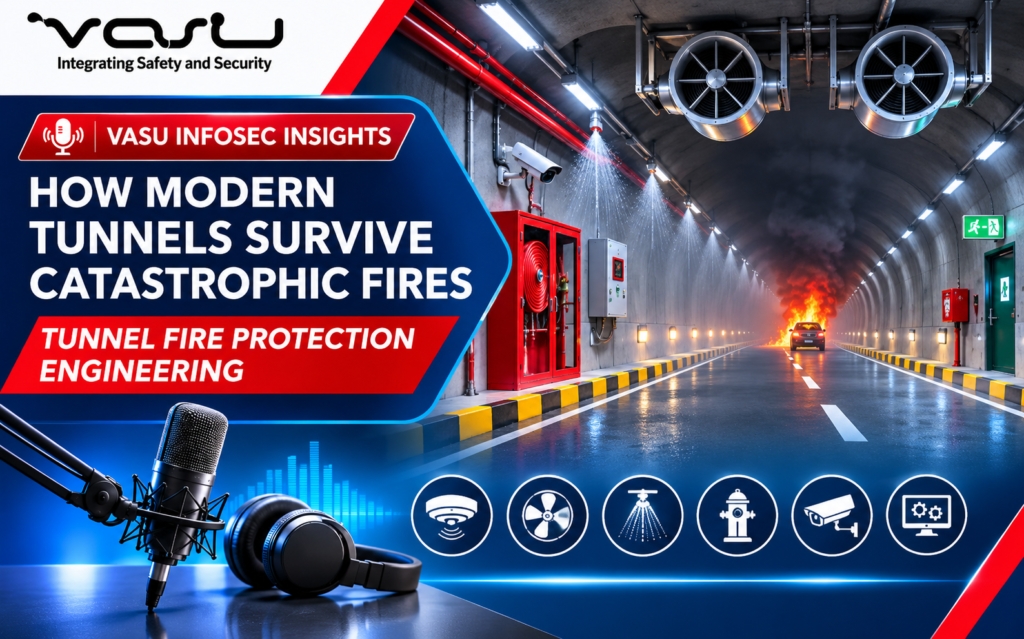
How Modern Tunnels Survive Catastrophic Fires
Nov 2026
How Modern Tunnels Survive Catastrophic Fires
Spotify Embedded Player
Category: Podcast Transcripts
Episode: VEP-002
Industry: Metro Rail, Road Tunnels & Critical Infrastructure
Format: Technical Podcast Discussion
Publisher: VASU Infosec Ltd.
1. Episode Overview
Tunnels are critical transportation assets, but their enclosed environments create complex fire safety challenges. Smoke accumulation, high temperatures, limited escape routes and difficult emergency access require a coordinated engineering approach.
This episode explores the principles of tunnel fire protection engineering for road, metro and railway tunnels.
Through a technical discussion, the episode examines how modern tunnel fire safety strategies integrate fire detection, smoke management, ventilation engineering, firefighting systems and emergency response coordination.
2. Episode Summary
Modern tunnel fire protection requires more than installing individual firefighting and detection systems. It requires a coordinated safety architecture designed around tunnel-specific fire hazards and operational conditions.
This episode of the Vasu Engineering Podcast explores tunnel fire dynamics, smoke behaviour, tenability, risk assessment, linear heat detection, fibre-optic sensing, CCTV analytics, ventilation, computational fire modelling and water mist suppression.
The discussion also examines hydrant and deluge systems, tunnel SCADA, cause-and-effect engineering, emergency communication, international standards, Indian project delivery challenges, commissioning, lifecycle maintenance and future intelligent tunnel technologies.
Special attention is given to system integration: ensuring that detection, ventilation, suppression, traffic management, SCADA and emergency communication work together during a real incident.
The central engineering message: A tunnel is not made safe by installing individual systems. It becomes resilient when the complete safety architecture is properly designed, integrated, tested and maintained.
3. Key Discussion Areas
A. Tunnel Fire Dynamics and Risk Assessment
- Fire behaviour in enclosed tunnel environments
- Smoke movement and accumulation
- Temperature development and heat exposure
- Tenability and evacuation considerations
- Tunnel-specific fire risk assessment
- Computational fire modelling
B. Fire Detection and Monitoring Technologies
- Linear Heat Detection Systems
- Fibre-optic temperature sensing
- CCTV-based fire and incident analytics
- Early fire identification and alarm notification
- Integration with tunnel monitoring platforms
C. Smoke Management and Ventilation Engineering
- Tunnel ventilation strategies
- Smoke extraction and movement control
- Longitudinal ventilation considerations
- Ventilation response during fire emergencies
- Coordination between detection and ventilation systems
D. Fire Suppression and Firefighting Systems
- Water mist suppression systems
- Fire hydrant systems
- Deluge systems
- Selection of suitable firefighting strategies
- Coordination of suppression systems with detection and control systems
E. Tunnel SCADA and Integrated System Coordination
- Tunnel SCADA architecture
- Fire detection and ventilation interfaces
- Cause-and-effect engineering
- Traffic management coordination
- Emergency communication systems
- Integrated monitoring and control
F. Project Delivery and Lifecycle Management
- Indian tunnel project delivery challenges
- Engineering design and system coordination
- Testing and commissioning
- Integrated system validation
- Lifecycle maintenance
- Future intelligent tunnel technologies
4. Why Tunnels Need Specialised Fire Protection
Tunnels have unique structural, environmental and operational characteristics. A fire incident can affect visibility, evacuation conditions, emergency response and the continuity of transportation services.
A specialised tunnel fire protection strategy should consider:
Fire Detection: Appropriate detection technologies to identify abnormal fire conditions and initiate timely emergency response.
Smoke Management: Engineered ventilation and smoke control strategies to manage smoke movement and support safer evacuation.
Fire Suppression: Selection of suitable suppression and firefighting arrangements based on tunnel-specific hazards and project requirements.
Emergency Communication: Coordination of alarms, communication systems and emergency response procedures.
System Integration: Interconnection of detection, ventilation, suppression, traffic management and SCADA systems through coordinated control logic.
Engineering Validation: Proper design review, cause-and-effect verification, testing, commissioning and lifecycle maintenance.
5. Listen to the Podcast
Listen to the complete episode of the Vasu Engineering Podcast on Spotify.
Episode Title: How Modern Tunnels Survive Catastrophic Fires
Episode Reference: VEP-002
Platform: Spotify
Listen Here:
Listen to VEP-002 on Spotify
6. Speaker Details
Ayesha – Host / Technical Discussion
Kabir – Technical Discussion
In this episode, Ayesha and Kabir explore the principles of tunnel fire protection engineering for road, metro and railway tunnels.
Their discussion covers tunnel fire dynamics, detection technologies, smoke management, ventilation engineering, firefighting systems and integrated tunnel safety architecture.
7. Full Podcast Transcript
The complete speaker-wise transcript can be presented in this section after verification against the final recorded audio.
The transcript should retain the original speaker contributions, technical terminology and sequence of discussion.
8. Technical Takeaways
- Tunnel fire safety requires an integrated engineering approach.
- Smoke behaviour and tenability are important considerations in tunnel fire scenarios.
- Linear heat detection and fibre-optic sensing can support tunnel fire monitoring.
- Ventilation and smoke management strategies must be evaluated against project-specific fire scenarios.
- Water mist, hydrant and deluge arrangements should be selected according to the relevant hazards and design requirements.
- Tunnel SCADA and cause-and-effect engineering support coordinated emergency operations.
- Detection, ventilation, suppression, traffic management and emergency communication must work together.
- Testing, commissioning and lifecycle maintenance are essential for long-term system readiness.
9. Related VASU Insights
Explore more technical resources from VASU Infosec:
1. Tunnel Ventilation & Fire Mode
Explore Tunnel Ventilation & Fire Mode
2. Tunnel Fire Detection System
Explore Tunnel Fire Detection System
3. Tunnel Fire Safety: Complete Architecture
Explore Complete Tunnel Fire Safety Architecture
4. Water Mist for Tunnels
Explore Tunnel Water Mist Engineering
5. Tunnel Fire Safety Risk Assessment
Explore Tunnel Fire Safety Risk Assessment
10. About VASU Infosec Ltd.
VASU Infosec Ltd. is an EPC contractor and system integrator specialising in Fire & Life Safety and Electronic Security solutions.
The company provides engineering, supply, installation, testing, commissioning and maintenance services across critical infrastructure and industrial sectors.
Key Solutions:
- Fire Alarm Systems
- Gas Suppression Systems
- Fire Fighting Systems
- High-Pressure Water Mist Systems
- CCTV & Electronic Security
- Access Control Systems
- IBMS / BMS Integration
VASU Infosec focuses on delivering integrated safety and security solutions for complex infrastructure environments.
Website: https://vasuinfosec.com/