
Knowledge Base Entry
Beam Smoke Detector – Working Principle & Applications
Nov 2026
Introduction
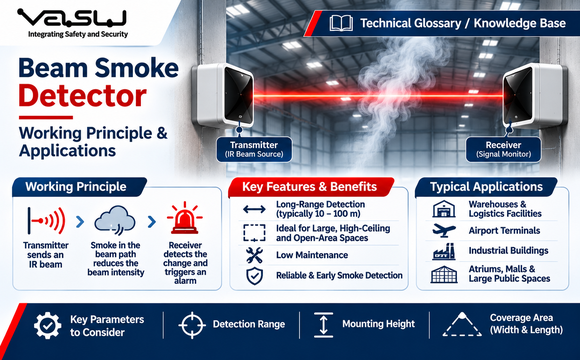
A Beam Smoke Detector is a fire detection device designed to detect smoke across large open spaces using a projected infrared light beam between a transmitter and receiver. It is particularly suitable for buildings with high ceilings or large floor areas where conventional point-type smoke detectors may be difficult to install and maintain.
Working Principle
Beam Smoke Detectors operate using an infrared light beam. The transmitter projects the beam towards a receiver or reflector. When smoke enters the beam path, it reduces the received light intensity. The detector identifies this reduction and activates a fire alarm when the configured alarm threshold is reached.
Main Components
- Transmitter: Generates and projects the infrared beam.
- Receiver / Reflector: Receives or reflects the projected beam.
- Control Unit: Processes the signal and monitors detector status.
- Alarm Interface: Communicates fire and fault signals to the Fire Alarm Control Panel.
Applications
Beam Smoke Detectors are commonly used in:
- Warehouses and logistics facilities.
- Airports and railway stations.
- Shopping malls and atriums.
- Industrial buildings.
- Exhibition halls and large assembly spaces.
- High-ceiling commercial facilities.
Key Installation Considerations
Correct alignment, mounting height, structural movement, obstructions, environmental conditions and manufacturer-specified spacing are important for reliable operation.
Conclusion
Beam Smoke Detectors provide an effective smoke detection solution for large and open spaces. Proper selection, installation, alignment and periodic testing help ensure reliable fire detection.
VASU Infosec Limited provides Fire Alarm and Fire & Life Safety solutions for commercial, industrial and critical infrastructure projects.