
Whitepaper
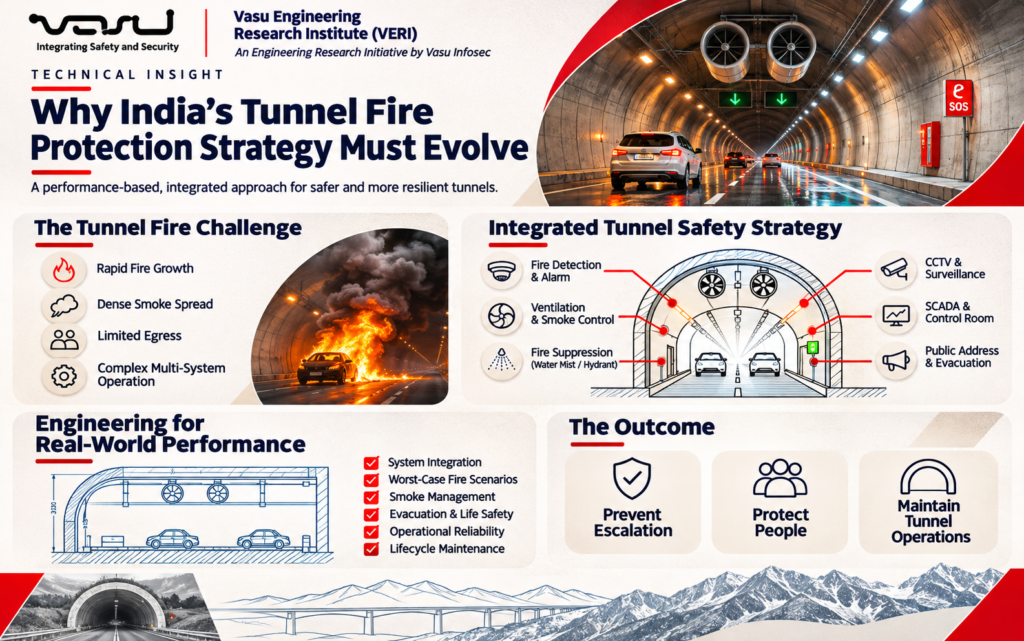
Why India’s Tunnel Fire Protection Strategy Must Evolve
Nov 2026
Executive Summary
India is entering the largest tunnel construction phase in its history. Expressway tunnels, metro systems, railway tunnels and underwater corridors are becoming critical components of the nation’s infrastructure. Projects such as the Mumbai Coastal Road, Delhi–Mumbai Expressway tunnels, Zojila Tunnel, Silkyara Tunnel, Chenab Railway connectivity, metro rail expansions and numerous Himalayan highway tunnels demonstrate that underground infrastructure is no longer exceptional—it is becoming standard.
Despite this transformation, tunnel fire safety continues to be treated in many projects as a procurement package rather than an integrated engineering discipline.
A tunnel does not become safe because it contains a fire alarm system, jet fans, water mist, hydrants, CCTV and SCADA.
A tunnel becomes safe only when these systems operate together during the first few minutes of a real fire.
History has repeatedly demonstrated this principle.
The Mont Blanc Tunnel fire claimed 39 lives.
The Tauern Tunnel fire exposed deficiencies in emergency response and smoke management.
The Gotthard Tunnel fire highlighted the devastating impact of smoke and secondary collisions.
Each incident reshaped international engineering philosophy and led to decades of research involving organizations such as PIARC, NFPA, ITA, SOLIT² and numerous European research institutions.
The result was a fundamental change in thinking.
The question is no longer:
“Is every individual system compliant?”
The modern engineering question is:
“Will the complete tunnel perform safely under the worst credible fire scenario?”
This distinction defines the future of tunnel fire engineering.
India now has an opportunity to move beyond minimum compliance and adopt a performance-based, systems-engineering approach tailored to its unique operational environment, climate, traffic conditions and rapidly growing electric vehicle ecosystem.
This paper examines that transition from the perspective of a system integrator, highlighting the interaction between fire detection, ventilation, suppression, SCADA, traffic management, communications, emergency response and lifecycle maintenance.
The objective is not to recommend products.
The objective is to improve engineering.
1. Why Tunnel Fires Are Different
Most fire protection philosophies originate from buildings.
Tunnels are fundamentally different.
Unlike buildings, occupants cannot simply exit through multiple staircases. Firefighters cannot access every location within minutes. Smoke cannot naturally disperse through open windows. Vehicles become obstacles, visibility collapses within minutes and emergency decisions must often be made remotely through control rooms.
This creates one of the most complex fire engineering environments in modern infrastructure.
A tunnel fire is therefore not a single incident.
It is a simultaneous interaction between:
Fire growth
Smoke movement
Human behaviour
Traffic management
Ventilation performance
Structural response
Emergency communication
Electrical reliability
Control room decision-making
Failure of any one element can compromise the performance of the entire safety strategy.
For this reason, tunnel fire protection should be treated as a systems engineering discipline rather than an equipment installation exercise.
(To be continued in the next section: “Lessons from Mont Blanc, Tauern and Gotthard – How Three Fires Changed Tunnel Engineering Forever.”
2. Lessons from Mont Blanc, Tauern and Gotthard
Three Fires That Changed Tunnel Engineering Forever
Modern tunnel fire engineering was not developed in laboratories. It was forged in the aftermath of catastrophic failures that exposed weaknesses in design, operations and emergency response. Three tunnel fires—Mont Blanc, Tauern and Gotthard—reshaped international practice and continue to influence standards such as NFPA 502, PIARC recommendations and European tunnel directives.
2.1 Mont Blanc Tunnel Fire (1999)
On 24 March 1999, a heavy goods vehicle carrying combustible goods caught fire inside the Mont Blanc Tunnel connecting France and Italy. Within minutes, temperatures exceeded 1,000°C and dense toxic smoke spread through the confined space.
The incident resulted in:
39 fatalities.
Tunnel closure for almost three years.
Extensive structural damage.
Hundreds of millions of euros in repair and economic losses.
The investigation concluded that the tragedy was not caused by a single equipment failure. Instead, multiple systems failed to function as one coordinated safety strategy. Ventilation, communications, operational decision-making and emergency response were not sufficiently integrated.
Engineering lesson: A tunnel is only as safe as the interaction between its systems.
2.2 Tauern Tunnel Fire (1999)
Just two months later, a collision involving heavy vehicles inside Austria’s Tauern Tunnel led to a rapidly developing fire. Fuel-fed flames and multiple vehicle ignitions generated extreme heat and smoke.
Key findings included:
Secondary collisions significantly increased fire severity.
Early traffic control could have reduced vehicle entrapment.
Smoke management and emergency communication were critical to survival.
Engineering lesson: Traffic management must be considered part of the fire protection strategy, not a separate operational function.
2.3 Gotthard Tunnel Fire (2001)
In October 2001, a collision between two heavy goods vehicles in the Gotthard Road Tunnel in Switzerland triggered another major tunnel fire.
Although the fire originated from a vehicle collision, the greatest hazard became smoke. Most fatalities resulted from smoke inhalation rather than direct exposure to flames.
The investigation reinforced several principles:
Smoke is the primary life safety threat.
Ventilation strategy must priorities tenable evacuation conditions.
Escape routes and emergency communication require equal attention to suppression systems.
2.4 The Common Engineering Message
Despite occurring in different countries under different circumstances, these incidents revealed common engineering truths:
Tunnel fires escalate faster than most building fires.
Smoke management is often more important than extinguishment during the initial phase.
Control rooms require accurate real-time information to make effective decisions.
Detection, ventilation, suppression, SCADA and communications must operate as one integrated system.
Periodic testing and lifecycle maintenance are as important as initial design.
These lessons became the foundation for modern performance-based tunnel fire engineering and continue to influence new tunnel projects worldwide.
In the next chapter, I’ll move into fire dynamics inside tunnels, including heat release rates, smoke stratification, back layering, critical ventilation velocity, heavy goods vehicle fires, and the emerging challenges posed by electric vehicle battery fires. ❶
Chapter 3
Fire Dynamics Inside Tunnels
Understanding What Really Happens During a Tunnel Fire
3.1 Fire Does Not Behave the Same Inside a Tunnel
One of the biggest misconceptions in fire protection engineering is the assumption that fire behaves similarly in all environments. While the chemistry of combustion remains unchanged, the surrounding environment fundamentally alters how heat, smoke and toxic gases develop.
A tunnel is a confined linear structure. Unlike buildings, there are no open facades or multiple vertical escape paths through which heat and smoke can dissipate naturally. Instead, hot gases are channelled along the tunnel axis, often travelling hundreds of meters before occupants become aware of the fire.
Consequently, tunnel fire engineering begins with understanding smoke—not flames.
International investigations consistently show that most fatalities in major tunnel fires have resulted from smoke inhalation, reduced visibility and delayed evacuation rather than direct flame impingement.
This observation has fundamentally changed modern tunnel design philosophy.
The primary engineering objective during the first phase of a tunnel fire is to maintain a tenable environment long enough for occupants to escape safely.
3.2 Heat Release Rate (HRR)
The severity of a tunnel fire is measured by its Heat Release Rate (HRR), expressed in megawatts (MW). HRR represents the amount of thermal energy generated by a fire every second.
Historically, passenger vehicle fires were considered the governing design scenario, typically producing heat release rates between 5 MW and 10 MW.
Modern transportation has changed this assumption dramatically.
Heavy Goods Vehicles (HGVs) carrying combustible cargo, tankers, buses and hazardous materials can generate fires exceeding 100 MW, while some full-scale tests have demonstrated peak heat release rates approaching or exceeding 200 MW depending on fuel load and ventilation conditions.
Electric vehicles introduce an additional dimension. Although not every EV fire is larger than an equivalent conventional vehicle fire, battery thermal runaway can create prolonged burning, repeated reignition and challenges for suppression and post-fire recovery.
Consequently, selecting an appropriate design fire is now one of the most important engineering decisions during tunnel planning.
3.3 Smoke – The Greatest Threat
Contrary to public perception, flames are rarely the primary cause of fatalities inside tunnels.
Smoke is.
Tunnel smoke contains:
Carbon monoxide (CO)
Carbon dioxide (CO₂)
Hydrogen cyanide (HCN)
Nitrogen oxides (NOₓ)
Fine particulates
Hot combustion gases
Reduced oxygen concentrations
Within minutes, visibility may reduce from several hundred meters to less than five meters. Drivers lose orientation, emergency exits become difficult to locate and evacuation slows significantly.
Even when temperatures remain survivable, smoke inhalation can rapidly incapacitate occupants.
This is why modern tunnel ventilation systems are designed primarily to manage smoke rather than simply remove heat.
3.4 Smoke Stratification
During the initial stages of a tunnel fire, hot smoke naturally rises towards the tunnel crown due to buoyancy.
This creates a layer of hot gases above cooler air, a phenomenon known as smoke stratification.
Maintaining this layer is beneficial because it allows cleaner air to remain near road level, providing occupants with a clearer evacuation path.
However, excessive ventilation velocities can destroy this stratification by mixing smoke throughout the tunnel.
Engineers therefore face a delicate balance:
Too little ventilation allows smoke to spread unpredictably.
Too much ventilation can force smoke down to occupant level.
The objective is to maintain conditions that maximize evacuation safety rather than simply increasing airflow.
3.5 Backlayering
When ventilation velocity is insufficient, smoke may begin travelling upstream against the direction of airflow.
This phenomenon is known as backlayering.
Backlayering creates several hazards:
Occupants upstream may become trapped unexpectedly.
Emergency responders lose visibility.
Detection systems may activate outside the intended fire zone.
Control room operators receive conflicting information.
Preventing excessive backlayering is one of the principal objectives of longitudinal ventilation design.
The concept of critical ventilation velocity emerged from decades of experimental research to address this challenge.
3.6 Critical Ventilation Velocity
Critical ventilation velocity is the minimum airflow required to prevent significant upstream smoke movement.
It is influenced by several parameters:
Tunnel gradient
Tunnel geometry
Fire size (MW)
Ambient temperature
Vehicle blockage
Ventilation configuration
Contrary to common belief, increasing airflow indefinitely does not always improve safety.
Excessive ventilation may:
Intensify combustion.
Increase flame length.
Reduce water mist effectiveness.
Increase downstream smoke spread.
Complicate evacuation.
Modern tunnel ventilation therefore seeks optimum airflow, not maximum airflow.
3.7 Heavy Goods Vehicle Fires
Heavy Goods Vehicles remain among the most demanding tunnel fire scenarios.
Cargo may include:
Plastics
Tyres
Chemicals
Timber
Fuel
Consumer goods
Industrial materials
Each commodity produces different burning characteristics, smoke generation rates and toxic gas compositions.
Engineering design should therefore consider credible freight scenarios rather than assuming a single generic vehicle fire.
3.8 Electric Vehicle Fires
The increasing adoption of electric vehicles introduces new engineering considerations.
Battery thermal runaway differs from conventional fuel fires in several ways:
Multiple cells may fail sequentially.
Reignition is possible even after apparent extinguishment.
Cooling requirements may extend for several hours.
Damaged batteries require specialized post-fire handling.
Current international research is still evolving in this area. As EV penetration increases, future tunnel design guidance will likely incorporate revised fire scenarios, suppression strategies and emergency response procedures.
3.9 Engineering Implications
Understanding tunnel fire dynamics directly influences:
Fire detection strategy
Water mist zoning
Nozzle spacing
Ventilation philosophy
Jet fan operation
SCADA control logic
Emergency evacuation planning
Control room procedures
Commissioning tests
Lifecycle maintenance
Fire dynamics should therefore be considered the foundation upon which every tunnel fire protection system is designed.
Chapter 3 – Key Engineering Takeaways
Smoke, not flames, is the principal life safety hazard in most tunnel fires.
Heat Release Rate (HRR) governs the severity of tunnel fire scenarios.
Maintaining smoke stratification improves evacuation conditions.
Critical ventilation velocity should optimize smoke control, not maximize airflow.
Heavy Goods Vehicles and Electric Vehicles require different design considerations.
Fire dynamics should guide every major engineering decision within a tunnel fire protection strategy.
Next Chapter: SOLIT², Memorial Tunnel and Runehamar – The Research That Changed Tunnel Engineering, where we examine the full-scale fire tests that shaped modern tunnel fire protection and how those findings apply to Indian tunnel projects.
Chapter 4
Full-Scale Fire Testing
How SOLIT², Memorial Tunnel and Runehamar Changed Tunnel Engineering
4.1 Why Full-Scale Fire Testing Was Necessary
For many years, tunnel fire protection systems were designed using theoretical calculations, small-scale laboratory experiments and engineering judgement. While these methods provided valuable guidance, they could not accurately predict the behaviour of large fires inside real tunnels.
Questions remained unanswered.
How does smoke actually move inside a long tunnel?
At what point does smoke stratification collapse?
How effective is longitudinal ventilation during fires exceeding 100 MW?
Can fixed fire suppression systems control large vehicle fires?
How quickly do tunnel temperatures rise?
How do ventilation and suppression interact?
These uncertainties prompted governments, research institutions and industry to undertake some of the largest fire experiments ever conducted.
The findings from these programmed fundamentally changed international tunnel fire engineering.
4.2 The Memorial Tunnel Fire Ventilation Test Program (USA)
One of the most influential studies was conducted in the abandoned Memorial Tunnel in West Virginia, USA.
Over a period of several years, researchers carried out dozens of controlled full-scale fire experiments using realistic tunnel geometry, ventilation systems and fire scenarios.
The objectives were to understand:
Smoke propagation.
Ventilation effectiveness.
Emergency response conditions.
Temperature distribution.
Visibility during evacuation.
Performance of ventilation control strategies.
The research demonstrated that ventilation should not simply maximize airflow.
Instead, ventilation should be controlled to create conditions that allow occupants to evacuate while enabling firefighters to approach the incident safely.
This represented a major shift from earlier engineering practice.
4.3 Runehamar Tunnel Fire Tests (Norway)
Perhaps the most significant contribution to modern tunnel fire engineering came from the Runehamar Tunnel Tests.
Unlike previous studies, Runehamar focused on fires involving heavy goods vehicles carrying realistic combustible loads.
Researchers deliberately burned:
Timber cargo
Plastic commodities
Furniture loads
Mixed combustible materials
The results surprised many engineers.
Peak Heat Release Rates exceeded 200 MW, far beyond the assumptions commonly used in tunnel design at that time.
Temperatures near the tunnel ceiling exceeded 1,300°C.
These experiments demonstrated that cargo type—not simply vehicle size—governs fire severity.
The findings continue to influence modern tunnel design throughout Europe.
4.4 SOLIT² Research Programme
The SOLIT² programme represents one of the world’s most comprehensive investigations into tunnel fire protection.
Unlike studies focusing solely on ventilation, SOLIT² evaluated the interaction between:
Fire detection
Water mist systems
Ventilation
Human evacuation
Structural protection
System integration
The programme involved numerous full-scale fire tests under realistic operating conditions.
Among its most significant conclusions were:
Water Mist Can Significantly Reduce Heat Release
Properly designed high-pressure water mist systems were shown to reduce fire intensity, lower ceiling temperatures and improve environmental conditions for evacuation.
Smoke Conditions Improved
By reducing fire size and cooling combustion gases, water mist helped maintain more tenable conditions inside the tunnel.
Structural Temperatures Were Reduced
Lower thermal loading improved protection of concrete linings, structural reinforcement and critical infrastructure.
Ventilation and Water Mist Must Work Together
Perhaps the most important engineering lesson was that suppression systems cannot be designed independently of ventilation.
Incorrect airflow may reduce water mist effectiveness.
Similarly, suppression influences smoke production and ventilation behaviour.
The two systems must therefore be engineered as one coordinated solution.
4.5 What These Studies Changed
Following these research programmes, tunnel engineering changed fundamentally.
Engineers no longer designed systems independently.
Instead, they recognized that:
Detection influences ventilation.
Ventilation influences smoke.
Smoke influences evacuation.
Evacuation influences emergency response.
Suppression influences heat release.
Heat release influences structural behaviour.
SCADA coordinates all these decisions.
Tunnel fire safety became a systems engineering discipline rather than a collection of individual technologies.
4.6 Implications for Indian Tunnel Projects
India is currently constructing some of the world’s most ambitious tunnel infrastructure.
Many projects involve:
Long road tunnels through mountainous terrain.
Urban underground expressways.
Metro rail tunnels.
Railway tunnels.
Coastal and underwater tunnels.
Traffic densities, climatic conditions and emergency response capabilities differ significantly from Europe.
Therefore, simply copying international specifications without understanding the underlying engineering principles may produce suboptimal results.
Indian projects should evaluate:
Design fire scenarios based on expected traffic composition.
Heavy goods vehicle frequency.
Future electric vehicle penetration.
Tunnel gradients.
Environmental conditions.
Operational staffing.
Emergency response time.
Lifecycle maintenance capability.
The engineering objective should be adaptation—not replication.
4.7 The System Integrator’s Perspective
From a system integrator’s viewpoint, the most valuable lesson from decades of international research is straightforward:
Individual technologies do not save tunnels.
Integrated engineering does.
An effective tunnel protection strategy requires coordinated operation of:
Fire Detection Systems
Linear Heat Detection
CCTV Analytics
Water Mist Systems
Hydrant Systems
Ventilation
Jet Fans
SCADA
Public Address
Emergency Telephones
Variable Message Signs
Radio Communication
Traffic Management
Power Distribution
UPS and Backup Systems
Every interface must be tested.
Every cause-and-effect sequence must be validated.
Every failure mode must be understood before the tunnel enters service.
Chapter 4 – Key Engineering Takeaways
Full-scale testing transformed tunnel fire engineering.
Runehamar demonstrated that heavy goods vehicle fires can exceed 200 MW.
Memorial Tunnel established modern ventilation philosophy.
SOLIT² proved the importance of integrated suppression and ventilation.
Tunnel safety depends on coordinated system performance rather than isolated equipment.
International research should be adapted to Indian operating conditions rather than copied directly.
Next Chapter: Performance-Based Fire Engineering (PBFE): Moving Beyond Compliance, where we examine why performance-based design is becoming the preferred engineering approach for modern tunnel infrastructure and how it can be applied to Indian projects from a system integrator’s perspective.
Chapter 5
Performance-Based Fire Engineering (PBFE)
Moving Beyond Compliance
5.1 A Fundamental Shift in Tunnel Engineering
For decades, tunnel fire protection has been driven by prescriptive compliance.
The engineering process typically followed a familiar sequence:
Select the applicable code.
Install systems required by the code.
Demonstrate compliance.
Obtain approvals.
Commission the tunnel.
While this approach has improved safety significantly, it has an inherent limitation.
It assumes that compliance automatically results in safety.
History has repeatedly demonstrated that this assumption is incorrect.
The Mont Blanc, Tauern and Gotthard tunnel fires all occurred in tunnels that complied with the engineering practices accepted at the time. The failures were not necessarily caused by the absence of equipment, but by the inability of multiple systems to operate together under rapidly changing emergency conditions.
This realization led to the development of Performance-Based Fire Engineering (PBFE).
5.2 What Is Performance-Based Fire Engineering?
Performance-Based Fire Engineering does not begin with a checklist.
It begins with the question:
> Can this tunnel continue to protect life under a credible worst-case fire scenario?
Instead of asking whether a detector has been installed or whether a ventilation fan meets its specification, PBFE evaluates whether the entire tunnel system achieves defined safety objectives.
Typical performance objectives include:
Safe evacuation of occupants.
Acceptable visibility during evacuation.
Smoke temperatures within survivable limits.
Structural stability throughout the fire event.
Safe access for emergency responders.
Reliable operation of critical infrastructure.
Rapid post-incident recovery.
The emphasis shifts from equipment compliance to system performance.
5.3 Prescriptive Design vs Performance-Based Design
Prescriptive Approach Performance-Based Approach
Follows minimum code requirements Demonstrates engineering performance
Equipment-oriented System-oriented
Standard design assumptions Project-specific risk analysis
Limited flexibility Optimized engineering solutions
Compliance is the objective Resilience is the objective
Neither approach is inherently wrong.
Prescriptive standards establish an essential baseline.
However, tunnels with unusual geometry, long lengths, mixed traffic, steep gradients, hazardous cargo or high operational importance often require engineering beyond minimum code requirements.
5.4 Defining the Design Fire
One of the first steps in PBFE is selecting the design fire.
This is not simply the largest possible fire.
It is the most credible fire scenario that the tunnel should be capable of managing.
The selected scenario influences:
Ventilation capacity.
Detection philosophy.
Water mist design.
Structural protection.
Emergency procedures.
Escape route spacing.
Power system redundancy.
Examples include:
Passenger vehicle fire.
Bus fire.
Heavy Goods Vehicle (HGV) fire.
Fuel tanker fire.
Electric Vehicle (EV) battery fire.
Multiple-vehicle collision.
Hazardous goods incident.
Choosing an unrealistic design fire may result in unnecessary expenditure.
Choosing an inadequate design fire may compromise life safety.
This decision should therefore be supported by engineering evidence, traffic analysis and operational risk assessment.
5.5 The Importance of Fire Scenarios
Performance-based design evaluates multiple scenarios rather than a single event.
Typical scenarios include:
Scenario 1
A passenger vehicle fire during free-flow traffic.
Scenario 2
A heavy goods vehicle fire during peak traffic.
Scenario 3
A bus fire with full passenger occupancy.
Scenario 4
An electric vehicle battery thermal runaway.
Scenario 5
A collision involving multiple vehicles.
Scenario 6
A fire occurred during partial failure of the ventilation system.
Scenario 7
A fire during loss of primary electrical power.
Scenario 8
A fire while maintenance activities are in progress.
Each scenario challenges the integrated performance of the tunnel differently.
5.6 Integrated System Response
One of the defining characteristics of PBFE is that systems are evaluated together, not independently.
For example:
A Linear Heat Detection (LHD) system identifies abnormal temperature.
The Fire Alarm Control Panel confirms the alarm.
SCADA receives the event.
CCTV automatically displays the affected zone.
Variable Message Signs close the tunnel entrance.
Traffic signals stop incoming vehicles.
Jet fans change operating mode.
Public Address announces evacuation instructions.
Water mist activates only within the affected protection zone.
Emergency telephones remain operational.
Control room operators receive a complete incident overview.
This sequence may occur within seconds.
Any interruption in the chain reduces the overall effectiveness of the emergency response.
5.7 The Role of Digital Engineering
Modern PBFE increasingly relies on digital tools to predict system behaviour before construction.
These include:
Computational Fluid Dynamics (CFD) for smoke movement.
Fire modelling for heat release rates.
Evacuation simulations.
Structural thermal analysis.
Ventilation performance analysis.
SCADA cause-and-effect verification.
Digital twins for lifecycle management.
These tools do not replace engineering judgement.
They enhance it.
Simulation should always be supported by engineering assumptions that are realistic, documented and independently reviewed.
5.8 Why PBFE Matters for India
India is constructing tunnels across a wide range of environments:
Himalayan highways.
Urban expressways.
Metro rail systems.
Railway tunnels.
Coastal infrastructure.
Underwater crossings.
Traffic composition, maintenance capability, climatic conditions and emergency response resources vary significantly from one project to another.
Applying identical fire protection strategies to every tunnel may not produce the best outcome.
Performance-based engineering allows designers to tailor solutions to project-specific risks while maintaining consistent safety objectives.
This approach is particularly valuable for high-value assets where operational continuity is as important as regulatory compliance.
5.9 The System Integrator’s Perspective
For a system integrator, Performance-Based Fire Engineering is not an optional design philosophy—it is the framework that connects every discipline involved in tunnel safety.
A successful PBFE strategy requires seamless coordination between:
Fire Detection.
Linear Heat Detection.
Ventilation Systems.
High-Pressure Water Mist.
SCADA.
CCTV Analytics.
Public Address and Voice Evacuation.
Radio Rebroadcast Systems.
Emergency Telephones.
Traffic Management.
Power Distribution.
UPS and Generator Backup.
Building Management Systems.
Emergency Response Procedures.
The role of the system integrator extends beyond installation. It includes defining interface logic, validating cause-and-effect matrices, coordinating testing, supporting authority approvals and ensuring that the complete tunnel performs as one integrated life safety ecosystem.
Chapter 5 – Key Engineering Takeaways
Compliance establishes the minimum acceptable standard; performance-based engineering aims for demonstrable resilience.
PBFE evaluates complete system behaviour under realistic fire scenarios.
The choice of design fire influences every major engineering decision.
Digital modelling supports engineering judgement but does not replace it.
Integrated testing and validation are essential before commissioning.
For India’s expanding tunnel network, PBFE provides a practical framework for balancing safety, operational continuity and lifecycle performance.
Next Chapter: Tunnel Fire Protection Technologies – Detection, Water Mist, Ventilation and SCADA as One Integrated Ecosystem, where we will compare technologies objectively and explain how they should interact rather than compete.
Chapter 6
Tunnel Fire Protection Technologies
Why Integration Matters More Than Individual Systems
6.1 Introduction
Ask ten tunnel engineers what the most important fire protection system is and you are likely to receive ten different answers.
Some will argue for high-pressure water mist.
Others will recommend powerful ventilation systems.
Some will prioritise Linear Heat Detection (LHD).
Others will emphasise SCADA, CCTV analytics or emergency communications.
The reality is that none of them are individually correct.
Every major international investigation has reached the same conclusion:
> No single technology makes a tunnel safe.
A tunnel survives a fire because multiple systems work together within seconds of the incident.
This chapter examines the major technologies used in tunnel fire protection—not as independent products, but as components of one integrated engineering ecosystem.
6.2 Fire Detection – The First Link in the Safety Chain
Every emergency begins with one critical question:
Where is the fire?
If the control room cannot accurately determine the location of the incident within the first minute, every subsequent decision becomes more difficult.
Fire detection therefore forms the first layer of tunnel resilience.
Modern tunnels commonly employ a combination of:
Linear Heat Detection (LHD)
Point Heat Detectors
Flame Detectors
Aspirating Smoke Detection (where applicable)
Video Analytics
Manual Call Points
Each technology has advantages and limitations.
No single detection method is suitable for every tunnel.
The selection should be based on tunnel geometry, environmental conditions, maintenance philosophy and expected fire scenarios.
Engineering Consideration
Detection systems should not merely raise alarms.
They should automatically initiate predefined cause-and-effect sequences that coordinate every downstream system.
6.3 Linear Heat Detection (LHD)
Linear Heat Detection has become one of the most widely adopted technologies for road and rail tunnels because it provides continuous monitoring over long distances.
Unlike conventional point detectors, LHD identifies abnormal temperatures along the cable length.
Advantages include:
Continuous coverage.
Precise fire location.
Immunity to dust.
Performance in harsh environments.
Long operational life.
Compatibility with SCADA integration.
However, engineers should remember that LHD is a detection technology—not a fire suppression strategy.
Its effectiveness depends entirely on how rapidly other systems respond.
6.4 High-Pressure Water Mist
High-pressure water mist has attracted increasing attention over the past two decades, particularly following international research programmes such as SOLIT².
Unlike conventional sprinklers, water mist uses extremely fine droplets operating at high pressure.
The objectives include:
Fire control.
Heat reduction.
Smoke cooling.
Radiation reduction.
Structural protection.
Improved evacuation conditions.
International testing has demonstrated significant reductions in heat release rates when systems are properly engineered.
However, successful application depends upon:
Hydraulic design.
Nozzle selection.
Zoning philosophy.
Ventilation interaction.
Pump reliability.
Detection logic.
Maintenance.
Water mist should therefore be viewed as an engineered system rather than simply a collection of nozzles.
6.5 Ventilation Systems
Ventilation remains one of the most critical components of tunnel fire safety.
Its purpose extends far beyond supplying fresh air during normal operation.
During emergencies, ventilation is responsible for:
Smoke control.
Visibility improvement.
Temperature management.
Evacuation support.
Firefighter access.
Common ventilation strategies include:
Longitudinal ventilation.
Semi-transverse ventilation.
Full transverse ventilation.
Each approach has different engineering implications depending on tunnel length, traffic density, geometry and operational philosophy.
One common misconception is that greater airflow always produces better safety.
Research has repeatedly demonstrated that excessive airflow may increase flame spread, destroy smoke stratification and reduce suppression effectiveness.
Engineering optimisation is therefore more important than maximum capacity.
6.6 SCADA – The Brain of the Tunnel
Modern tunnels contain thousands of field devices.
Without SCADA, operators would need to manage every subsystem independently.
SCADA transforms individual systems into a coordinated operational platform.
Typical functions include:
Alarm management.
Fire location.
Ventilation control.
Pump monitoring.
Water mist activation.
Traffic control.
CCTV integration.
Variable Message Signs.
Emergency communication.
Power system monitoring.
Event recording.
A well-designed SCADA system allows operators to understand the situation within seconds rather than minutes.
In tunnel emergencies, those minutes often determine survival.
6.7 CCTV Analytics
Traditional CCTV provides visual confirmation.
Modern analytics provide operational intelligence.
Artificial intelligence increasingly enables:
Automatic stopped vehicle detection.
Smoke detection.
Flame recognition.
Pedestrian identification.
Wrong-way vehicle detection.
Traffic congestion monitoring.
Incident verification.
These capabilities significantly reduce operator response time and minimise false alarms.
However, analytics should support—not replace—engineering judgement.
6.8 Public Address and Emergency Communication
Occupants require accurate information immediately after a fire begins.
Confusion frequently creates greater risk than the fire itself.
Emergency communication systems should therefore provide:
Voice evacuation.
Emergency telephones.
Radio rebroadcast for emergency services.
Variable Message Signs.
Dynamic traffic signals.
Communication should be:
Immediate.
Unambiguous.
Reliable.
Multilingual where appropriate.
Integrated with operational procedures.
6.9 Electrical Reliability
Every tunnel protection strategy depends upon continuous electrical power.
Fire detection, ventilation, SCADA, communications and suppression systems cannot function without reliable power.
Critical considerations include:
Dual incoming power supplies.
UPS redundancy.
Diesel generator backup.
Fire-resistant cable routing.
Electrical segregation.
Automatic transfer schemes.
Loss of power during a major fire may compromise multiple safety systems simultaneously.
Electrical resilience is therefore a life safety requirement—not merely an operational convenience.
6.10 The Missing Discipline: Systems Integration
Many tunnel projects continue to procure technologies as independent packages.
Typical packages include:
Fire Alarm.
Ventilation.
SCADA.
CCTV.
Public Address.
Electrical Systems.
Water Mist.
Traffic Management.
Each contractor successfully completes its own scope.
Yet the tunnel may still fail operationally if interfaces have not been engineered.
Questions that often remain unresolved include:
Who validates the cause-and-effect matrix?
Who confirms detection activates the correct ventilation mode?
Who verifies water mist zoning aligns with detection zones?
Who confirms SCADA receives every critical signal?
Who tests every failure scenario?
Who ensures all contractors follow one operational philosophy?
The answer is the System Integrator.
This role extends far beyond installation.
It encompasses engineering coordination, interface management, integrated testing, commissioning, authority demonstrations and lifecycle optimization.
As tunnels become increasingly digital, the importance of the system integrator will continue to grow.
Chapter 6 – Key Engineering Takeaways
No individual technology provides tunnel safety on its own.
Detection is valuable only if downstream systems respond correctly.
Water mist, ventilation and SCADA must be engineered together.
CCTV analytics enhance situational awareness but do not replace engineering judgement.
Reliable electrical infrastructure underpins every life safety system.
System integration is the discipline that transforms individual technologies into one resilient tunnel protection strategy.
Engineering Insight
The future of tunnel fire protection will not be defined by who manufactures the equipment. It will be defined by who successfully integrates the entire safety ecosystem into a predictable, reliable and testable engineering solution.
Next Chapter: Water Mist in Tunnel Fire Protection – Engineering Beyond the Product, where we will examine hydraulic design, zoning, nozzle placement, interaction
Chapter 6
Tunnel Fire Protection Technologies
Why No Single Technology Can Protect a Tunnel
> Engineering Insight
There is no “best” tunnel fire protection technology. There is only the best integrated engineering solution for a particular tunnel.
This distinction separates engineering from product marketing.
6.1 The Biggest Mistake in Tunnel Fire Protection
Tunnel fire protection discussions often begin with technology.
Should we install Water Mist?
Should we use Jet Fans?
Should we install Linear Heat Detection?
Should we use Video Analytics?
These are the wrong questions.
The correct engineering question is:
> What sequence of events must occur during the first five minutes of a tunnel fire to protect life?
Only after answering this question should technologies be selected.
The tunnel should dictate the technology.
The technology should never dictate the engineering.
6.2 Tunnel Fire Safety Is a Chain
Tunnel safety depends upon a sequence.
If any link fails, the entire strategy weakens.
Step 1
A fire starts.
↓
Step 2
Detection identifies the fire.
↓
Step 3
SCADA verifies the incident.
↓
Step 4
CCTV confirms location.
↓
Step 5
Tunnel entrances close.
↓
Step 6
Ventilation changes mode.
↓
Step 7
Voice evacuation begins.
↓
Step 8
Water Mist activates.
↓
Step 9
Emergency services respond.
↓
Step 10
Tunnel recovery begins.
Every technology contributes to one part of this sequence.
None can replace the others.
6.3 Fire Detection
Detection is the first engineering decision.
If the fire is detected late, every downstream system also reacts late.
Tunnel detection technologies typically include:
Linear Heat Detection (LHD)
Suitable for:
Long tunnels
Harsh environments
Cable trays
Continuous monitoring
Advantages
Pinpoints fire location.
Resistant to dust.
Continuous sensing.
Low maintenance.
Limitations
Detects heat rather than smoke.
Activation depends upon temperature rise.
Video Analytics
Modern AI-based systems analyses CCTV images.
Capabilities include:
Smoke detection.
Flame detection.
Stopped vehicle detection.
Pedestrian detection.
Wrong-way vehicle movement.
Congestion monitoring.
Advantages
Very early incident recognition.
Limitations
Dependent upon:
Camera cleanliness.
Lighting.
Visibility.
Image quality.
Aspirating Smoke Detection
Usually applied in:
Technical rooms.
Equipment galleries.
Electrical rooms.
Not generally suitable as the primary tunnel detection technology because airflow dilutes smoke.
Engineering Recommendation
The most reliable tunnels combine multiple detection technologies.
No single detector should become the sole decision-making source.
6.4 Ventilation
Ventilation has one objective:
Control smoke.
Not extinguish fire.
Not cool the tunnel.
Not improve comfort.
Smoke control.
Tunnel ventilation systems typically include:
Jet Fans
Longitudinal Ventilation
Semi-Transverse Ventilation
Transverse Ventilation
The selected philosophy depends upon:
Tunnel length.
Traffic density.
Gradient.
Design fire.
Escape strategy.
Construction geometry.
Engineering Principle
Ventilation should maintain:
Visibility.
Tenable temperatures.
Escape routes.
Firefighter access.
It should not simply maximize airflow.
6.5 Water Mist
High-pressure Water Mist has become increasingly important for tunnel applications.
Unlike conventional sprinklers, Water Mist produces extremely fine droplets.
These droplets:
Absorb heat rapidly.
Reduce flame temperature.
Displace oxygen locally.
Improve visibility.
Reduce radiant heat.
Research programmes including SOLIT² demonstrated significant reductions in:
Ceiling temperature.
Heat Release Rate.
Fire spread.
Structural thermal loading.
However,…
Water Mist is not a replacement for ventilation.
It is a complementary technology.
Engineering Principle
Ventilation manages smoke.
Water Mist controls fire.
Together they improve survivability.
6.6 SCADA
Many engineers still consider SCADA an automation platform.
In tunnel engineering…
SCADA is the brain.
Without SCADA:
Detection becomes isolated.
Ventilation becomes manual.
Water Mist loses coordination.
Traffic systems operate independently.
Emergency decisions become slower.
SCADA integrates:
Fire Alarm Panels.
LHD.
CCTV.
Variable Message Signs.
Traffic Signals.
Public Address.
Emergency Telephones.
Water Mist.
Ventilation.
Power Systems.
UPS.
Electrical Monitoring.
During an emergency the control room should receive one integrated operational picture.
6.7 Communications
Tunnel users require immediate guidance.
Communication systems typically include:
Public Address.
Voice Evacuation.
Emergency Telephones.
Radio Rebroadcast.
GSM Coverage.
Variable Message Signs.
Poor communication often results in:
Delayed evacuation.
Vehicle abandonment.
Panic.
Secondary collisions.
Engineering therefore treats communication as a life safety system, not merely a convenience.
6.8 Electrical Reliability
Every life safety system depends upon electrical continuity.
Design considerations include:
Dual power supplies.
UPS.
Diesel Generators.
Redundant fibre networks.
Ring communication architecture.
Fault-tolerant PLCs.
Network redundancy.
Fire protection cannot outperform its power infrastructure.
6.9 Why Technology Alone Fails
Many projects evaluate systems individually.
For example:
“Which Water Mist system is better?”
“Which detector is faster?”
“Which SCADA software is best?”
These questions miss the engineering challenge.
The real question is:
How do these technologies interact during the first five minutes of a fire?
That interaction determines tunnel resilience.
6.10 The System Integrator’s Responsibility
This is where system integration becomes the most valuable engineering discipline.
A system integrator is responsible for ensuring:
✓ Detection activates correctly.
✓ SCADA interprets alarms correctly.
✓ CCTV automatically displays the correct camera.
✓ Ventilation changes mode.
✓ Tunnel entrances close.
✓ Water Mist activates only in the affected zone.
✓ Voice evacuation begins immediately.
✓ Emergency services receive accurate information.
✓ Every event is recorded.
✓ Manual override remains available.
The system integrator therefore becomes responsible for transforming independent technologies into one coordinated emergency response system.
Chapter 6 – Key Engineering Takeaways
No single technology can protect a tunnel.
Detection is only the beginning.
Ventilation and Water Mist complement each other.
SCADA is the operational brain of the tunnel.
Communications directly influence survival.
Electrical reliability underpins every life safety system.
System integration determines whether the complete strategy succeeds.
Engineering Quote
> “The safest tunnel is not the one with the most equipment. It is the one where every system responds together, at the right time, for the right reason.”
Next Chapter: Water Mist in Tunnel Fire Protection – Science, International Research, SOLIT² Findings and Practical Engineering Considerations, where the discussion will move beyond products and focus on the engineering principles, design philosophy, advantages, limitations, and integration of high-pressure water mist systems in road, rail, and metro tunnels.
Chapter 7
High-Pressure Water Mist in Tunnel Fire Protection
Engineering Beyond the Product
> Engineering Statement
Water Mist is not a product.
It is a fire engineering strategy whose effectiveness depends upon hydraulic design, fire dynamics, ventilation interaction, detection philosophy and systems integration.
7.1 Introduction
Few technologies in tunnel fire protection generate as much discussion as High-Pressure Water Mist (HPWM).
Supporters often describe it as the future of tunnel fire suppression.
Critics argue that it increases project cost and operational complexity.
Both views are incomplete.
The correct engineering question is not:
> “Is Water Mist better than another technology?”
The correct question is:
> “Under what conditions does Water Mist improve tunnel resilience, and how should it be engineered?”
This distinction is fundamental.
Water Mist should never be evaluated in isolation. Its value depends on how effectively it integrates with fire detection, ventilation, SCADA, hydraulic design and emergency operations.
7.2 What Is Water Mist?
Unlike conventional sprinkler systems that discharge relatively large droplets at lower pressures, High-Pressure Water Mist systems produce extremely fine droplets, typically at operating pressures exceeding 80–140 bar, depending on system design and nozzle characteristics.
These fine droplets create a significantly larger total surface area than conventional sprinkler droplets. The increased surface area enables rapid heat absorption and faster evaporation.
The engineering objective is fire control, not simply water discharge.
7.3 How Water Mist Controls Fire
Water Mist influences a tunnel fire through four primary mechanisms.
1. Rapid Cooling
The fine droplets absorb heat efficiently as they evaporate.
This reduces:
Flame temperature
Ceiling gas temperature
Thermal radiation
Lower temperatures help protect tunnel linings, electrical services and structural components.
2. Oxygen Displacement
As water converts to steam, it locally displaces oxygen around the fire plume.
This assists in reducing combustion intensity.
It is important to note that Water Mist does not inert the entire tunnel. The effect is localised around the fire.
3. Smoke Cooling
Water Mist cools hot combustion gases.
This reduces:
Smoke buoyancy
Thermal loading
Heat transfer to the tunnel structure
In many scenarios, cooler smoke contributes to improved conditions for evacuation and firefighting.
4. Radiant Heat Reduction
Large tunnel fires generate intense radiant heat.
Water Mist forms a fine water curtain that absorbs and scatters radiant energy.
Reduced radiation lowers the likelihood of fire spread to adjacent vehicles and improves survivability for occupants evacuating nearby.
7.4 Water Mist Is Not Designed to Extinguish Every Fire
One of the most common misconceptions is that Water Mist should completely extinguish every tunnel fire.
In reality, the engineering objectives are broader.
A properly designed Water Mist system seeks to:
Limit fire growth.
Reduce heat release rate.
Delay fire spread.
Improve evacuation conditions.
Protect structural integrity.
Assist firefighters.
Complete extinguishment may occur in some scenarios, but it should not be the sole performance criterion.
7.5 Lessons from SOLIT²
The SOLIT² research programme remains one of the most significant studies of Water Mist in tunnel applications.
Its findings demonstrated that, when correctly designed and integrated:
Heat Release Rate can be significantly reduced.
Ceiling temperatures decrease substantially.
Structural exposure to heat is reduced.
Smoke conditions improve.
Firefighter access becomes safer.
The probability of secondary vehicle ignition is reduced.
Perhaps the most important conclusion was that Water Mist and ventilation must be designed together.
Neither system can achieve optimum performance independently.
7.6 Hydraulic Design Matters More Than Pressure
Many procurement discussions focus almost exclusively on pump pressure.
This is a mistake.
High pressure alone does not guarantee performance.
The effectiveness of a Water Mist system depends on the complete hydraulic design, including:
Pump capacity.
Flow rate.
Pressure stability.
Pipe sizing.
Pressure losses.
Nozzle K-factor.
Droplet characteristics.
Nozzle spacing.
Zoning philosophy.
Activation logic.
An inadequately designed hydraulic network cannot be compensated for by installing a larger pump.
7.7 Interaction with Ventilation
Ventilation and Water Mist should never be designed independently.
Ventilation influences:
Droplet trajectory.
Evaporation rate.
Smoke movement.
Cooling effectiveness.
Conversely, Water Mist influences:
Heat release rate.
Smoke temperature.
Smoke volume.
Visibility.
The combined behaviour of these systems should be evaluated during engineering and commissioning.
This interaction is one of the principal reasons why integrated system testing is essential.
7.8 Zoning Philosophy
Tunnel Water Mist systems are typically divided into protection zones.
Proper zoning provides several engineering benefits:
Reduced water demand.
Faster response.
Lower pump loading.
Improved maintenance.
Reduced operational disruption.
Zones should be determined by engineering considerations rather than arbitrary distances.
Factors include:
Tunnel geometry.
Vehicle spacing.
Detection coverage.
Ventilation sectors.
Hydraulic calculations.
Emergency response strategy.
Poor zoning can reduce the effectiveness of the entire suppression strategy.
7.9 Reliability and Lifecycle Considerations
A Water Mist system is expected to remain operational for decades.
Reliability therefore depends on:
Corrosion-resistant piping.
High-quality nozzles.
Reliable pumps.
Redundant power supply.
Valve performance.
Routine inspection.
Preventive maintenance.
Functional testing.
Spare parts availability.
Lifecycle engineering should be considered during the design stage—not after commissioning.
7.10 Water Mist from the System Integrator’s Perspective
For a system integrator, Water Mist is not an isolated fire suppression package.
It is one element of a larger life safety ecosystem.
Before activation, the system must communicate with:
Linear Heat Detection.
Fire Alarm Control Panels.
SCADA.
Ventilation Control.
CCTV.
Emergency Voice Communication.
Traffic Management.
Electrical Power Systems.
During activation, operators must know:
Which zone is active?
Is pump pressure stable?
Have selector valves operated?
Has ventilation changed mode?
Are adjacent zones healthy?
Is adequate water available?
Has the event been logged?
After activation, the system should support:
Incident review.
Fault diagnostics.
Restoration.
Maintenance planning.
The true engineering challenge therefore lies not in installing Water Mist, but in integrating it into the operational philosophy of the tunnel.
Chapter 7 – Key Engineering Takeaways
Water Mist is an engineering strategy, not merely a suppression product.
Heat reduction, smoke cooling and radiation control are its principal benefits.
Pump pressure alone does not determine system performance.
Hydraulic design, nozzle placement and zoning are equally important.
Ventilation and Water Mist must be engineered as complementary systems.
Long-term reliability depends on lifecycle maintenance as much as initial design.
Successful implementation requires full integration with detection, SCADA, communications and tunnel operations.
Engineering Insight
A tunnel does not become safer because Water Mist is installed. It becomes safer only when Water Mist is correctly engineered, correctly integrated, correctly tested and correctly maintained throughout the asset’s lifecycle.
Chapter 8
The System Integrator’s Role
The Missing Link in Tunnel Fire Protection
> Engineering Insight
A tunnel rarely fails because one piece of equipment stops working.
It fails because independently working systems fail to work together.
8.1 The Industry’s Blind Spot
Most tunnel projects are divided into packages.
Typical packages include:
Civil Works
Electrical Systems
Fire Alarm System
Ventilation System
SCADA
CCTV
Communication Systems
Public Address
Variable Message Signs
Traffic Management
Water Mist
Hydrants
Power Distribution
Building Management Systems
Each contractor successfully completes its own scope.
Each contractor demonstrates its own FAT.
Each contractor performs its own SAT.
Each contractor obtains approvals.
Yet…
No one owns the complete emergency response philosophy.
This is one of the biggest weaknesses in tunnel engineering.
8.2 The Difference Between Installation and Integration
Installing systems is relatively straightforward.
Integrating them is engineering.
Consider a fire occurring 2,350 meters from the tunnel portal.
A contractor responsible for the Fire Alarm System confirms that the Linear Heat Detection cable has identified the fire.
His job is complete.
The ventilation contractor confirms that the Jet Fans have started.
His job is complete.
The SCADA contractor confirms that the PLC has received the signal.
His job is complete.
The CCTV contractor confirms that the camera is operational.
His job is complete.
The Public Address contractor confirms that announcements are available.
His job is complete.
But one question remains unanswered.
Did every system respond in the correct sequence, at the correct time, using the correct operational philosophy?
Only a System Integrator can answer that question.
8.3 What a System Integrator Actually Does
The term System Integrator is often misunderstood.
It does not mean supplying equipment from multiple manufacturers.
It means creating a single, coordinated life-safety ecosystem.
A System Integrator is responsible for ensuring that every subsystem behaves as one engineering solution.
Typical Responsibilities
Develop the overall cause-and-effect philosophy.
Define interface requirements.
Coordinate multiple contractors.
Review design compatibility.
Validate communication protocols.
Integrate PLC logic.
Configure SCADA graphics.
Verify control sequences.
Conduct integrated testing.
Support authority demonstrations.
Develop operational procedures.
Support lifecycle maintenance.
The objective is not simply functionality.
The objective is predictable system behaviour during a real emergency.
8.4 Cause-and-Effect Matrix
One of the most critical engineering documents in any tunnel project is the Cause-and-Effect Matrix.
It defines how every system should respond when a specific event occurs.
Example:
Event
Linear Heat Detection activates in Zone 14.
Automatic Responses
Fire Alarm confirms alarm.
CCTV displays Cameras 42–46.
SCADA highlights Zone 14.
Tunnel entrances close.
Traffic signals turn red.
Variable Message Signs display closure messages.
Public Address begins evacuation announcements.
Ventilation changes to Fire Mode 3.
Water Mist activates in Zone 14.
Adjacent zones remain on standby.
Event logging begins.
Control room receives confirmation.
Every action should occur automatically and in the correct order.
This sequence cannot be left to individual contractors.
8.5 Integrated Testing
Traditional testing verifies equipment.
Integrated testing verifies engineering.
Examples include:
Scenario 1
Fire detection with complete power availability.
Scenario 2
Fire detection during UPS operation.
Scenario 3
Fire detection after failure of one PLC.
Scenario 4
Fire detection while one communication network is unavailable.
Scenario 5
False alarm verification.
Scenario 6
Manual override from the control room.
Scenario 7
Failure of one Water Mist pump.
Scenario 8
Ventilation fan unavailable.
The objective is not to prove that equipment works.
The objective is to prove that the entire tunnel continues to function safely when components fail.
8.6 Human Factors
Engineering does not stop with automation.
Control room operators remain central to tunnel safety.
During a fire they must answer critical questions within seconds.
Where is the fire?
How large is it?
Which systems have activated?
Has Water Mist discharged?
Are all Jet Fans operational?
Are emergency exits available?
Is smoke moving as expected?
Have emergency services been informed?
Is evacuation progressing safely?
Poor Human-Machine Interface (HMI) design can delay these decisions even when every subsystem functions correctly.
Therefore, SCADA screens should be designed for emergencies—not for demonstrations.
8.7 Lifecycle Integration
Integration does not end at commissioning.
Throughout the operational life of the tunnel:
Software changes.
Equipment ages.
Sensors drift.
Networks evolve.
Firmware is updated.
Components are replaced.
Every modification has the potential to affect multiple systems.
Lifecycle engineering therefore requires:
Change management.
Configuration control.
Periodic integrated testing.
Annual cause-and-effect verification.
Cybersecurity assessments.
Documentation updates.
Operator retraining.
Without these activities, integration quality gradually deteriorates.
8.8 Lessons for Indian Projects
India is rapidly expanding its tunnel network through highway, metro and railway projects.
Many projects involve multiple EPC contractors, specialist vendors and international consultants.
This makes system integration even more important.
Authorities should consider asking the following questions during design reviews:
Who owns the integrated cause-and-effect philosophy?
Who validates cross-system interfaces?
Who is responsible for integrated testing?
Who signs off the operational philosophy?
Who maintains integration throughout the asset lifecycle?
If these responsibilities are unclear, tunnel resilience may depend on assumptions rather than engineering.
8.9 Engineering Recommendations
Future tunnel projects should include a clearly defined System Integration Strategy covering:
Interface management.
Cause-and-effect philosophy.
Integrated FAT.
Integrated SAT.
SCADA validation.
Cybersecurity.
Redundancy testing.
Failure mode analysis.
Lifecycle maintenance.
Operator training.
Documentation management.
This strategy should be treated as an engineering deliverable—not an administrative requirement.
Chapter 8 – Key Engineering Takeaways
Integration is a discipline, not a procurement package.
Equipment testing alone does not prove tunnel safety.
Cause-and-effect engineering is central to emergency response.
Integrated testing should include equipment failures, communication failures and operator intervention.
Human-machine interfaces are critical during emergencies.
Lifecycle integration is essential for long-term resilience.
The System Integrator is responsible for transforming independent technologies into one coordinated life-safety ecosystem.
Engineering Conclusion
The future of tunnel fire protection will not be defined by better equipment alone. It will be defined by better engineering integration.
This is the point at which Vasu Infosec’s value proposition becomes clear. The company is not simply installing fire protection systems; it is integrating life safety, detection, suppression, ventilation, SCADA, communications and operational response into a single engineering solution. That is a fundamentally different position from acting as a product supplier, and it is a distinction worth reinforcing throughout the white paper.
Chapter 9
The Indian Perspective
Why International Standards Alone Are Not Enough
> Engineering Insight
International standards provide the foundation.
Engineering excellence comes from adapting those standards to Indian conditions—not copying them blindly.
9.1 India’s Tunnel Revolution
Until two decades ago, tunnels in India were largely associated with railway crossings and mountain roads. Today, they are becoming an integral part of national infrastructure.
India is constructing tunnels at an unprecedented scale across:
National Highways
Expressways
Metro Rail Networks
Railway Corridors
Coastal Roads
Underwater Crossings
Hydropower Projects
Strategic Defense Infrastructure
Projects such as the Zojila Tunnel, Mumbai Coastal Road, Delhi–Mumbai Expressway, Rishikesh–Karnaprayag Rail Link, Mumbai Metro, Delhi Metro, Bengaluru Metro, and numerous Himalayan tunnels illustrate the pace and complexity of underground infrastructure development.
Many of these tunnels are expected to remain operational for 100 years or more.
The fire protection systems installed today will therefore influence several generations of users.
9.2 Indian Conditions Are Different
Most international tunnel guidance has evolved from European experience.
European tunnels typically operate under conditions that differ from those encountered in India.
Indian tunnels often experience:
Higher traffic density.
Mixed vehicle types.
Heavy freight movement.
Seasonal monsoon conditions.
High dust levels.
Elevated ambient temperatures.
Variable maintenance resources.
Diverse driver behaviour.
Rapid growth in electric vehicle adoption.
These factors influence:
Fire growth.
Detection performance.
Ventilation requirements.
Maintenance strategy.
Emergency response.
System reliability.
Consequently, engineering solutions should be adapted to Indian operational realities.
9.3 The Challenge of Mixed Traffic
Unlike many developed countries, Indian tunnels frequently accommodate a diverse mix of traffic.
A single tunnel may simultaneously carry:
Motorcycles.
Passenger cars.
Buses.
Multi-axle trucks.
Fuel tankers.
Hazardous goods.
Construction vehicles.
Electric vehicles.
Each vehicle category presents different fire loads, evacuation characteristics and operational challenges.
Designing for a single generic vehicle fire no longer represents good engineering practice.
Traffic studies should become an integral part of fire engineering.
9.4 Emergency Response Challenges
Response times vary significantly across India.
Urban tunnels may benefit from nearby fire stations and specialized rescue services.
Remote mountain tunnels may require considerably longer intervention times due to:
Terrain.
Weather.
Limited access roads.
Communication constraints.
Seasonal disruptions.
Engineering should therefore assume that tunnel systems may need to maintain tenable conditions for longer periods before external assistance arrives.
This places greater emphasis on:
Early detection.
Smoke management.
Reliable communication.
Self-evacuation.
9.5 Operation and Maintenance
The performance of a tunnel over its lifecycle depends as much on maintenance as on design.
Experience has shown that even well-designed systems gradually deteriorate if:
Detectors are not calibrated.
Pumps are not tested.
Valves are not exercised.
Ventilation systems are not commissioned periodically.
SCADA software is not updated.
Communication systems are neglected.
Authorities should therefore evaluate not only capital cost but also lifecycle maintainability.
A system that performs exceptionally on the day of commissioning but cannot be maintained effectively over the next twenty years is unlikely to deliver long-term resilience.
9.6 The Growing Importance of Electric Vehicles
India’s transition towards electric mobility introduces new engineering considerations.
Battery thermal runaway differs from conventional hydrocarbon fires.
Key challenges include:
Extended burning duration.
Re-ignition potential.
High heat release during specific failure modes.
Specialist recovery procedures.
Post-fire battery handling.
While international research continues to evolve, Indian tunnel projects should begin considering EV scenarios during:
Risk assessments.
Fire modelling.
Emergency planning.
Operator training.
Maintenance planning.
Waiting until EV penetration becomes widespread may delay necessary design improvements.
9.7 Procurement Must Change
Many infrastructure projects continue to evaluate bids primarily on:
Initial cost.
Equipment compliance.
Delivery schedules.
However, tunnel fire protection should also assess:
System integration capability.
Engineering competence.
Interface management.
Lifecycle support.
Commissioning methodology.
Integrated testing experience.
Availability of specialist personnel.
Selecting the lowest-cost package without evaluating these factors may increase operational risk over the tunnel’s lifetime.
9.8 Recommendations for Indian Authorities
Future tunnel projects should consider incorporating the following engineering requirements into tender documents:
Design Stage
Project-specific fire risk assessment.
Performance-based design philosophy.
Integrated cause-and-effect matrix.
CFD smoke modelling where appropriate.
Hydraulic calculations for suppression systems.
Construction Stage
Independent interface reviews.
Integrated Factory Acceptance Testing (FAT).
Witness testing by consultants.
Verification of communication protocols.
Commissioning Stage
Full integrated Site Acceptance Testing (SAT).
Realistic emergency simulations.
Operator training.
Fire service participation.
Emergency response drills.
Operational Stage
Periodic integrated testing.
Annual review of cause-and-effect logic.
Preventive maintenance.
Cybersecurity assessments.
Continuous competency training.
9.9 The Opportunity Before India
India is not merely constructing tunnels.
It is building the foundation of future mobility.
This presents an opportunity to move beyond minimum compliance and develop tunnel fire engineering practices that combine international research with Indian operational experience.
The objective should not be to replicate European tunnels.
The objective should be to create Indian tunnels that meet international engineering standards while addressing Indian realities.
Chapter 9 – Key Engineering Takeaways
India’s tunnel network is expanding rapidly and will remain operational for generations.
International standards should be adapted—not adopted without evaluation.
Mixed traffic, climate and emergency response conditions require project-specific engineering.
Lifecycle maintenance is as important as initial design.
Electric vehicles introduce new fire engineering challenges that should be addressed proactively.
Procurement should reward engineering capability and systems integration, not simply equipment supply.
India has the opportunity to become a global leader in performance-based tunnel fire engineering by combining international knowledge with local expertise.
Engineering Quote
> “The safest tunnel for India will not be the one that copies Europe. It will be the one that understands India.”
Next Chapter: The Future of Tunnel Fire Protection – Artificial Intelligence, Digital Twins, Predictive Maintenance, Robotics, Autonomous Inspection and the Next Generation of Integrated Infrastructure, bringing the paper to a forward-looking conclusion before the final recommendations and references.
Chapter 10
The Future of Tunnel Fire Protection
From Reactive Systems to Intelligent Infrastructure
> Engineering Insight
Tomorrow’s tunnels will not simply detect and respond to fires. They will predict failures, assist operators, support emergency responders, and continuously optimize their own performance.
10.1 The Next Generation of Tunnel Engineering
Tunnel infrastructure is evolving from a collection of independent electro-mechanical systems into intelligent, connected infrastructure.
The traditional philosophy has been:
> Fire occurs → Detection → Alarm → Response.
The future philosophy is:
> Continuous monitoring → Risk prediction → Preventive action → Incident response → Learning and optimization.
This evolution is driven by advances in:
Artificial Intelligence (AI)
Digital Twins
Industrial Internet of Things (IIoT)
Edge Computing
High-speed communications (5G/Private LTE)
Robotics
Advanced analytics
Cloud-based asset management
The objective is not greater automation alone, but better engineering decisions throughout the asset lifecycle.
10.2 Artificial Intelligence in Tunnel Operations
Artificial Intelligence is increasingly capable of analyzing vast quantities of operational data in real time.
Future AI-enabled tunnel management systems will assist operators by:
Detecting smoke before it becomes visible to the human eye.
Identifying abnormal equipment behaviour.
Predicting pump, fan or valve failures.
Detecting unusual traffic patterns.
Recommending operational responses.
Prioritising alarms based on risk.
Supporting post-incident investigations.
AI should be viewed as a decision-support tool rather than a replacement for experienced operators.
Engineering judgement remains essential during critical incidents.
10.3 Digital Twins
A Digital Twin is a continuously updated virtual representation of a physical tunnel.
Unlike a static 3D model, a Digital Twin receives live information from field devices, including:
Fire detection systems.
Ventilation equipment.
Water Mist pumps.
SCADA.
Electrical systems.
Environmental sensors.
CCTV analytics.
Traffic management systems.
This enables operators to visualize the tunnel’s real-time condition and simulate the effects of operational decisions before implementing them.
Potential applications include:
Emergency response planning.
Predictive maintenance.
Energy optimization.
Operator training.
Future expansion studies.
10.4 Predictive Maintenance
Traditional maintenance is generally:
Reactive (repair after failure), or
Preventive (maintenance at fixed intervals).
Future tunnel infrastructure will increasingly adopt predictive maintenance.
Using continuous monitoring, AI and analytics, engineers will be able to identify early indicators of equipment degradation.
Examples include:
Pump vibration trends.
Motor temperature increases.
Valve operating time changes.
Fan bearing wear.
Battery health monitoring.
Communication network degradation.
Maintenance can then be scheduled before failures occur, reducing downtime and improving reliability.
10.5 Robotics and Autonomous Inspection
Routine tunnel inspections expose personnel to operational risks and often require lane closures.
Robotic systems are beginning to address these challenges.
Emerging technologies include:
Autonomous inspection vehicles.
Drone-based visual inspections (where operationally feasible).
Robotic thermal imaging.
Laser scanning for structural assessment.
AI-assisted crack detection.
These tools improve inspection frequency while reducing operational disruption.
They supplement—not replace—the expertise of inspection engineers.
10.6 Cybersecurity
As tunnels become increasingly connected, cybersecurity becomes a critical component of life safety.
Potential threats include:
Unauthorized access to SCADA systems.
Malware affecting operational networks.
Communication system disruption.
Data manipulation.
Denial-of-service attacks.
Future tunnel projects should incorporate cybersecurity from the earliest design stages.
This includes:
Network segmentation.
Secure remote access.
Multi-factor authentication.
Continuous monitoring.
Regular vulnerability assessments.
Incident response planning.
Cyber resilience should be treated as part of tunnel safety, not merely an IT responsibility.
10.7 Sustainability and Lifecycle Engineering
Modern infrastructure is expected to achieve not only safety but also environmental sustainability.
Future tunnel systems should aim to:
Reduce energy consumption.
Optimize ventilation operation.
Minimize water consumption.
Extend equipment life.
Reduce maintenance-related traffic disruption.
Improve lifecycle cost efficiency.
Engineering decisions should therefore consider total cost of ownership rather than initial procurement cost alone.
10.8 The Evolving Role of the System Integrator
The responsibilities of the System Integrator will continue to expand.
Future projects will require expertise in:
Fire engineering.
Mechanical systems.
Electrical systems.
Automation.
SCADA.
Cybersecurity.
AI integration.
Digital Twin implementation.
Data analytics.
Lifecycle asset management.
The successful System Integrator will combine traditional engineering with digital capabilities to support infrastructure throughout its operational life.
10.9 India’s Opportunity
India is entering a period of unprecedented infrastructure development.
Unlike countries modernizing century-old tunnels, India has the opportunity to incorporate advanced engineering principles into new projects from the outset.
This provides an opportunity to:
Integrate digital technologies during design.
Adopt performance-based engineering.
Develop national testing capability.
Strengthen research collaboration between industry and academia.
Create Indian expertise in tunnel fire engineering.
Rather than following global trends, India has the potential to contribute to future international best practices.
Chapter 10 – Key Engineering Takeaways
Tunnel infrastructure is becoming intelligent, connected and data-driven.
Artificial Intelligence will enhance decision-making but not replace engineering judgement.
Digital Twins provide a platform for operational optimisation and lifecycle management.
Predictive maintenance improves reliability and reduces downtime.
Robotics and autonomous inspection will enhance safety and inspection efficiency.
Cybersecurity is now a core life safety consideration.
System Integrators will play an increasingly strategic role in delivering resilient infrastructure.
Final Conclusion
Tunnel fire protection is no longer about installing compliant equipment. It is about engineering resilient infrastructure capable of protecting lives, safeguarding critical assets and maintaining operational continuity under the most demanding conditions.
The evolution from prescriptive compliance to performance-based engineering, from isolated systems to integrated ecosystems, and from reactive maintenance to intelligent infrastructure represents the future of tunnel safety.
For India, this transformation is particularly significant. As one of the world’s fastest-growing builders of tunnels, the country has an opportunity to define new benchmarks in fire engineering by combining international research with local expertise and operational realities.
The future will belong to organizations that can integrate detection, suppression, ventilation, SCADA, communications, cybersecurity and digital technologies into one coherent engineering solution. That is the role of the modern System Integrator.