
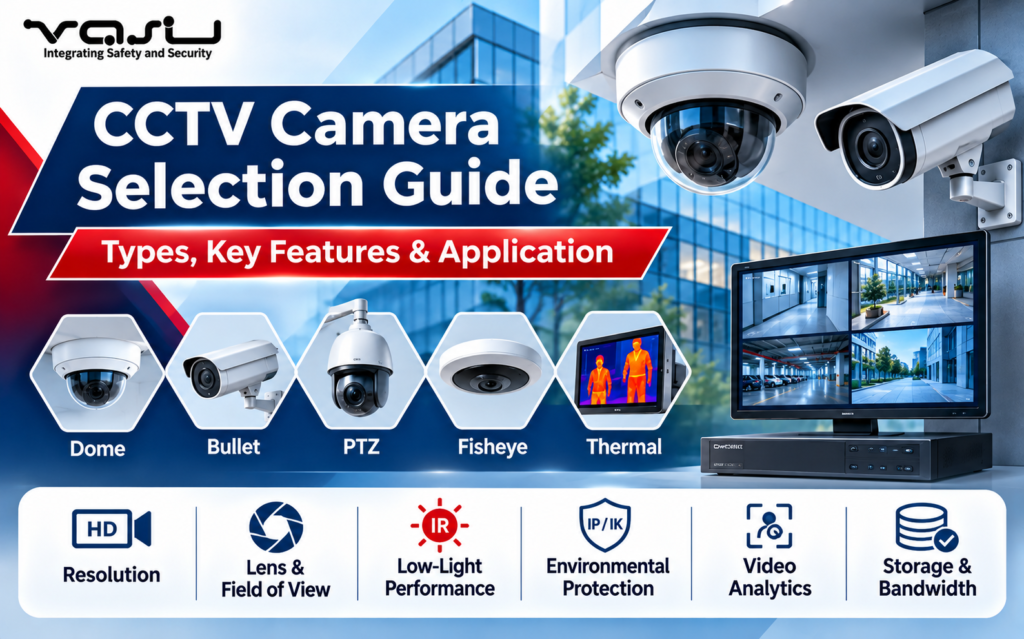
Application Guide
CCTV Camera Selection Guide – Types, Features & Selection Criteria
Nov 2026
1. Introduction
CCTV (Closed-Circuit Television) systems are essential components of modern electronic security infrastructure. They help monitor activities, improve situational awareness, record security events and support incident investigation across commercial, industrial and critical infrastructure facilities.
Selecting the right CCTV camera requires consideration of the surveillance area, lighting conditions, monitoring requirements, environmental conditions, image quality and system integration.
This guide explains the key factors involved in selecting suitable CCTV cameras for different applications.
2. Scope & Applications
CCTV cameras are widely used across various sectors:
- Data Centres and IT Facilities.
- Airports and Metro Rail Stations.
- Industrial Plants and Manufacturing Facilities.
- Warehouses and Logistics Centres.
- Commercial Buildings and Corporate Offices.
- Oil & Gas Facilities and Refineries.
- Power Utilities and Substations.
- Pharmaceutical and Healthcare Facilities.
- Parking Areas and Perimeter Security.
Camera selection should be based on the specific security objectives and operational requirements of each location.
3. Types of CCTV Cameras
Different camera types are suitable for different surveillance applications.
| Camera Type | Application |
|---|---|
| Dome Camera | Indoor offices, corridors and commercial areas |
| Bullet Camera | Outdoor surveillance and perimeter monitoring |
| PTZ Camera | Large areas requiring pan, tilt and zoom functionality |
| Fisheye Camera | Wide-area surveillance with panoramic coverage |
| Box Camera | Specialised surveillance applications |
| Thermal Camera | Temperature-based monitoring and detection |
| ANPR Camera | Automatic Number Plate Recognition |
| Explosion-Proof Camera | Hazardous and classified industrial areas |
The camera type should be selected according to the required field of view, installation environment and surveillance objective.
4. Key Factors for CCTV Camera Selection
4.1 Resolution
Camera resolution determines the level of image detail captured.
Common resolution options include:
- 2 MP (1080p)
- 4 MP
- 5 MP
- 8 MP (4K)
Higher resolution can provide greater image detail but also increases bandwidth and storage requirements.
4.2 Lens & Field of View
Lens selection determines the area covered by the camera.
- Fixed Lens – Suitable for predefined monitoring areas.
- Varifocal Lens – Allows adjustment of focal length.
- Motorised Lens – Supports remote focal length adjustment.
- PTZ Zoom Lens – Supports optical zoom for distant objects.
The lens should be selected based on the required viewing angle, target distance and identification objective.
4.3 Low-Light Performance
For areas with limited illumination, consider:
- Low-light image sensors.
- Infrared (IR) illumination.
- Wide Dynamic Range (WDR).
- Day/Night functionality.
- Suitable supplementary lighting.
These features help maintain usable video quality under varying lighting conditions.
4.4 Environmental Protection
For outdoor and industrial applications, evaluate:
- IP rating for dust and water ingress protection.
- IK rating for mechanical impact resistance.
- Operating temperature range.
- Corrosion resistance.
- Weatherproof housing.
- Hazardous-area certification, where required.
4.5 Video Analytics
Depending on project requirements, cameras may support:
- Motion Detection.
- Intrusion Detection.
- Line Crossing Detection.
- Object Classification.
- People Counting.
- Face Detection.
- ANPR / LPR.
Analytics capabilities should be verified against the intended application and privacy requirements.
5. CCTV Camera Selection by Application
| Application Area | Recommended Camera Type |
|---|---|
| Data Centre Server Rooms | Fixed Dome / Bullet Camera |
| Building Entrances | Dome / Bullet Camera |
| Perimeter Security | Bullet / Thermal / PTZ Camera |
| Parking Areas | Bullet / PTZ / ANPR Camera |
| Industrial Facilities | Rugged Dome / Bullet Camera |
| Warehouses | Dome / PTZ Camera |
| Hazardous Areas | Certified Explosion-Proof Camera |
| Large Open Areas | PTZ / Multi-Sensor Camera |
Final selection should be validated through site assessment, field-of-view analysis and surveillance coverage planning.
6. CCTV System Design Considerations
A properly designed CCTV system requires more than selecting individual cameras.
1. Site Survey: Identify surveillance locations, security risks, blind spots and monitoring requirements.
2. Camera Placement: Determine mounting height, viewing direction, coverage area and installation position.
3. Storage Calculation: Estimate recording storage based on camera count, resolution, frame rate, compression, recording duration and retention period.
4. Network Bandwidth: Evaluate camera bitrate, network capacity, PoE requirements and uplink bandwidth.
5. Recording Architecture: Select suitable Network Video Recorders (NVRs), Video Management Systems (VMS) and storage infrastructure.
6. Power Supply: Verify PoE switch capacity, power budgets, UPS backup and electrical requirements.
7. System Integration: Consider integration with access control, video analytics, IBMS/BMS and other security systems where required.
8. Cybersecurity: Implement secure passwords, network segmentation, access restrictions, firmware updates and controlled remote access.
7. Installation, Testing & Commissioning
CCTV installation and commissioning should follow approved project drawings, manufacturer instructions and applicable standards.
Installation Requirements:
- Verify camera locations and mounting arrangements.
- Ensure correct lens selection and camera orientation.
- Provide suitable cable routing and termination.
- Verify PoE switch and power supply capacity.
- Configure IP addresses and network connectivity.
- Ensure suitable environmental protection.
- Provide equipment labelling and identification.
Testing & Commissioning:
- Camera live-view verification.
- Image quality and focus testing.
- Day and night performance testing.
- Field-of-view and coverage verification.
- Recording and playback testing.
- Storage and retention verification.
- Video analytics functional testing, where applicable.
- Network and cybersecurity configuration checks.
- Integration testing with VMS and other systems.
- Preparation of commissioning and handover documents.
8. CCTV Camera Selection Checklist
| Sr. No. | Verification Point |
|---|---|
| 1 | Surveillance objective identified |
| 2 | Site survey completed |
| 3 | Camera type selected |
| 4 | Resolution requirement verified |
| 5 | Lens and field of view assessed |
| 6 | Low-light performance evaluated |
| 7 | IP / IK protection requirements checked |
| 8 | Video analytics requirements identified |
| 9 | Network bandwidth calculated |
| 10 | Storage capacity and retention period assessed |
| 11 | Power and UPS requirements verified |
| 12 | VMS / NVR compatibility confirmed |
| 13 | Cybersecurity requirements reviewed |
| 14 | Testing and commissioning completed |
9. Frequently Asked Questions (FAQs)
Q1. Which CCTV camera is best for industrial facilities?
Bullet, dome, PTZ or specialised rugged cameras may be suitable depending on the surveillance area, environmental conditions and security objectives.
Q2. What is the difference between dome and bullet cameras?
Dome cameras are commonly used for indoor and discreet surveillance, while bullet cameras are commonly used for visible outdoor and perimeter monitoring.
Q3. What CCTV resolution is suitable for a data centre?
Resolution should be selected based on the required level of detail, viewing distance, field of view and identification objectives.
Q4. What is the difference between NVR and DVR?
An NVR records video from IP cameras over a network, whereas a DVR generally records video from analogue camera systems.
Q5. What is WDR in CCTV cameras?
Wide Dynamic Range (WDR) helps manage scenes containing both very bright and very dark areas.
Q6. How is CCTV storage capacity calculated?
Storage depends on camera count, bitrate, recording duration, compression method, frame rate and retention period.
Q7. Which standard is relevant to CCTV systems?
IEC 62676 is an important international standard series for video surveillance systems for use in security applications.
10. Conclusion
Effective CCTV camera selection is essential for achieving reliable surveillance coverage, image quality and operational performance. A systematic approach involving site assessment, camera selection, network design, storage planning, cybersecurity and commissioning helps deliver an integrated video surveillance solution.
For EPC contractors and system integrators, proper coordination between CCTV, access control, IBMS and other electronic security systems is important for developing a comprehensive security infrastructure.
Important Reference
IEC 62676 Series – Video Surveillance Systems for Use in Security Applications.
Official Reference: https://www.iec.ch/