
Article
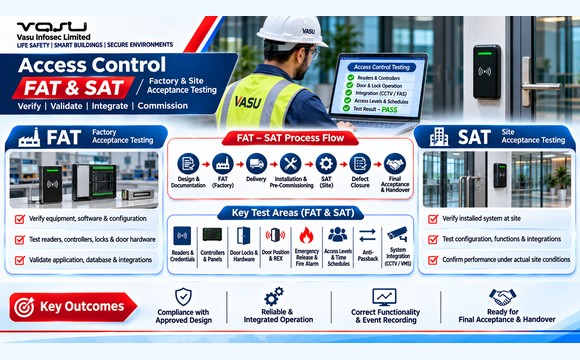
Access Control FAT & SAT
Oct 2026
Direct Answer
Factory Acceptance Testing (FAT) and Site Acceptance Testing (SAT) provide structured verification of an Access Control System before delivery and after site installation. FAT verifies equipment, software and configuration against approved requirements, while SAT verifies the installed and integrated system under actual site conditions.
1. Engineering Overview
Factory Acceptance Testing (FAT) and Site Acceptance Testing (SAT) provide structured verification of an Access Control System before delivery and after site installation. FAT verifies equipment, software and configuration against approved requirements, while SAT verifies the installed and integrated system under actual site conditions.
2. Complete FAT–SAT Architecture
Approved Design & Documentation → Equipment / Software Verification → FAT → Delivery → Installation → Pre-Commissioning → Device Testing → Network Testing → Access Control Configuration → Integration Testing → SAT → Defect Closure → Final Acceptance → Handover
3. FAT Objective
FAT confirms that the supplied access-control equipment, software, configuration and defined functions comply with the approved technical requirements before site acceptance. The FAT scope should follow the approved test procedure and inspection requirements.
4. FAT Documentation
FAT documentation may include approved datasheets, equipment schedules, access-control architecture, door schedules, controller schedules, software configuration, test procedures, interface matrices and manufacturer documentation.
5. Reader FAT
Reader FAT should verify the approved model, credential technology, communication interface, environmental characteristics and relevant functional features. Where practical, credential reading and controller communication should be demonstrated.
6. Controller / Panel FAT
Controller FAT should verify controller model, door capacity, reader interfaces, input / output capacity, configuration, communication capability, event handling and other approved functions.
7. Lock & Door Hardware FAT
Where included in the FAT scope, locking devices and associated hardware should be verified for model, operating characteristics, electrical requirements and compatibility with the approved access-control architecture.
8. Server & Software FAT
Server and software FAT may verify application installation, database operation, user management, access levels, door configuration, schedules, alarms, event logging, reporting and approved system integrations.
9. FAT Integration Testing
Where the final integration can be demonstrated, interfaces with CCTV, visitor management, fire alarm, turnstiles, vehicle barriers or other approved systems should be tested against the approved integration matrix.
10. FAT Witness & Records
FAT may be witnessed by the client, consultant or authorised representative where specified. All results, observations, deviations and corrective actions should be documented and approved by the relevant parties.
11. Site Readiness for SAT
Before SAT, site readiness should be confirmed, including installed doors, readers, controllers, locking devices, door position sensors, request-to-exit devices, network connectivity, power supply, server availability and approved system configuration.
12. Device Installation Verification
Each access-control device should be checked for correct location, model, mounting, wiring, identification, physical condition, environmental suitability and connection to the correct controller.
13. Credential Testing
SAT should verify valid credential recognition, invalid credential rejection, credential assignment, access schedules and access-level restrictions for representative users.
14. Door Lock Testing
Each representative door or all designated doors, as required, should be tested for lock release, secure condition, access-granted response, access-denied response and correct restoration after the access event.
15. Door Position Testing
Door position sensors should be tested for closed, open, forced-door and door-held-open conditions. The system should correctly display and record the associated status and alarm events.
16. Request-to-Exit Testing
Request-to-exit devices should be tested to confirm authorised exit operation and correct event correlation. Normal exit activity should not be incorrectly reported as forced entry.
17. Emergency Release Testing
Emergency release arrangements should be tested according to the approved life-safety procedure. Designated doors should achieve the required release condition during the approved emergency scenario.
18. Fire Alarm Interface SAT
Where integrated, the fire alarm interface should be tested to confirm the approved emergency-release cause-and-effect, door response, status indication, event logging and restoration sequence.
19. Access Level & Schedule Testing
Representative access levels, time schedules, holidays and restricted-area permissions should be tested to confirm that users receive only the authorised access rights.
20. Anti-Passback Testing
Where anti-passback is provided, SAT should verify valid entry / exit sequences and configured violation behaviour. Hard or soft anti-passback response should match the approved configuration.
21. Turnstile Testing
Where turnstiles are included, testing should verify credential authentication, lane release, passage detection, direction control, safety functions, emergency release and access-event logging.
22. Vehicle Barrier Testing
Where vehicle barriers are integrated, testing should verify vehicle credential / identification, barrier opening, safety detection, barrier status, emergency operation and event correlation.
23. Visitor Management Testing
Where visitor management is integrated, testing should verify visitor registration, approval, temporary credential issuance, access activation, access expiry and check-out functions.
24. CCTV Integration Testing
Where CCTV integration is provided, access events should be correlated with the appropriate camera or video event according to the approved interface configuration.
25. Network & Communication Testing
SAT should verify communication between readers, controllers, servers, workstations and approved integrated systems. IP addressing, VLAN connectivity, communication status and fault indications should be verified.
26. Power & UPS Testing
Where required, power supplies, controller backup batteries and UPS-supported equipment should be tested. The system response to power interruption and restoration should be verified against the approved design.
27. User & Security Testing
Operator and administrator accounts should be tested to confirm role-based permissions. Unauthorised users should not be able to access restricted configuration or administrative functions.
28. Event & Reporting Testing
The system should be tested for event generation, timestamp accuracy, event retrieval, alarm acknowledgement, reporting and audit records. Representative access and fault events should be reviewed.
29. Failure & Recovery Testing
Where required, controlled tests should verify controller communication loss, server communication loss, network interruption, power interruption and recovery. Local controller operation and event synchronisation should be verified where supported.
30. Defect & Punch List
All defects identified during FAT, SAT or commissioning should be recorded in a controlled punch list with equipment identification, observation, responsible party, corrective action, target date and retest status.
31. Retesting & Closure
Corrective actions should be followed by retesting of the affected functions. FAT / SAT items should be considered closed only after the required acceptance criteria have been demonstrated and documented.
32. Handover Requirements
Handover should include approved as-built drawings, door and reader schedules, controller schedules, access-level matrix, user / credential records as permitted, network details, interface matrices, test reports, defect closure records, configuration backups and O&M documentation.
33. Documentation
Access control FAT and SAT documentation should include, as applicable:
- Approved FAT procedure
- FAT test records
- Approved SAT procedure
- SAT test records
- Door / reader test sheets
- Controller test records
- Lock test records
- Emergency-release test records
- Integration test records
- Network test records
- Punch list and closure records
- Final acceptance records
- As-built documentation
- O&M manual
34. Engineering Objective
The engineering objective is:
Verify Approved Design → Verify Equipment & Configuration → Conduct FAT → Confirm Site Installation → Test Devices & Doors → Verify Network & Server → Validate Access Levels & Alarms → Test Emergency & Integrated Functions → Conduct SAT → Close Defects → Obtain Final Acceptance → Establish Documented & Maintainable Access Control System
Frequently Asked Questions
What is access control fat & sat?
Factory Acceptance Testing (FAT) and Site Acceptance Testing (SAT) provide structured verification of an Access Control System before delivery and after site installation. FAT verifies equipment, software and configuration against approved requirements, while SAT verifies the installed and integrated system under actual site conditions.
What should be checked before installation?
Confirm equipment compatibility, approved interfaces, power and network requirements, installation details, emergency or fault behaviour where applicable, and manufacturer instructions.
What should be tested during commissioning?
Test functions and scenarios identified in the source content and approved project procedures, including normal operation, alarms, integrations, power or communication failures where applicable, and restoration.
What documentation should be retained?
Retain applicable schedules, wiring and interface details, configuration records, test and commissioning records, as-built drawings and O&M documentation as required by the project.