
Article
Access Control Integration with Fire Alarm
Oct 2026
Direct Answer
Access Control and Fire Alarm integration provides coordinated door-release behaviour during fire or other approved emergency conditions. The interface ensures that designated access-controlled doors respond according to the approved life-safety strategy while maintaining normal security functions during non-emergency operation.
1. Engineering Overview
Access Control and Fire Alarm integration provides coordinated door-release behaviour during fire or other approved emergency conditions. The interface ensures that designated access-controlled doors respond according to the approved life-safety strategy while maintaining normal security functions during non-emergency operation.
2. Complete Integration Architecture
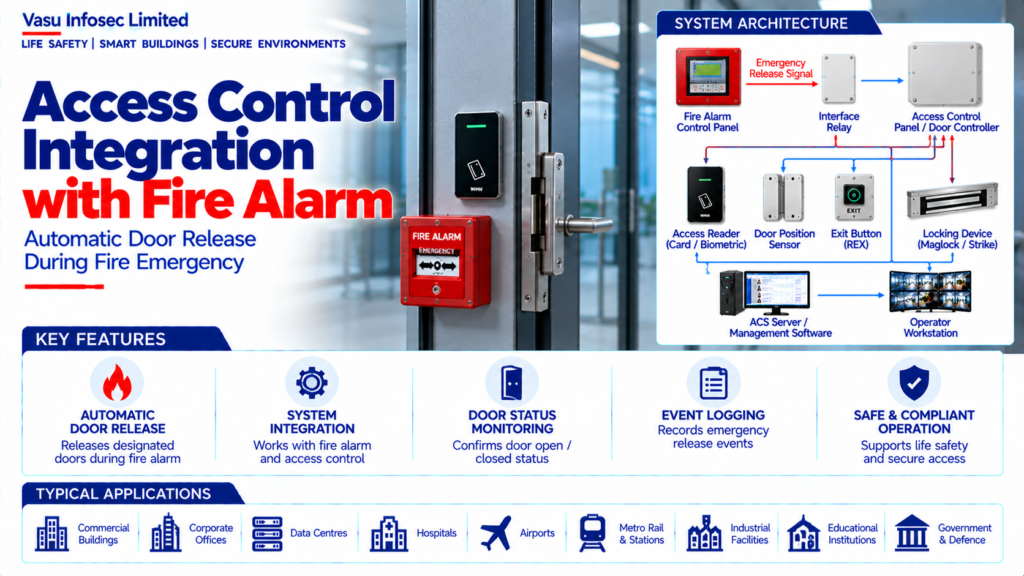
Fire Alarm Control Panel → Approved Interface / Relay → Access Control Panel / Door Controller → Designated Door Locking Devices
Access Control Reader → Door Controller → Locking Device
Door Position Sensor + Request-to-Exit → Door Controller
Access Control Network → ACS Server / Management Software → Operator Workstation
Supporting Infrastructure → Power Supply / UPS → Field Devices
3. Normal Operating Principle
Under normal conditions, the access control system controls the designated doors according to authorised credentials, schedules and access levels. The fire alarm interface remains in its normal supervisory state until an approved emergency signal is received.
4. Emergency Operating Principle
When the fire alarm system generates the defined emergency signal, the approved interface transfers the signal to the access control system. The access control system then places designated doors into the pre-engineered emergency-release condition.
5. Cause-and-Effect Architecture
The cause-and-effect matrix should identify:
- Fire alarm initiating condition
- Affected access-controlled doors
- Release command
- Locking-device response
- Door status monitoring
- Alarm / event indication
- Restoration sequence
- Manual override conditions, where approved
6. Door Selection
Not every access-controlled door necessarily follows the same emergency-release logic. The affected doors should be identified from the approved fire strategy, life-safety drawings, access-control drawings and cause-and-effect matrix.
7. Electromagnetic Lock Interface
Where electromagnetic locks are used, the approved emergency-release arrangement may remove power to designated locks. The interface should be designed so that the required emergency egress behaviour is achieved under the approved power architecture.
8. Electric Strike Interface
Where electric strikes are used, the emergency-release response depends on the selected fail-safe / fail-secure configuration and door hardware. The arrangement must maintain required emergency egress and comply with the approved life-safety design.
9. Emergency Release Interface
The fire alarm signal should be transmitted through an approved interface arrangement. Relay contacts, monitored interfaces or other approved methods may be used according to the fire alarm and access-control system architecture.
10. Signal Integrity
The fire alarm-to-access-control interface should be designed so that the emergency signal is reliably transmitted and correctly interpreted. Interface faults should be identified where the selected systems support fault monitoring.
11. Door Status Monitoring
Door position sensors should continue to provide status feedback where supported. The access control system may record doors released by the fire alarm and subsequent door movement.
12. Event Logging
Emergency release events should be logged by the access control system where supported. The event record should provide appropriate information such as door identification, event type and timestamp.
13. Fire Alarm Reset & Restoration
Restoration of access-control operation after a fire alarm condition should follow the approved cause-and-effect sequence. Resetting the fire alarm should not automatically create an unsafe or unintended door condition.
14. Manual Reset / Override
Where manual reset, override or bypass functions are provided, they should be clearly defined, access-controlled and documented. Such functions should not compromise required emergency egress.
15. Power Supply & UPS
The integration must consider normal power, UPS and battery-backed supplies. Backup power should not unintentionally prevent required emergency door release. The power architecture should be reviewed as part of the life-safety design.
16. Fire Alarm Panel Interface
The fire alarm panel should provide the approved output or interface required to initiate access-control emergency release. Interface points, relay characteristics and termination arrangements should be verified against the approved system design.
17. Access Control Panel Interface
The access control panel should receive and process the approved emergency signal and control the designated locking devices. Controller input configuration and emergency-release logic should be documented.
18. Integration with CCTV
Where required, fire alarm emergency release events may be integrated with CCTV / VMS to support situational monitoring. The interface should be defined in the approved integration matrix.
19. Security Considerations
The fire alarm interface should be protected against unauthorised modification or bypass. Access to configuration, interface wiring and override functions should be restricted to authorised personnel.
20. Installation Requirements
Installation should verify:
- Correct fire alarm interface point
- Correct access control interface point
- Correct affected door list
- Correct relay / interface configuration
- Correct lock-release logic
- Correct door position monitoring
- Correct power / UPS arrangement
- Correct cause-and-effect configuration
- Correct cable routing and identification
- Proper segregation and protection of interface wiring
21. Testing & Commissioning
Integration commissioning should verify:
- Normal access control operation
- Fire alarm emergency signal
- Release of designated doors
- Door position indication
- Emergency event logging
- Lock restoration behaviour
- Fire alarm reset behaviour
- Manual override / reset, where applicable
- Power interruption behaviour
- Communication / interface fault indication, where supported
22. Failure & Recovery
Controlled tests should verify the approved response to interface faults, power interruptions and restoration. Any failure mode should be assessed against the approved life-safety and security requirements.
23. Maintenance
Maintenance should include periodic interface testing, relay / module inspection, wiring checks, door-release verification, fire alarm interface verification, access-control event review and confirmation that approved cause-and-effect logic remains unchanged.
24. Design Change Control
Any change to fire alarm zones, access-controlled doors, locking devices, controller configuration, interface modules, power architecture or emergency-release logic should trigger a review of the approved cause-and-effect matrix.
25. Documentation
Integration documentation should include, as applicable:
- Fire alarm / access control interface architecture
- Affected door schedule
- Cause-and-effect matrix
- Fire alarm interface schedule
- Access control panel input / output schedule
- Lock schedule
- Power / UPS calculation
- Wiring diagrams
- Testing and commissioning records
- Interface test reports
- As-built drawings
- O&M manual
26. Engineering Objective
The engineering objective is:
Define Life-Safety Requirement → Identify Affected Access-Controlled Doors → Establish Fire Alarm Interface → Define Cause & Effect → Integrate Door Controllers & Locks → Verify Power / UPS Behaviour → Test Emergency Release & Restoration → Establish Safe, Reliable & Documented Fire Alarm–Access Control Integration
Frequently Asked Questions
What is access control integration with fire alarm?
Access Control and Fire Alarm integration provides coordinated door-release behaviour during fire or other approved emergency conditions. The interface ensures that designated access-controlled doors respond according to the approved life-safety strategy while maintaining normal security functions during non-emergency operation.
What should be checked before installation?
Confirm equipment compatibility, approved interfaces, power and network requirements, installation details, emergency or fault behaviour where applicable, and manufacturer instructions.
What should be tested during commissioning?
Test functions and scenarios identified in the source content and approved project procedures, including normal operation, alarms, integrations, power or communication failures where applicable, and restoration.
What documentation should be retained?
Retain applicable schedules, wiring and interface details, configuration records, test and commissioning records, as-built drawings and O&M documentation as required by the project.
SEO & Publishing Details
| SEO Title | Access Control Integration with Fire Alarm | Technical Guide | Vasu Infosec Limited |
| Meta Description | Access Control and Fire Alarm integration provides coordinated door-release behaviour during fire or other approved emergency conditions. The |
| Primary Keyword | Access Control Integration with Fire Alarm |
| Secondary Keywords | Access Control Integration with Fire Alarm; access control system; electronic security; system architecture; installation and commissioning |
| Suggested URL Slug | access-control-integration-with-fire-alarm |
| Suggested Image Alt Text | Technical architecture and key components of access control integration with fire alarm |