
Article
Access Control Integration with IBMS
Oct 2026
Direct Answer
Access Control Integration with an Integrated Building Management System (IBMS) provides central supervisory visibility of door status, approved access events, alarms and controller health. Authentication, credential validation, access decisions and security-critical functions remain within the dedicated access control system.
1. Engineering Overview
Access Control Integration with IBMS establishes a controlled interface between the dedicated access control system and the Integrated Building Management System. The integration provides central supervisory visibility of doors, access events, alarms and approved status information while the dedicated access control system retains its primary authentication, access decision and security functions.
2. Integration Architecture
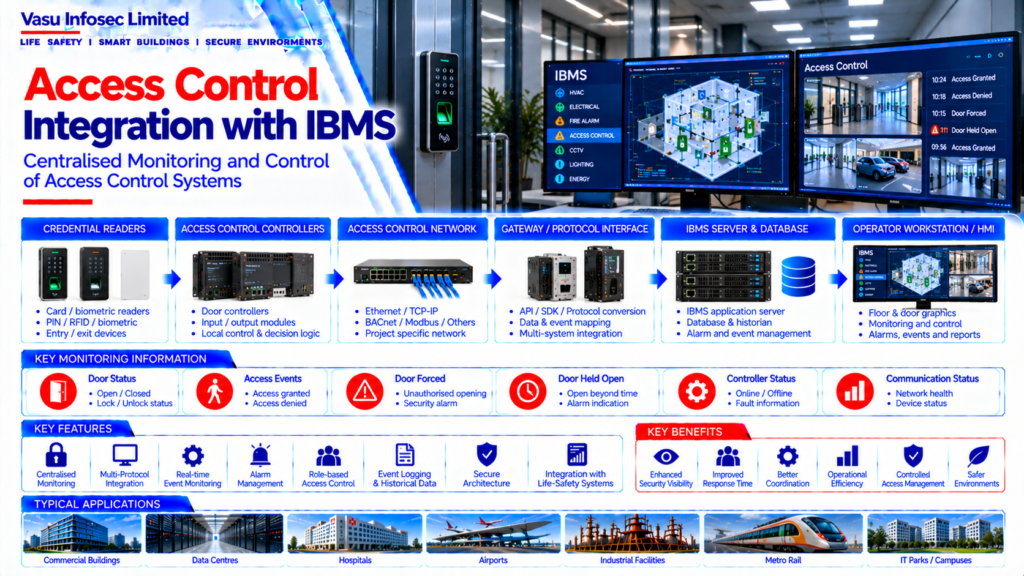
Card / Biometric / Credential Reader → Access Control Controller → Access Control Network → Gateway / API / Protocol Interface → IBMS Server → Database → Operator Workstation / HMI
Typical Information → Door Status → Access Granted / Denied → Door Forced → Door Held Open → Controller Fault → Communication Status → Other Approved Events
3. Integration Philosophy
The IBMS should provide monitoring and only those control functions specifically defined in the approved integration scope. Access authentication, credential validation, access decisions and security-critical functions should remain within the dedicated access control architecture.
4. Access Control System Components
A typical system may include card readers, biometric readers, access control panels, door controllers, electromagnetic locks, electric strikes, request-to-exit devices, door contacts, exit switches, software servers and operator workstations.
5. Door Status Monitoring
Door contact information may be integrated into IBMS to indicate door open, closed or other approved states. The status should be mapped to the correct door identification and displayed through the approved graphics.
6. Access Event Monitoring
Approved access events such as authorised entry, denied access, invalid credential, forced door and other defined events may be transmitted to IBMS. Event descriptions should clearly identify the associated door or access point.
7. Door Forced Alarm
A door forced condition indicates that a monitored door has been opened without the expected authorised access sequence. Where integrated, the condition should be displayed as an appropriate security alarm within IBMS.
8. Door Held Open Monitoring
Where supported, the access control system may generate a door-held-open event when a door remains open beyond the approved duration. IBMS should display the event according to the approved alarm priority and response philosophy.
9. Access Controller Monitoring
Controller health, communication status, power condition and approved fault indications may be monitored through IBMS. The exact points should be defined in the approved integration point list.
10. Emergency Interface
Where emergency functions are required, access control may interface with fire alarm or other life-safety systems through an approved Cause and Effect arrangement. Life-safety release logic should remain governed by the dedicated approved system architecture.
11. IBMS Commands
Where specifically approved, IBMS may provide limited commands such as authorised door unlock, lock / unlock status or other supervisory functions. Commands should be subject to role-based permissions and should not bypass the access control system’s security logic.
12. Gateway / Protocol Interface
Integration may use an approved API, SDK, BACnet, Modbus, TCP/IP or other supported interface depending on the access control platform. Gateway configuration should define point mapping, event mapping, commands and communication health.
13. Point & Event Mapping
The integration schedule should define door identifiers, controller identifiers, status points, alarm events, access events and authorised commands. Mapping should be verified against the access control database and approved IBMS graphics.
14. Alarm Management
Access control alarms may include forced door, door held open, controller fault, communication failure, tamper condition and other approved security events. Alarm priorities should follow the approved security alarm philosophy.
15. Graphics & HMI
IBMS graphics should provide a clear representation of access-controlled doors, their status and relevant alarms. Floor-level and door-level navigation should correspond with approved access control drawings and schedules.
16. Event Logging
Approved access and security events displayed in IBMS may be logged for historical review. Time synchronisation should be coordinated so that events from the access control system and IBMS have consistent timestamps where required.
17. User & Role Management
Access to integrated access control information and commands should be role-based. Monitoring, acknowledgement and control privileges should be assigned only to authorised personnel.
18. Cybersecurity
Access control integration should follow the approved cybersecurity architecture. Network segregation, secure communication, user authentication and controlled remote access should be implemented as required by the project.
19. Installation Requirements
Installation should verify:
- Correct readers and controllers
- Correct door contacts
- Correct access control network
- Correct gateway / interface
- Correct point and event mapping
- Correct door identification
- Correct alarm mapping
- Correct graphics
- Correct user permissions
- Proper cable segregation
20. Testing & Commissioning
Access Control-IBMS commissioning should verify:
- Door status
- Access granted / denied events
- Door forced alarm
- Door held open alarm
- Controller fault
- Communication failure
- Event mapping
- Alarm priority
- Graphics
- Authorised commands
- Emergency interface, where applicable
21. Communication Failure
Loss of communication between the access control system and IBMS should generate the approved communication fault indication. The dedicated access control system should continue its local security functions according to its designed operating mode.
22. Maintenance
Maintenance should include reader and controller checks, door contact verification, communication diagnostics, gateway inspection, database / configuration backup, alarm testing and periodic verification of integrated points.
23. Design Change Control
Changes to doors, readers, controllers, access levels, communication protocols, integration interfaces, point lists, graphics or emergency interfaces should be reviewed against the approved access control integration design before implementation.
24. Documentation
Access control integration documentation should include, as applicable:
- Access control architecture
- Door schedule
- Controller schedule
- Point / event list
- Interface matrix
- Gateway / API details
- Cause and Effect Matrix
- Alarm philosophy
- Graphics schedule
- User access matrix
- Testing and commissioning records
- As-built drawings
- O&M manual
25. Engineering Objective
The engineering objective is:
Reliable Credential & Door Monitoring → Dedicated Access Decision → Controlled Integration → Accurate IBMS Status & Event Monitoring → Clear Security Alarms → Authorised Supervisory Control → Verified Emergency Interface → Complete Commissioning → Reliable Access Management
SEO & Website Publishing Information
SEO title: Access Control Integration with IBMS | Architecture & Monitoring
Meta description: Learn how access control integrates with IBMS for door status, access events, alarms, controller monitoring, approved commands, cybersecurity and commissioning.
Suggested URL slug: /access-control-integration-with-ibms/
Primary keyword: Access Control Integration with IBMS
Secondary keywords: IBMS access control monitoring; door status monitoring; access event integration; forced door alarm; door held open alarm; access control gateway; building management system security integration
Suggested image alt text: Access control system integration architecture showing credential readers, access control controllers, approved interface and IBMS operator workstation
Suggested excerpt: A practical engineering overview of integrating an access control system with IBMS while retaining authentication, access decisions and security-critical functions in the dedicated access control architecture.
Frequently Asked Questions
What is access control integration with IBMS?
It is an approved interface that allows IBMS to display selected access-control status information, events and alarms from the dedicated access control system.
Which access-control events can IBMS monitor?
Depending on the approved point and event list, examples include access granted or denied, door status, forced-door events, door-held-open events, controller faults and communication status.
Does IBMS make access decisions?
The source document specifies that authentication, credential validation, access decisions and security-critical functions should remain within the dedicated access control architecture.
Can IBMS unlock a door?
Only where specifically approved. Any such command should use role-based permissions and must not bypass the access control system’s security logic.
How is the integration connected?
Depending on the platform, the interface may use an approved API, SDK, BACnet, Modbus, TCP/IP or another supported interface. The final method must be confirmed for the selected equipment and project.
What should be checked during commissioning?
Checks include door status, access events, forced-door and held-open alarms, controller faults, communication failure, event mapping, alarm priority, graphics, authorised commands and emergency interfaces where applicable.