
Article
Access Control Panel Architecture
Oct 2026
Direct Answer
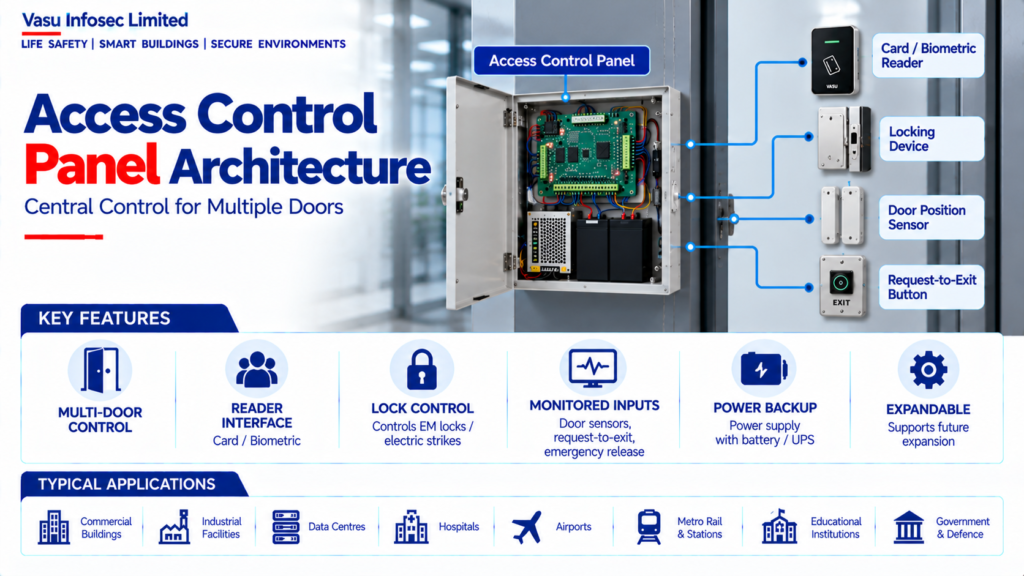
An Access Control Panel is the central field-level hardware interface used to connect and manage multiple access-control devices such as readers, door controllers, locking devices, door position sensors, request-to-exit devices and emergency release inputs. The panel architecture should provide reliable control, monitoring, communication, power distribution and expansion capability.
1. Engineering Overview
An Access Control Panel is the central field-level hardware interface used to connect and manage multiple access-control devices such as readers, door controllers, locking devices, door position sensors, request-to-exit devices and emergency release inputs. The panel architecture should provide reliable control, monitoring, communication, power distribution and expansion capability.
2. Complete Access Control Panel Architecture
Access Readers → Access Control Panel / Door Controllers → Locking Devices
Door Position Sensors + Request-to-Exit + Emergency Release → Panel Inputs
Panel → Access Control Network → ACS Server / Management Software → Operator Workstation
Power Supply / Battery / UPS → Panel → Field Devices
Supporting Infrastructure → Network → Time Synchronisation → Cybersecurity
3. Panel Core Functions
The access control panel may provide reader interfaces, door-control outputs, monitored inputs, access decision processing, event handling, local configuration, communication with the central server and control of connected locking devices.
4. Panel Capacity
Panel capacity is determined by the number of doors, readers, inputs, outputs, controllers and communication interfaces supported. The selected panel should accommodate the current requirement and approved future expansion.
5. Reader Interface
The panel receives credential information from connected readers through the approved communication interface. Interface type, cable distance, reader power requirements and security features should be verified during selection.
6. Door Controller Interface
Depending on the architecture, the panel may contain integrated door controllers or communicate with distributed door controllers. The selected arrangement should match the project door count, network topology and operational requirements.
7. Lock Control Outputs
Panel outputs control the approved door locking devices. Output type, current rating, relay configuration and fail-safe / fail-secure behaviour should be coordinated with the selected lock and life-safety requirements.
8. Door Monitoring Inputs
Monitored inputs receive signals from door position sensors and other field devices. Input configuration should distinguish normal, alarm and fault conditions according to the approved door logic.
9. Request-to-Exit Inputs
Request-to-exit devices provide an authorised exit signal to the panel. The panel should process the input so that a valid exit is not incorrectly reported as a forced-door condition.
10. Emergency Release Interface
Emergency release inputs allow designated doors to respond to approved fire alarm or emergency-release commands. The interface and restoration behaviour should be defined in the approved cause-and-effect matrix.
11. Access Decision Logic
The panel may perform local access decisions or receive authorisation information from the central access control server, depending on system architecture. Offline behaviour should be defined and tested.
12. Local Processing & Memory
Where supported, panels may retain access permissions, event data and configuration locally so that essential access functions can continue during temporary communication loss. Memory capacity should be verified for the required offline operation.
13. Network Communication
Panels may communicate with the ACS server through Ethernet or other approved communication networks. IP addressing, VLANs, communication protocols, bandwidth and cybersecurity controls should be defined in the network architecture.
14. Panel Power Supply
The panel and connected field devices require an appropriately sized power supply. The power calculation should include readers, controllers, locks, auxiliary devices and required design margin.
15. Battery Backup
Where battery backup is required, battery capacity should be calculated based on the panel and connected loads, required autonomy and applicable project requirements. Battery monitoring should be provided where supported.
16. UPS Integration
Critical access control panels may be supplied through UPS systems in addition to or instead of local battery backup. The power architecture should define the required continuity for controllers, readers and locks.
17. Panel Enclosure
The panel enclosure should provide suitable physical protection, access for maintenance, cable entry, component arrangement and environmental protection. Outdoor or harsh-area installations require appropriately rated enclosures.
18. Tamper Monitoring
Panel enclosures may include tamper switches to detect unauthorised opening. Tamper events should be transmitted to the access control system and recorded where required.
19. Communication Redundancy
Critical access control systems may use redundant network paths, controllers or communication arrangements. Redundancy should be coordinated with the approved availability requirements and tested during commissioning.
20. Fire Alarm Integration
Where required, the access control panel should interface with the fire alarm system to release designated doors during an emergency. The interface should be coordinated with the approved fire strategy and life-safety requirements.
21. CCTV Integration
The access control panel / system may provide events to the CCTV platform so that access transactions can be correlated with video. The event interface should follow the approved integration matrix.
22. Installation Requirements
Installation should verify:
- Correct panel model
- Correct door capacity
- Correct reader capacity
- Correct input / output capacity
- Correct locking-device interface
- Correct power supply
- Correct battery arrangement
- Correct network connectivity
- Correct IP / VLAN configuration
- Correct emergency release interface
- Correct tamper monitoring
- Proper cable routing and identification
23. Testing & Commissioning
Panel commissioning should verify:
- Reader communication
- Access granted / denied
- Lock control
- Door position monitoring
- Request-to-exit
- Door-held-open alarm
- Forced-door alarm
- Emergency release
- Network communication
- Offline operation, where supported
- Battery / UPS operation
- Tamper alarm
- Event logging
24. Maintenance
Maintenance should include panel inspection, terminal and cable checks, power-supply verification, battery condition checks, network communication, input / output testing, tamper verification, configuration backup and review of system events.
25. Capacity Verification
Final panel capacity verification should consider:
- Number of doors
- Number of readers
- Number of inputs
- Number of outputs
- Lock loads
- Auxiliary loads
- Network interfaces
- Battery / UPS capacity
- Future expansion
26. Design Change Control
Changes to door count, reader type, lock type, input / output requirements, panel model, network architecture or emergency release logic should trigger a panel capacity and compatibility review.
27. Documentation
Access control panel documentation should include, as applicable:
- Panel schedule
- Door / reader allocation
- Input / output schedule
- Lock schedule
- Wiring diagrams
- Power and battery calculations
- Network / IP details
- Cause-and-effect matrix
- Panel configuration
- Testing and commissioning records
- As-built drawings
- O&M manual
28. Engineering Objective
The engineering objective is:
Establish Door & Reader Count → Determine Panel Capacity → Define Inputs & Outputs → Select Controller / Panel Architecture → Size Power & Battery → Integrate Network & Emergency Release → Verify Local & Central Operation → Complete Testing → Establish Reliable Access Control Field Infrastructure
Frequently Asked Questions
What is the main purpose of access control panel architecture?
An Access Control Panel is the central field-level hardware interface used to connect and manage multiple access-control devices such as readers, door controllers, locking devices, door position sensors, request-to-exit devices and emergency release inputs. The panel architecture should provide reliable control, monitoring, communication, power distribution and expansion capability.
What should be checked before selection or installation?
Verify compatibility with the approved system architecture, door hardware and connected devices, power requirements, network or communication interface, environmental conditions and applicable emergency-release requirements.
What should be tested during commissioning?
Test the functions identified in the source technical content and approved project documents, including normal operation, access granted/denied behaviour, monitoring inputs, alarms, emergency release where applicable, power and communication behaviour.
What documentation should be retained?
Maintain applicable schedules, wiring and interface details, configuration records, power calculations, test and commissioning records, as-built drawings and the O&M manual as required by the project.
SEO & Publishing Details
| SEO Title | Access Control Panel Architecture | Technical Guide | Vasu Infosec Limited |
| Meta Description | An Access Control Panel is the central field-level hardware interface used to connect and manage multiple access-control devices such as readers, |
| Primary Keyword | Access Control Panel Architecture |
| Secondary Keywords | Access Control Panel Architecture; access control system; electronic security; system architecture; installation and commissioning |
| Suggested URL Slug | access-control-panel-architecture |
| Suggested Image Alt Text | Technical architecture and key components of access control panel architecture |