
Article
Access Control Server Architecture
Oct 2026
Direct Answer
The Access Control Server is the central software and computing platform that manages access permissions, credentials, doors, controllers, events, alarms, reports and system configuration. Its architecture provides centralised administration and monitoring while supporting communication with field controllers and authorised operator workstations.
1. Engineering Overview
The Access Control Server is the central software and computing platform that manages access permissions, credentials, doors, controllers, events, alarms, reports and system configuration. Its architecture provides centralised administration and monitoring while supporting communication with field controllers and authorised operator workstations.
2. Complete Server Architecture
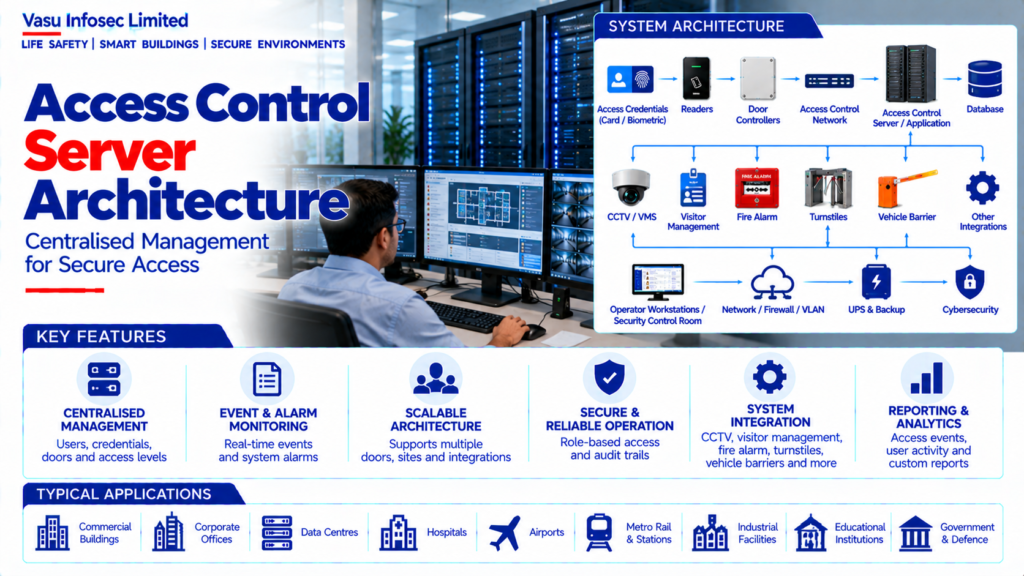
Access Credentials / Readers → Door Controllers → Access Control Network → Access Control Server / Application → Database
ACS Server → Management Workstations / Security Control Room
ACS Server ↔ Visitor Management / CCTV / Fire Alarm / Other Approved Integrations
Supporting Infrastructure → Core Network → Firewall / VLAN → UPS → Backup → Cybersecurity
3. Server Core Functions
The server platform may provide user and credential management, access-level configuration, door and controller management, event logging, alarm monitoring, reporting, system administration, integration services and configuration management.
4. Application Architecture
The access-control application provides the operational interface between administrators, operators, field controllers and the system database. Application services should be sized according to the number of doors, users, events, integrations and concurrent operators.
5. Database Architecture
The database stores approved system information such as users, credentials, access levels, door configuration, schedules, events and audit information. Database capacity should be based on expected transaction volume and retention requirements.
6. Server Deployment Models
The system may be deployed on a dedicated physical server, virtual machine or approved cloud / hosted infrastructure depending on project requirements. The selected deployment model should meet performance, availability, security and support requirements.
7. Server Capacity
Server sizing should consider:
- Number of doors
- Number of controllers
- Number of users
- Credential volume
- Event transaction rate
- Event retention period
- Number of operator workstations
- Integrated systems
- Database size
- Future expansion
8. Controller Communication
The server communicates with access-control panels and door controllers through the approved network. Communication status should be monitored so that controller connectivity failures can be identified and managed.
9. Network Architecture
The server should be connected to the approved security network using defined IP addressing, VLANs, firewall rules, routing and communication ports. Network segregation should be applied according to the approved cybersecurity architecture.
10. Operator Workstations
Authorised operators connect to the access-control application through designated workstations. Operator permissions should be role-based and restricted to required functions such as monitoring, reporting, access management or administration.
11. User & Credential Management
The server provides central management of user identities, credentials, access levels, schedules and status. Credential creation, modification, suspension and deletion should be controlled through authorised administrative roles.
12. Access Level Management
Access levels define the doors or zones available to users and the applicable time schedules. The server should provide controlled creation and assignment of access groups according to the approved security policy.
13. Time Schedule Management
The system should support approved access schedules, holidays and special periods where required. Consistent time configuration across servers and controllers is essential for accurate access decisions.
14. Event & Audit Management
The server should collect and store access events such as granted access, denied access, forced door, door held open, emergency release and system faults where supported. Administrative changes should also be auditable.
15. Alarm Management
Access-control alarms should be received, processed and presented to authorised operators. Alarm priorities, acknowledgement, escalation and event history should follow the approved alarm-management philosophy.
16. Reporting
The system may provide reports for access transactions, user activity, door events, alarms, attendance-related access records, visitor activity and administrative changes depending on the approved application.
17. Integration Architecture
The access-control server may integrate with CCTV / VMS, visitor management, fire alarm, IBMS, turnstiles, vehicle barriers and other approved platforms. Each interface should have a defined protocol, data exchange and responsibility matrix.
18. Fire Alarm Integration
Where required, the server should support monitoring or management of access-control status associated with fire alarm emergency-release events. The actual emergency door-release path should follow the approved life-safety architecture and cause-and-effect matrix.
19. CCTV Integration
Access events can be exchanged with the CCTV / VMS platform to correlate credential transactions with video. Integration should be based on the approved interface and event mapping.
20. Visitor Management Integration
The server may exchange visitor identity, temporary credential and visit-status information with the visitor management platform. Temporary access should be limited to the approved visit period and zones.
21. High Availability
Critical access-control systems may use redundant servers, virtualisation, database redundancy or other approved availability arrangements. The selected architecture should reflect the required system availability.
22. Backup & Recovery
System configuration and database information should be backed up according to the approved backup strategy. Recovery procedures should be documented and periodically tested.
23. Disaster Recovery
Where required, disaster recovery arrangements should define backup location, recovery sequence, recovery responsibilities and expected recovery performance. Critical access-control functions should be assessed for continuity requirements.
24. Cybersecurity
The server environment should implement secure authentication, role-based access, network segmentation, endpoint protection, patch management, restricted services, secure remote access and controlled administrative privileges according to the approved cybersecurity architecture.
25. Time Synchronisation
The server and connected controllers should use an approved time source. Consistent timestamps are important for access decisions, event sequencing, audit records and investigations.
26. Server Power & UPS
The server, network equipment and associated critical infrastructure should receive reliable power. UPS support should be provided according to the required availability and shutdown strategy.
27. Installation & Configuration Requirements
Server implementation should verify:
- Correct server specification
- Correct application version
- Correct database configuration
- Correct controller connectivity
- Correct IP addressing
- Correct VLAN / firewall configuration
- Correct user roles
- Correct access levels
- Correct time synchronisation
- Correct backup configuration
- Correct integration interfaces
- Proper cybersecurity configuration
28. Testing & Commissioning
Server commissioning should verify:
- Application availability
- Database operation
- Controller communication
- User management
- Credential management
- Access-level configuration
- Door monitoring
- Alarm handling
- Event logging
- Reporting
- Backup and restore
- Integration with approved systems
- Operator permissions
29. Maintenance
Maintenance should include server health monitoring, database checks, disk-space review, backup verification, application-service checks, operating-system / application updates through change control, cybersecurity review and audit-log review.
30. Failure & Recovery
Controlled tests should verify the approved response to server failure, network communication loss and recovery. Where controllers support local operation, offline access behaviour and subsequent event synchronisation should be verified.
31. Design Change Control
Changes to server capacity, application version, database architecture, controller quantity, integrations, network topology, user roles or retention requirements should be reviewed before implementation.
32. Documentation
Access control server documentation should include, as applicable:
- Server architecture
- Server / VM schedule
- Application architecture
- Database architecture
- Controller network topology
- IP address schedule
- Firewall / communication matrix
- User / role matrix
- Access level matrix
- Integration matrix
- Backup and recovery procedure
- Cybersecurity configuration
- Testing and commissioning records
- As-built documentation
- O&M manual
33. Engineering Objective
The engineering objective is:
Define System Capacity → Establish Server & Database Architecture → Size Computing & Storage → Integrate Controllers & Workstations → Configure Users, Credentials & Access Levels → Establish Backup, Security & Availability → Integrate Approved Systems → Test Communication, Events & Recovery → Establish Centralised, Secure & Maintainable Access Control Management
Frequently Asked Questions
What is access control server architecture?
The Access Control Server is the central software and computing platform that manages access permissions, credentials, doors, controllers, events, alarms, reports and system configuration. Its architecture provides centralised administration and monitoring while supporting communication with field controllers and authorised operator workstations.
What should be checked before installation?
Confirm equipment compatibility, approved interfaces, power and network requirements, installation details, emergency or fault behaviour where applicable, and manufacturer instructions.
What should be tested during commissioning?
Test functions and scenarios identified in the source content and approved project procedures, including normal operation, alarms, integrations, power or communication failures where applicable, and restoration.
What documentation should be retained?
Retain applicable schedules, wiring and interface details, configuration records, test and commissioning records, as-built drawings and O&M documentation as required by the project.
SEO & Publishing Details
| SEO Title | Access Control Server Architecture | Technical Guide | Vasu Infosec Limited |
| Meta Description | The Access Control Server is the central software and computing platform that manages access permissions, credentials, doors, controllers, events, |
| Primary Keyword | Access Control Server Architecture |
| Secondary Keywords | Access Control Server Architecture; access control system; electronic security; system architecture; installation and commissioning |
| Suggested URL Slug | access-control-server-architecture |
| Suggested Image Alt Text | Technical architecture and key components of access control server architecture |