
Article
Access Control System: Complete Architecture
Oct 2026
Direct Answer
An Access Control System (ACS) is an electronic security system used to regulate, authenticate, monitor and record access to controlled areas. A complete architecture integrates credentials, readers, door controllers, locking devices, door status monitoring, request-to-exit devices, management servers, software, network infrastructure and authorised operator workstations.
1. Engineering Overview
An Access Control System (ACS) is an electronic security system used to regulate, authenticate, monitor and record access to controlled areas. A complete architecture integrates credentials, readers, door controllers, locking devices, door status monitoring, request-to-exit devices, management servers, software, network infrastructure and authorised operator workstations.
2. Complete Access Control Architecture
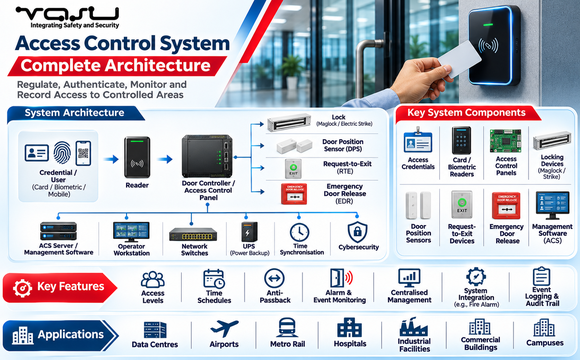
Credential / User → Card / Biometric / Mobile Credential → Reader → Door Controller / Access Control Panel → Locking Device
Door Status Sensor + Exit Button / Emergency Release → Door Controller
Access Control Network → ACS Server / Management Software → Operator Workstation / Security Control Room
Supporting Infrastructure → PoE / Power Supply → UPS → Network → Time Synchronisation → Cybersecurity
3. Access Control System Components
A typical system comprises:
- Access credentials
- Card / biometric readers
- Access control panels
- Door controllers
- Electromagnetic locks / electric strikes
- Door position sensors
- Request-to-exit devices
- Emergency door release devices
- Exit buttons
- Access control server
- Management software
- Operator workstations
- Network switches
- Power supplies and UPS
4. Access Credential Architecture
Credentials may include proximity cards, smart cards, biometric identifiers, mobile credentials or other approved technologies. Credential type should be selected according to security level, operational requirements, compatibility and client policy.
5. Reader Architecture
Readers authenticate the presented credential and communicate the access request to the door controller. Reader selection should consider credential technology, communication interface, environmental conditions, mounting arrangement and required security level.
6. Door Controller Architecture
The door controller processes access decisions or receives authorisation from the central access control system. It interfaces with readers, locks, door position sensors, request-to-exit devices and emergency release inputs.
7. Access Control Panel Architecture
Access control panels provide centralised control for multiple door controllers or door interfaces, depending on the selected system architecture. Panel capacity, communication interfaces, power requirements and expansion capability should be verified.
8. Door Locking Architecture
The access control system may operate electromagnetic locks, electric strikes or other approved locking devices. Lock selection should consider door construction, security requirement, fire-life-safety requirements, power mode and emergency egress requirements.
9. Door Position Monitoring
Door position sensors provide feedback regarding whether a door is open or closed. The status can be used for forced-door detection, door-held-open alarms, access-event correlation and monitoring.
10. Request-to-Exit Architecture
Request-to-exit devices provide an authorised exit input to the access control system. The device type and installation should be coordinated with the door hardware and life-safety requirements.
11. Emergency Door Release
Emergency release arrangements should allow doors to be released where required by the approved fire and life-safety strategy. Access control interfaces should be coordinated with the fire alarm system and applicable emergency egress requirements.
12. Access Decision Process
Typical sequence:
Credential Presented → Reader Authentication → Access Request → Controller / Server Authorisation → Access Granted / Denied → Lock Command → Door Status Monitoring → Event Logging → Alarm / Notification, where applicable
13. Access Levels
Access levels define which users can access specific doors or zones and during which approved time periods. Access groups should be established according to organisational roles, security zones and operational requirements.
14. Time Schedules
Access rights may be controlled through predefined schedules, holidays and special access periods. Schedule configuration should be documented and restricted to authorised administrators.
15. Anti-Passback
Where required, anti-passback logic prevents a credential from being reused in an inconsistent access sequence. The architecture should include the required entry / exit readers and system logic.
16. Access Control Network
Access control panels and servers should communicate through the approved network architecture. IP addressing, VLANs, communication paths, bandwidth, redundancy and cybersecurity controls should be defined and documented.
17. Server & Management Software
The central access control server hosts management functions such as user administration, access levels, door configuration, event logging, alarm management, reporting and system monitoring, depending on the selected platform.
18. Operator Workstation
Authorised operators may use workstations to monitor doors, alarms, events and system status and to perform permitted administrative or security functions. User permissions should be role-based.
19. Integration with Fire Alarm
Access control should be integrated with the fire alarm system where required so that designated doors can achieve the approved emergency release behaviour. The interface should be defined in the approved cause-and-effect / integration matrix.
20. Integration with CCTV
Access events may be integrated with CCTV so that an access transaction can be correlated with associated camera views. The integration should follow the approved interface architecture and event mapping.
21. Visitor Management Integration
Where a visitor management system is provided, visitor credentials, access permissions, visit schedules and access events may be integrated with the ACS. The interface and responsibility matrix should be clearly defined.
22. Power Supply & UPS
Access control panels, controllers, readers and locks should receive appropriate power from approved power supplies. Critical systems may require UPS support. Lock loads, controller loads and battery requirements should be included in the power calculation.
23. Cybersecurity
Network-connected access control equipment should comply with the approved cybersecurity architecture, including secure credentials, role-based access, network segmentation, controlled remote access, firmware management, configuration backup and restricted services.
24. Installation Requirements
Installation should verify:
- Correct reader type
- Correct credential technology
- Correct controller / panel
- Correct locking device
- Correct door position sensor
- Correct request-to-exit device
- Correct emergency release arrangement
- Correct network connectivity
- Correct IP addressing
- Correct power supply
- Correct user / access configuration
- Proper cable routing and identification
25. Testing & Commissioning
Access control commissioning should verify:
- Valid credential access
- Invalid credential rejection
- Door lock operation
- Door position monitoring
- Request-to-exit operation
- Door-held-open alarm
- Forced-door alarm
- Emergency release
- Access schedules
- User permissions
- Event logging
- CCTV / fire alarm integration, where applicable
26. Failure & Recovery
Where redundancy is required, controlled tests should verify controller communication failure, network interruption, server communication loss and power interruption. Local controller behaviour and restoration after communication recovery should be verified.
27. Maintenance
Maintenance should include reader inspection, lock operation, door alignment, sensor operation, request-to-exit testing, emergency release verification, controller health checks, power-supply checks, server health, database backup and user-access review.
28. Design Change Control
Changes to door quantity, reader technology, locking devices, controller capacity, access levels, network architecture or system integrations should be reviewed against the approved access control architecture before implementation.
29. Documentation
Access control documentation should include, as applicable:
- Access control architecture
- Door schedule
- Reader schedule
- Controller / panel schedule
- Lock schedule
- Door hardware details
- IP address schedule
- Access level matrix
- User / credential matrix
- Cause-and-effect / integration matrix
- Network topology
- Power / UPS calculation
- Testing and commissioning records
- As-built drawings
- O&M manual
30. Engineering Objective
The engineering objective is:
Define Security & Access Requirement → Establish Door & Zone Architecture → Select Credential & Reader → Select Controller & Locking Device → Integrate Door Monitoring & Emergency Release → Establish Network & Server Architecture → Configure Access Levels → Integrate Approved Systems → Complete Testing → Establish Secure & Maintainable Access Control
Frequently Asked Questions
What is the main purpose of access control system: complete architecture?
An Access Control System (ACS) is an electronic security system used to regulate, authenticate, monitor and record access to controlled areas. A complete architecture integrates credentials, readers, door controllers, locking devices, door status monitoring, request-to-exit devices, management servers, software, network infrastructure and authorised operator workstations.
What should be checked before selection or installation?
Verify compatibility with the approved system architecture, door hardware and connected devices, power requirements, network or communication interface, environmental conditions and applicable emergency-release requirements.
What should be tested during commissioning?
Test the functions identified in the source technical content and approved project documents, including normal operation, access granted/denied behaviour, monitoring inputs, alarms, emergency release where applicable, power and communication behaviour.
What documentation should be retained?
Maintain applicable schedules, wiring and interface details, configuration records, power calculations, test and commissioning records, as-built drawings and the O&M manual as required by the project.
SEO & Publishing Details
| SEO Title | Access Control System: Complete Architecture | Technical Guide | Vasu Infosec Limited |
| Meta Description | An Access Control System (ACS) is an electronic security system used to regulate, authenticate, monitor and record access to controlled areas. A |
| Primary Keyword | Access Control System: Complete Architecture |
| Secondary Keywords | Access Control System: Complete Architecture; access control system; electronic security; system architecture; installation and commissioning |
| Suggested URL Slug | access-control-system-complete-architecture |
| Suggested Image Alt Text | Technical architecture and key components of access control system: complete architecture |