
Article
AHU System Design
Nov 2026
1. Engineering Overview
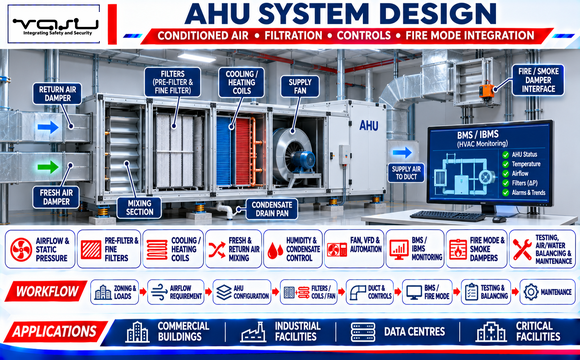
AHU System Design establishes the engineering basis for selecting, configuring, sizing, controlling, installing and commissioning Air Handling Units to provide conditioned, filtered and ventilated air to designated spaces. The design should address airflow, cooling / heating, filtration, humidity, pressure, acoustics, energy efficiency, maintainability and integration with building controls and fire-life-safety systems.
2. Complete AHU System Architecture
Building Load Assessment → HVAC Zoning → Airflow Requirement → AHU Configuration → Filters → Cooling / Heating Coil → Fan → Mixing Section → Fresh / Return Air → Humidification / Dehumidification → Duct Connections → Controls → BMS / IBMS → Fire Mode → Testing & Balancing → Maintenance
3. Design Philosophy
AHUs should be selected according to the actual space requirements, design airflow, sensible and latent loads, indoor-air-quality requirements, operating schedule, filtration level, pressure requirements, redundancy, energy objectives and available plant services.
4. AHU Zoning
AHU service zones should be defined based on occupancy, operating hours, orientation, internal loads, temperature requirements, ventilation requirements and control strategy.
5. Airflow Requirement
Supply-air quantity should be established from cooling / heating loads, ventilation requirements, space air-change requirements and pressure relationships. Design airflow should account for system diversity where applicable.
6. Cooling Coil Selection
Cooling coils should be selected for required sensible and latent cooling capacity, entering and leaving air conditions, chilled-water conditions, face velocity, pressure drop and condensate generation.
7. Heating Coil Selection
Where heating is required, heating coils should be selected for the required heating capacity, entering and leaving air conditions, heating-medium characteristics and acceptable pressure drop.
8. Fan Selection
AHU fans should be selected for required airflow and total static pressure, including filter, coil, casing, duct, terminal and other system losses. Efficiency, operating point, noise and redundancy should be considered.
9. Fan Arrangement
Supply and return / exhaust fan arrangements should be configured according to the AHU application. Direct-drive or belt-drive arrangements should be selected based on duty, maintenance and operating requirements.
10. Fresh Air & Return Air
Fresh-air and return-air quantities should be established according to ventilation requirements and system operating modes. Mixing arrangements should maintain required indoor-air-quality and energy performance.
11. Mixing Box
Mixing sections should provide controlled blending of fresh and return air where applicable. Dampers, actuators and control logic should be coordinated with normal and fire-mode operation.
12. Filtration System
Filters should be selected according to required indoor-air quality, outdoor air quality, equipment protection and pressure-drop limits. Filter stages should be accessible for inspection and replacement.
13. Pre-Filters & Fine Filters
Where multiple filtration stages are required, pre-filters should protect downstream fine filters and coils. Final filter selection should reflect the required air-cleanliness criteria.
14. Humidity Control
Where humidity control is required, the AHU should incorporate suitable dehumidification, humidification or other control arrangements. Condensation and moisture-management risks should be addressed.
15. Casing & Thermal Performance
AHU casing should provide the required structural integrity, thermal insulation, air leakage performance, access and corrosion resistance for the intended environment.
16. Condensate Drainage
Cooling-coil condensate drains should be properly sized, trapped, sloped and routed to suitable drainage points. Drain-pan arrangement should prevent standing water and carryover.
17. Access & Maintenance
AHUs should provide adequate access to filters, coils, fans, motors, dampers, sensors, actuators, drain pans and internal components for inspection, cleaning and replacement.
18. Acoustic Control
Fan speed, casing construction, vibration isolation, duct connections and acoustic treatment should be assessed to maintain acceptable noise levels in occupied spaces.
19. Vibration Isolation
Fans and rotating equipment should be provided with suitable vibration-control arrangements. Flexible connections and equipment supports should prevent transmission of excessive vibration to the building.
20. Duct Interface
AHU discharge and return connections should be coordinated with ductwork dimensions, flexible connections, access requirements, airflow distribution and pressure-drop calculations.
21. Controls & Automation
AHU controls should regulate temperature, airflow, pressure, humidity and equipment sequencing. Sensors, valves, dampers, actuators, variable-speed drives and control logic should be coordinated.
22. BMS / IBMS Integration
AHU status, alarms, temperatures, pressures, fan speed, filter status, valve position and other relevant parameters should be integrated with BMS / IBMS where required.
23. HVAC Fire Mode Integration
AHU operation should transition to the approved fire mode where required. Supply / return fans, fresh-air dampers, return-air dampers, smoke dampers and associated controls should follow the approved fire sequence.
24. Fire & Smoke Damper Interface
Where AHUs connect to fire compartments, fire / smoke dampers should be coordinated with ductwork, compartmentation and fire alarm controls.
25. Electrical Interface
AHU motors, controls, variable-frequency drives and associated equipment should be coordinated with electrical power supplies, motor-control centres, emergency power and protection systems.
26. Redundancy & Reliability
Critical AHU systems should be assessed for redundancy requirements. Standby units, spare fan capacity or alternative air-conditioning arrangements should be considered where operational continuity is critical.
27. Energy Efficiency
AHU design should consider variable-speed fans, efficient coils, low-pressure-drop filters, heat recovery where applicable, demand-controlled ventilation and optimised control sequences.
28. Installation Requirements
AHU installation should verify:
- Correct AHU location
- Correct airflow
- Correct cooling / heating capacity
- Correct fan selection
- Correct filter arrangement
- Correct fresh / return air configuration
- Correct dampers
- Correct coils
- Correct condensate drainage
- Correct duct connections
- Correct vibration isolation
- Correct acoustic treatment
- Correct controls
- Correct BMS / IBMS interface
- Correct fire-mode interface
- Correct electrical supply
- Correct maintenance access
29. Testing & Commissioning
AHU commissioning should verify:
- Fan operation
- Airflow
- Static pressure
- Coil performance
- Supply-air temperature
- Return-air temperature
- Fresh-air quantity
- Filter pressure drop
- Damper operation
- Valve operation
- Condensate drainage
- VFD operation
- Control sequences
- BMS / IBMS monitoring
- Fire-mode operation
30. Air & Water Balancing
Air and chilled / heating-water flows should be balanced against the approved design values. Final reports should record measured airflow, water flow, pressure and temperature conditions.
31. Integrated HVAC Testing
AHU operation should be tested with chilled-water systems, pumps, controls, BMS / IBMS, fire alarm, fire / smoke dampers, smoke-control systems and emergency power where applicable.
32. Maintenance
Preventive maintenance should include filter replacement, coil cleaning, fan and motor inspection, belt / bearing checks, damper operation, sensor calibration, valve checks, drain-pan cleaning and control-system verification.
33. Impairment Management
Any impairment affecting a critical AHU, ventilation system or fire-mode interface should be formally controlled. Temporary operating arrangements should be established where necessary.
34. Failure & Recovery
The system should address fan failure, motor failure, power loss, sensor failure, valve / damper failure, control failure and communication loss. Recovery procedures should restore required AHU performance.
35. Design Change Control
Changes to occupancy, room layouts, partitions, cooling loads, ventilation requirements, plant capacity, ductwork or fire strategy should trigger a review of AHU selection, airflow and control sequences.
36. Documentation
AHU system documentation should include, as applicable:
- AHU design basis
- AHU schedule
- Airflow calculations
- Cooling / heating calculations
- AHU selection data
- Fan selection data
- Coil selection data
- Filter schedule
- Fresh / return air arrangement
- Damper schedule
- Ductwork layouts
- Condensate drainage details
- Controls philosophy
- BMS / IBMS interface
- Fire-mode sequence
- Electrical interface
- Equipment datasheets
- Installation records
- Testing and commissioning records
- TAB reports
- Integrated test reports
- Maintenance schedule
- Impairment records
- As-built drawings
- O&M manual
37. Engineering Objective
The engineering objective is:
Assess HVAC Zone Requirements → Establish Airflow & Thermal Loads → Configure AHU → Select Filters, Coils, Fans & Dampers → Design Fresh / Return Air Arrangement → Provide Condensate, Acoustic & Vibration Control → Integrate Controls & BMS / IBMS → Coordinate Fire Mode & Electrical Interfaces → Verify Installation → Test & Balance Air / Water Systems → Execute Integrated Testing → Maintain Reliable, Efficient & Maintainable AHU Performance
Frequently Asked Questions
What is covered under 1. Engineering Overview?
AHU System Design establishes the engineering basis for selecting, configuring, sizing, controlling, installing and commissioning Air Handling Units to provide conditioned, filtered and ventilated air to designated spaces. The design should address airflow, cooling / heating, filtration, humidity, pressure, acoustics, energy efficiency, maintainability and integration with building controls and fire-life-safety systems.
What is covered under 2. Complete AHU System Architecture?
Building Load Assessment → HVAC Zoning → Airflow Requirement → AHU Configuration → Filters → Cooling / Heating Coil → Fan → Mixing Section → Fresh / Return Air → Humidification / Dehumidification → Duct Connections → Controls → BMS / IBMS → Fire Mode → Testing & Balancing → Maintenance
What is covered under 3. Design Philosophy?
AHUs should be selected according to the actual space requirements, design airflow, sensible and latent loads, indoor-air-quality requirements, operating schedule, filtration level, pressure requirements, redundancy, energy objectives and available plant services.