
Article
Air Handling Unit Selection
Nov 2026
1. Engineering Overview
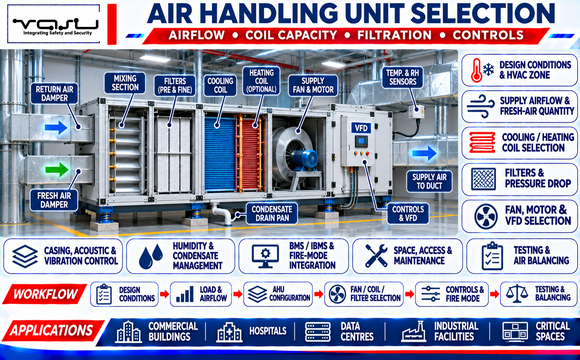
Air Handling Unit Selection establishes the engineering basis for selecting AHUs that satisfy required airflow, cooling / heating capacity, filtration, ventilation, humidity, pressure, acoustic, energy-efficiency and maintainability requirements. Selection should be based on approved load calculations, design conditions, zoning, operating schedules and connected HVAC systems.
2. Complete AHU Selection Architecture
Design Conditions → HVAC Zone → Cooling / Heating Load → Supply Air Quantity → Fresh Air Requirement → AHU Configuration → Coil Selection → Fan Selection → Filter Selection → Casing Selection → Motor / VFD → Controls → BMS / IBMS → Fire Mode → Space & Maintenance Requirements → Selection Verification → Testing & Balancing
3. Selection Philosophy
AHUs should be selected to operate efficiently across the expected load range while meeting required indoor environmental conditions. Selection should avoid unnecessary oversizing and should consider future requirements, redundancy and maintainability.
4. Design Conditions
Indoor and outdoor design temperatures, humidity, altitude, air quality, occupancy and operating schedule should be established before equipment selection.
5. Airflow Selection
AHU supply airflow should be established from space cooling / heating loads, ventilation requirements, air-change requirements and pressure relationships. Minimum and maximum operating airflow should be identified.
6. Cooling Capacity Selection
Cooling coil capacity should satisfy the calculated sensible and latent cooling loads at the selected entering and leaving air conditions. Coil selection should consider chilled-water temperature, flow, face velocity and pressure drop.
7. Heating Capacity Selection
Where heating is required, the heating coil should provide the required capacity at design conditions. Heating-medium temperature, flow and pressure drop should be considered.
8. Fresh Air Requirement
Outdoor-air quantity should be established from occupancy, indoor-air-quality requirements and applicable design criteria. Fresh-air quantity should be coordinated with energy and humidity control requirements.
9. Return & Recirculated Air
Return-air quantity and recirculation strategy should be established for each AHU. Mixing of outdoor and return air should maintain required air quality and system performance.
10. AHU Configuration
The AHU configuration should be selected according to application and may include mixing section, filters, cooling coil, heating coil, humidification / dehumidification, fan section, heat recovery and other required components.
11. Filter Selection
Filters should be selected according to required air cleanliness, outdoor-air quality, equipment protection and acceptable pressure drop. Filter access and replacement requirements should be considered.
12. Fan Selection
Fans should be selected for required airflow and total static pressure, including filters, coils, casing, ductwork, terminals and other system losses. Efficiency and noise should be considered.
13. Fan Motor Selection
Motor capacity should be adequate for the selected fan duty and operating range. Motor efficiency, electrical supply, starting method and environmental conditions should be considered.
14. VFD Selection
Variable-frequency drives should be provided where variable airflow or energy optimisation is required. VFD range, bypass requirements, harmonics and control integration should be considered.
15. Casing Selection
AHU casing should provide appropriate thermal insulation, structural integrity, air leakage performance, corrosion resistance and access for the intended application.
16. Coil Selection
Coils should be selected for required capacity, airflow, fluid conditions, face velocity, pressure drop, fin configuration and fouling / maintenance requirements.
17. Condensate Management
Cooling coils should include suitable drain pans and condensate drainage. Traps, slopes, drain connections and access should prevent standing water and condensate carryover.
18. Humidity Control
Where humidity control is required, AHU selection should include appropriate dehumidification, humidification or control provisions and should address condensation risk.
19. Heat Recovery
Where applicable, heat-recovery equipment should be evaluated for energy savings, pressure drop, cross-contamination risk, maintenance and operating conditions.
20. Acoustic Requirements
AHU fan speed, casing, internal components, acoustic treatment and downstream ductwork should be evaluated to achieve the required noise criteria.
21. Vibration Control
AHU selection should consider fan balance, motor arrangement, equipment support, vibration isolation and flexible connections to minimise vibration transmission.
22. Space & Maintenance Requirements
AHU dimensions and configuration should provide adequate access for filters, coils, fans, motors, dampers, sensors, actuators and cleaning. Replacement routes should be confirmed.
23. Redundancy & Reliability
Critical HVAC applications should assess duty / standby or redundant AHU arrangements. Selection should support required continuity and maintenance without unacceptable service interruption.
24. Controls & Automation
AHU controls should regulate supply-air temperature, airflow, pressure, humidity and equipment sequencing. Sensors, valves, dampers, actuators and VFDs should be compatible with the control philosophy.
25. BMS / IBMS Integration
AHU operating status, temperatures, pressures, fan speed, filter status, alarms and control parameters should be integrated with BMS / IBMS where required.
26. HVAC Fire Mode Integration
AHU selection should support the approved fire-mode sequence. Fire / smoke dampers, fan shutdown, fresh-air isolation and smoke-control interfaces should be compatible with the fire strategy.
27. Electrical Interface
Motor, VFD, control-panel and auxiliary power requirements should be coordinated with electrical distribution and available power quality.
28. Energy Efficiency
AHU selection should consider fan efficiency, coil pressure drop, filter pressure drop, heat recovery, variable airflow, efficient motors and optimised controls.
29. Equipment Selection Verification
The final AHU selection should be checked against airflow, capacity, fan pressure, coil conditions, filtration, fresh-air quantity, dimensions, weight, electrical load, acoustic requirements and maintenance clearances.
30. Installation Requirements
AHU installation should verify:
- Correct model / configuration
- Correct airflow
- Correct cooling / heating capacity
- Correct fan duty
- Correct motor rating
- Correct VFD
- Correct filter arrangement
- Correct coil arrangement
- Correct fresh / return air configuration
- Correct dampers
- Correct condensate drainage
- Correct controls
- Correct BMS / IBMS interface
- Correct fire-mode interface
- Correct electrical supply
- Correct vibration isolation
- Correct acoustic provisions
- Correct maintenance access
31. Testing & Commissioning
AHU commissioning should verify:
- Fan operation
- Airflow
- Static pressure
- Cooling performance
- Heating performance where applicable
- Supply-air temperature
- Return-air temperature
- Fresh-air quantity
- Filter pressure drop
- Coil flow
- Damper operation
- Valve operation
- Condensate drainage
- VFD operation
- Control sequences
- BMS / IBMS monitoring
- Fire-mode operation
32. Air Balancing
Supply, return and fresh-air quantities should be balanced against approved design values. Final TAB reports should record measured airflow and pressure conditions.
33. Integrated HVAC Testing
Selected AHUs should be tested with chilled-water / heating-water systems, pumps, control valves, BMS / IBMS, fire alarm, fire / smoke dampers and other interfaced systems.
34. Maintenance
Maintenance requirements should be considered during selection and should include filter replacement, coil cleaning, fan and motor servicing, belt / bearing checks, damper inspection, sensor calibration and drain-pan cleaning.
35. Impairment Management
Any impairment affecting a critical AHU should be formally controlled. Standby units or temporary ventilation / cooling arrangements should be assessed where required.
36. Failure & Recovery
The selection should support defined responses to fan failure, motor failure, power loss, sensor failure, damper failure, valve failure and control failure. Recovery procedures should restore required HVAC service.
37. Design Change Control
Changes to occupancy, cooling loads, ventilation requirements, room layouts, ductwork, fire strategy or operating schedules should trigger a review of AHU selection and performance.
38. Documentation
AHU selection documentation should include, as applicable:
- AHU selection basis
- Design conditions
- Cooling / heating load calculations
- Airflow calculations
- Fresh-air calculations
- AHU schedule
- Fan selection data
- Coil selection data
- Filter schedule
- Motor / VFD data
- Casing data
- Acoustic data
- Dimensional and weight data
- Controls philosophy
- BMS / IBMS interface
- Fire-mode interface
- Electrical requirements
- Equipment datasheet
- Installation records
- TAB reports
- Testing and commissioning records
- Integrated test reports
- Maintenance schedule
- Impairment records
- As-built drawings
- O&M manual
39. Engineering Objective
The engineering objective is:
Establish Design Conditions → Assess HVAC Zone Loads → Determine Supply & Fresh-Air Requirements → Select AHU Configuration → Select Fans, Coils, Filters, Motors & VFDs → Verify Casing, Acoustic, Vibration & Maintenance Requirements → Integrate Controls, BMS / IBMS & Fire Mode → Confirm Electrical & Space Requirements → Verify Equipment Selection → Install, Test & Balance → Execute Integrated Testing → Maintain Efficient, Reliable & Maintainable AHU Performance
Frequently Asked Questions
What is covered under 1. Engineering Overview?
Air Handling Unit Selection establishes the engineering basis for selecting AHUs that satisfy required airflow, cooling / heating capacity, filtration, ventilation, humidity, pressure, acoustic, energy-efficiency and maintainability requirements. Selection should be based on approved load calculations, design conditions, zoning, operating schedules and connected HVAC systems.
What is covered under 2. Complete AHU Selection Architecture?
Design Conditions → HVAC Zone → Cooling / Heating Load → Supply Air Quantity → Fresh Air Requirement → AHU Configuration → Coil Selection → Fan Selection → Filter Selection → Casing Selection → Motor / VFD → Controls → BMS / IBMS → Fire Mode → Space & Maintenance Requirements → Selection Verification → Testing & Balancing
What is covered under 3. Selection Philosophy?
AHUs should be selected to operate efficiently across the expected load range while meeting required indoor environmental conditions. Selection should avoid unnecessary oversizing and should consider future requirements, redundancy and maintainability.