
Article
Alarm Management in IBMS
Oct 2026
Direct Answer
IBMS alarm management provides a structured way to detect, prioritise, present, acknowledge and record abnormal conditions across integrated building systems. A clear alarm philosophy helps operators identify important events and respond appropriately without being overwhelmed by unnecessary notifications.
1. Engineering Overview
Alarm Management in an Integrated Building Management System (IBMS) provides a structured framework for detecting, prioritising, annunciating, acknowledging, recording and managing abnormal operating conditions across integrated building systems. Effective alarm management ensures that important events are clearly presented to authorised operators without overwhelming them with unnecessary notifications.
2. Complete Alarm Architecture
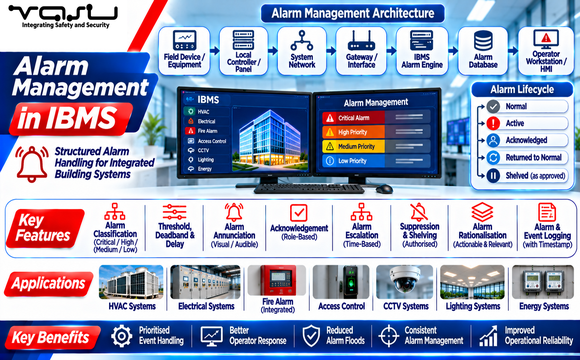
Field Device / Equipment → Local Controller / Panel → System Network → Gateway / Interface → IBMS Alarm Engine → Alarm Database → Operator Workstation / HMI → Operator Response / Escalation
3. Alarm Sources
IBMS alarms may originate from HVAC equipment, electrical systems, energy systems, fire alarm interfaces, access control, CCTV, lighting systems and other approved integrated systems. The originating system remains responsible for its dedicated safety and control functions.
4. Alarm Classification
Alarms should be classified according to the approved project alarm philosophy. Typical classifications may include critical, high, medium and low priority, with each category having defined operator response requirements.
5. Alarm Priority
Alarm priority should reflect the operational significance of the condition. Critical life-safety or major equipment conditions should receive appropriate priority, while routine maintenance or informational conditions should not obscure important alarms.
6. Alarm State
The alarm lifecycle may include normal, active, acknowledged, returned-to-normal, shelved or other project-defined states. The exact state model should follow the approved IBMS application and alarm philosophy.
7. Alarm Generation
An alarm may be generated when a monitored point changes to a defined abnormal state or crosses an approved threshold. Alarm thresholds, delays and deadbands should be established according to equipment requirements and approved control sequences.
8. Alarm Deadband & Delay
Deadbands can prevent repeated alarms caused by minor fluctuations around a threshold. Time delays can prevent transient conditions from generating unnecessary alarms. Values should be based on engineering requirements rather than arbitrary settings.
9. Alarm Annunciation
Active alarms should be clearly annunciated on operator workstations through appropriate visual and, where approved, audible indications. Alarm descriptions should identify the equipment, location, condition and required operator information.
10. Alarm Acknowledgement
Operators should be able to acknowledge alarms according to their assigned permissions. Acknowledgement confirms that the alarm has been recognised but does not necessarily mean that the underlying abnormal condition has been corrected.
11. Alarm Escalation
Where required, alarms may be escalated if they remain unacknowledged or unresolved for a defined period. Escalation rules should be documented and coordinated with the project’s operational response procedure.
12. Alarm Suppression & Shelving
Approved alarm shelving or suppression functions may be used to manage known temporary conditions. Such functions should be controlled, time-limited where appropriate and available only to authorised users.
13. Alarm Flood Management
Alarm flood management should prevent excessive simultaneous notifications from obscuring critical events. Priorities, delays, suppression rules and logical grouping should be configured to support effective operator response.
14. Alarm Rationalisation
Alarm rationalisation reviews whether each alarm is necessary, correctly prioritised, actionable and appropriately described. The objective is to ensure that the alarm system provides meaningful information to operators.
15. Alarm Naming & Description
Alarm names should use consistent equipment tags, locations and condition descriptions. The naming convention should correspond with approved drawings, point lists, equipment schedules and IBMS graphics.
16. Alarm & Event Logging
Alarm and event information should be recorded with appropriate timestamps, source information, state changes, acknowledgement details and operator actions where supported. Historical records should support troubleshooting and operational review.
17. Time Synchronisation
All integrated systems should use a coordinated time reference where required so that alarms and events from different platforms can be accurately sequenced and investigated.
18. Alarm Integration from Fire Alarm
Fire alarm conditions integrated into IBMS should be clearly identified and prioritised according to the approved interface. The dedicated fire alarm system remains the primary life-safety alarm platform.
19. Alarm Integration from HVAC
HVAC alarms may include equipment fault, high / low temperature, pressure abnormalities, filter conditions, communication failure and other approved conditions. Alarm settings should align with the HVAC control philosophy.
20. Electrical & Energy Alarms
Electrical alarms may include breaker trip, equipment fault, abnormal voltage or frequency, UPS / DG alarms, communication failures and approved energy threshold conditions. Alarm priorities should reflect the operational impact.
21. Security System Alarms
Access control and CCTV integrations may generate security alarms such as forced door, door held open, camera failure, video loss and approved analytics events. Security alarm priorities should follow the approved security philosophy.
22. Graphics & Alarm Navigation
IBMS graphics should allow operators to navigate from the alarm summary to the relevant building, floor, zone and equipment graphic. Alarm information should provide sufficient context for operator response.
23. User Roles & Permissions
Alarm acknowledgement, shelving, suppression, configuration and administrative functions should be controlled through role-based permissions. Users should only access functions required for their responsibilities.
24. Installation & Configuration Requirements
Configuration should verify:
25. Testing & Commissioning
Alarm management commissioning should verify:
26. Maintenance & Performance Review
Alarm systems should be periodically reviewed for nuisance alarms, repeated alarms, stale points, incorrect priorities and ineffective notifications. Configuration changes should be documented and approved.
27. Design Change Control
Changes to alarm points, thresholds, priorities, descriptions, delays, suppression rules, graphics, user permissions or integrated systems should be reviewed against the approved alarm philosophy before implementation.
28. Documentation
Alarm management documentation should include, as applicable:
29. Engineering Objective
The engineering objective is:
Frequently Asked Questions
What is alarm management in an IBMS?
It is the structured process for detecting, classifying, presenting, acknowledging, recording and managing abnormal operating conditions across approved integrated systems.
Does acknowledging an alarm mean the fault is cleared?
No. Acknowledgement confirms that an alarm has been recognised; it does not necessarily mean the underlying abnormal condition has been corrected.
How should alarm priorities be assigned?
Priorities should follow the approved project alarm philosophy and reflect the operational significance of each condition.
Why are alarm delays and deadbands used?
They can reduce repeated or unnecessary alarms caused by transient conditions or minor fluctuations. Settings should be based on engineering requirements and approved control sequences.
Does IBMS replace the dedicated fire alarm system?
No. The source document states that the dedicated fire alarm system remains the primary life-safety alarm platform. IBMS integration should follow the approved interface.
What should alarm commissioning verify?
Checks may include alarm generation and priority, annunciation, acknowledgement, return-to-normal indication, event logging, escalation where applicable, permissions, graphics navigation, communication failure alarms and timestamps.
SEO & Publishing Details
SEO title: Alarm Management in IBMS | Vasu Infosec Limited
Meta description: Understand IBMS alarm management, alarm priorities, annunciation, acknowledgement, event logging, escalation and commissioning checks.
Primary keyword: alarm management in IBMS
Secondary keywords: IBMS alarm system, alarm prioritisation, alarm annunciation, alarm event logging, alarm escalation, integrated building management system
Suggested URL slug: /alarm-management-ibms/
Suggested image alt text: IBMS alarm management architecture showing field devices, alarm engine, database and operator workstation