
Article
Anti-Passback Architecture
Oct 2026
Direct Answer
Anti-Passback is an access-control function designed to prevent a credential from being reused to gain entry to an area without a corresponding authorised exit transaction. It maintains the logical location or access state of a credential and compares subsequent access requests against the configured entry / exit sequence.
1. Engineering Overview
Anti-Passback is an access-control function designed to prevent a credential from being reused to gain entry to an area without a corresponding authorised exit transaction. It maintains the logical location or access state of a credential and compares subsequent access requests against the configured entry / exit sequence.
2. Complete Anti-Passback Architecture
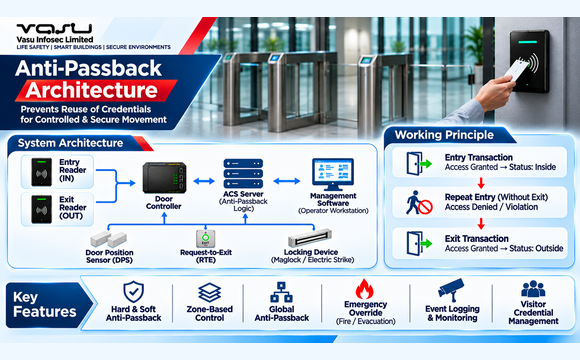
Entry Credential → Entry Reader → Door Controller → Access Control Server / Anti-Passback Logic
Exit Reader → Exit Door Controller → Access Control Server / Anti-Passback Logic
Access Decision → Door Locking Device
Door Position Sensor + Request-to-Exit → Door Controller
ACS Server → Management Software → Operator Workstation
Supporting Infrastructure → Network → Time Synchronisation → Power / UPS → Cybersecurity
3. Working Principle
When a user enters a controlled zone through an authorised entry point, the system records the credential as being inside that zone. A subsequent entry request without a valid exit transaction can then be denied or handled according to the configured anti-passback policy.
4. Entry / Exit Reader Pairing
Anti-passback generally requires defined entry and exit points so that the system can determine the expected movement of a credential. Reader pairing and door-to-zone relationships should be configured in accordance with the approved access-control architecture.
5. Hard Anti-Passback
Under a hard anti-passback policy, a credential that violates the defined movement sequence can be denied access. The system should generate an appropriate event or alarm for the violation.
6. Soft Anti-Passback
Under a soft anti-passback policy, the system may permit access while generating a violation event for monitoring and investigation. The selected policy should be established by the approved security requirements.
7. Zone-Based Anti-Passback
Anti-passback can be applied to defined security zones rather than individual doors. Entry and exit transactions update the credential’s logical zone status.
8. Global Anti-Passback
In a multi-door or multi-building architecture, global anti-passback may coordinate credential movement across multiple access-control controllers or sites. Reliable network and server communication are important for this architecture.
9. Local / Controller-Based Operation
Some access-control systems can maintain anti-passback information locally at controllers or panels. The supported offline behaviour should be verified because server communication loss may affect the consistency of credential-location information.
10. Credential State Management
The system maintains a logical state for each credential, such as inside, outside or assigned zone. State changes occur following authorised access events according to the configured reader and zone relationships.
11. Normal Access Sequence
Credential Presented at Entry → Credential Validated → Anti-Passback State Checked → Access Granted → Entry Event Recorded → Credential State Updated to Inside / Zone.
Exit Transaction → Exit Validated → Credential State Updated to Outside / Previous Zone.
12. Anti-Passback Violation
Credential Presented → Credential Validated → Anti-Passback State Indicates Invalid Sequence → Access Denied or Violation Recorded According to Policy → Event Logged → Operator Notification, where configured.
13. Door Position Monitoring
Door position sensors should be integrated so that the system can correlate credential transactions with actual door movement. Door status can assist in identifying abnormal access conditions and supporting anti-passback event investigation.
14. Request-to-Exit Integration
Request-to-exit signals should be coordinated with exit transactions where applicable. The system should distinguish authorised exit activity from forced or abnormal door opening.
15. Tailgating Consideration
Anti-passback is primarily a logical credential-control function and does not by itself guarantee that only one person passes through a door per credential. Where required, additional measures such as turnstiles, mantrap controls or occupancy monitoring should be considered.
16. Visitor Credential Management
Visitor credentials should be included in anti-passback logic where required. Temporary access periods, entry / exit tracking and credential expiry should be coordinated with the visitor management system.
17. Emergency Override
Emergency release and evacuation conditions should take precedence over normal anti-passback restrictions where required by the approved life-safety strategy. Emergency operations should not prevent required egress.
18. Fire Alarm Integration
Where access-controlled doors are released during a fire alarm condition, the resulting credential and zone states should be considered in the recovery strategy. The post-emergency state should be defined in the approved cause-and-effect and access-control configuration.
19. Network & Server Architecture
Anti-passback logic may depend on communication between readers, controllers and the central access-control server. Network availability, time synchronisation, controller memory and database integrity should be considered.
20. Time Synchronisation
Accurate and coordinated timestamps are important for anti-passback event sequencing. Controllers, servers and other participating devices should use an approved time source.
21. User Administration
Only authorised administrators should be permitted to create, modify or reset anti-passback rules, zones and credential states. Administrative actions should be logged where supported.
22. Manual State Reset
A controlled manual reset may be required when a credential state becomes inconsistent due to lost credentials, emergency evacuation, equipment failure or other approved circumstances. Reset procedures should be documented and access-controlled.
23. Installation Requirements
Installation and configuration should verify:
- Correct entry / exit reader pairing
- Correct door-controller allocation
- Correct zone configuration
- Correct anti-passback mode
- Correct credential assignments
- Correct time synchronisation
- Correct network communication
- Correct door position monitoring
- Correct emergency override behaviour
- Correct user permissions
- Proper cable routing and identification
24. Testing & Commissioning
Anti-passback commissioning should verify:
- Valid entry
- Valid exit
- Repeated entry without exit
- Repeated exit without entry
- Hard anti-passback response, where configured
- Soft anti-passback response, where configured
- Zone-based logic
- Controller communication loss behaviour
- Manual credential-state reset
- Fire alarm / emergency behaviour
- Event logging
25. Failure & Recovery
Controlled tests should verify system behaviour during network communication loss, controller failure, server unavailability and restoration. Credential states should synchronise correctly after recovery where supported.
26. Maintenance
Maintenance should include review of anti-passback events, reader status, controller communication, time synchronisation, database health, credential states, user permissions and configuration backups.
27. Design Change Control
Changes to door locations, entry / exit readers, zones, access levels, controller architecture, visitor management, emergency-release logic or server configuration should trigger an anti-passback impact review.
28. Documentation
Anti-passback documentation should include, as applicable:
- Anti-passback architecture
- Door / reader schedule
- Entry / exit pairing matrix
- Zone configuration
- Credential state logic
- Access level matrix
- Cause-and-effect matrix
- Network architecture
- Time synchronisation details
- Testing and commissioning records
- Reset / recovery procedure
- As-built drawings
- O&M manual
29. Engineering Objective
The engineering objective is:
Define Controlled Zones → Establish Entry / Exit Reader Pairing → Configure Credential State Logic → Select Hard / Soft Anti-Passback → Integrate Door Status & Emergency Logic → Verify Network & Time Synchronisation → Test Normal & Violation Scenarios → Establish Controlled Credential Movement
Frequently Asked Questions
What is anti-passback architecture?
Anti-Passback is an access-control function designed to prevent a credential from being reused to gain entry to an area without a corresponding authorised exit transaction. It maintains the logical location or access state of a credential and compares subsequent access requests against the configured entry / exit sequence.
What should be checked before installation?
Confirm equipment compatibility, approved interfaces, power and network requirements, installation details, emergency or fault behaviour where applicable, and manufacturer instructions.
What should be tested during commissioning?
Test functions and scenarios identified in the source content and approved project procedures, including normal operation, alarms, integrations, power or communication failures where applicable, and restoration.
What documentation should be retained?
Retain applicable schedules, wiring and interface details, configuration records, test and commissioning records, as-built drawings and O&M documentation as required by the project.
SEO & Publishing Details
| SEO Title | Anti-Passback Architecture | Technical Guide | Vasu Infosec Limited |
| Meta Description | Anti-Passback is an access-control function designed to prevent a credential from being reused to gain entry to an area without a corresponding |
| Primary Keyword | Anti-Passback Architecture |
| Secondary Keywords | Anti-Passback Architecture; access control system; electronic security; system architecture; installation and commissioning |
| Suggested URL Slug | anti-passback-architecture |
| Suggested Image Alt Text | Technical architecture and key components of anti-passback architecture |