
Article
BACnet Communication Architecture
Oct 2026
Direct Answer
BACnet communication architecture connects compatible building automation devices, controllers and supervisory platforms so that approved status, measurement, alarm and control information can be exchanged with an IBMS. A reliable implementation depends on correct device identification, network configuration, object and property mapping, access permissions, and commissioning.
1. Engineering Overview
BACnet Communication Architecture defines the communication framework used to exchange building automation data between controllers, field devices, supervisory systems and IBMS platforms. BACnet is commonly used for HVAC, BMS and other building automation applications and supports structured exchange of status, measurements, alarms and approved control information.
2. Communication Architecture
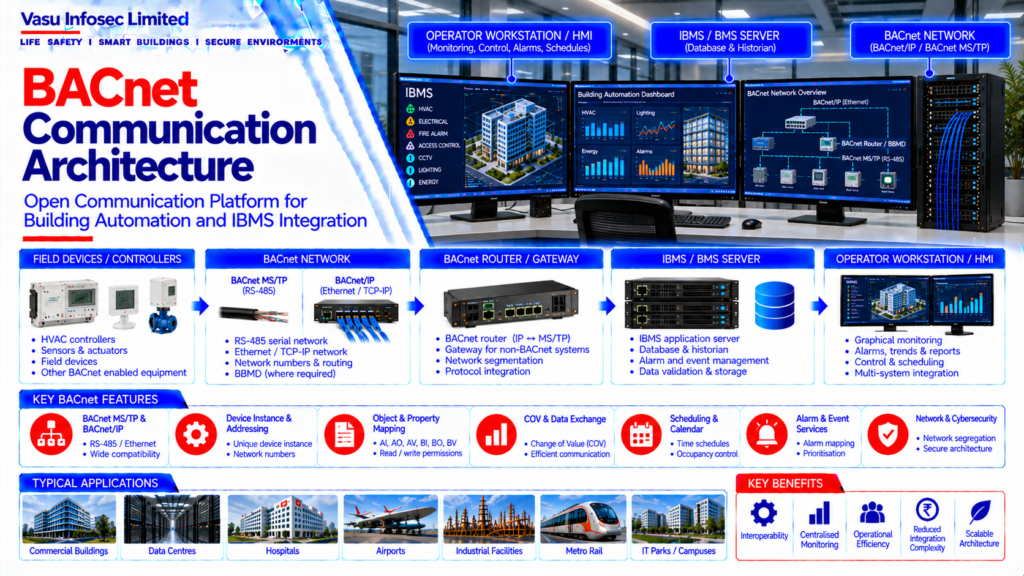
Field Sensors / Equipment Controllers → BACnet Network → BACnet Router / Gateway, where required → BMS / IBMS Server → Database / Historian → Operator Workstation / HMI
Typical Data → Status → Measurements → Alarms → Setpoints → Commands → Schedules → Equipment Information
3. BACnet Device Architecture
A BACnet network may contain application-specific controllers, operator workstations, servers, routers and other compatible devices. Each device should be uniquely identified and configured according to the approved network architecture.
4. BACnet Objects
BACnet represents building automation information through defined objects and properties. Typical objects may include Analog Input, Analog Output, Analog Value, Binary Input, Binary Output, Binary Value, Multi-state objects and other approved object types.
5. Object & Property Mapping
Each integrated point should be mapped to the correct BACnet object and property. The point list should define object identifiers, object names, present values, units, status information and read / write permissions.
6. BACnet MS/TP
BACnet MS/TP commonly operates over RS-485 networks. Correct MAC addressing, baud rate, network configuration, wiring, termination and device settings should be established according to the approved implementation.
7. BACnet/IP
BACnet/IP operates over Ethernet / IP networks and allows BACnet devices to communicate through the building automation network. IP addressing, network numbers and routing should be coordinated with the approved IT / IBMS architecture.
8. BACnet Network Numbering
BACnet network segments should be assigned appropriate network numbers within the approved architecture. Network numbering and routing should be coordinated where multiple BACnet segments are connected.
9. BACnet Router
A BACnet router may connect different BACnet network types, such as BACnet/IP and BACnet MS/TP. Router configuration should maintain correct network identification and reliable communication between segments.
10. BACnet Broadcast Management
Where BACnet/IP networks span multiple IP subnets, appropriate broadcast management arrangements may be required. BBMD or other approved mechanisms should be configured in accordance with the project network architecture.
11. Device Instance & Addressing
BACnet devices use unique device instance identifiers. Duplicate device instances can cause communication and discovery problems and should be prevented through controlled device addressing.
12. Data Types & Engineering Units
BACnet values should be represented using the appropriate object types, data formats and engineering units. Unit definitions and scaling should be verified during point integration and commissioning.
13. Read & Write Permissions
The approved integration should define which BACnet properties are read-only and which may receive commands. Write access should be restricted to authorised points and should not bypass dedicated equipment safety or control logic.
14. COV & Data Exchange
Where supported, Change of Value (COV) services can reduce unnecessary polling by allowing devices to communicate value changes. COV configuration should be coordinated with the device capabilities and approved communication strategy.
15. Alarm & Event Services
BACnet may support alarm and event information for compatible systems. Alarm priorities, event states and acknowledgements should be mapped to the approved IBMS alarm philosophy.
16. Scheduling & Calendar Objects
BACnet scheduling and calendar functions may be used where supported by the connected system. Schedule ownership and control authority should be clearly defined within the approved control philosophy.
17. Gateway Integration
Where a non-BACnet system is connected to a BACnet environment, a gateway may expose approved data as BACnet objects. Mapping should preserve point identity, units, status, alarm conditions and authorised commands.
18. Network & Cybersecurity
BACnet networks should follow the approved IT and cybersecurity architecture. Network segmentation, authorised access, firewall rules and controlled remote access should be implemented where required.
19. Installation Requirements
Installation should verify:
- Correct BACnet device type
Unique device instance
• Correct MAC / IP addressing
• Correct network number
• Correct baud rate for MS/TP
• Correct wiring and termination
• Correct object mapping
• Correct units
• Correct read / write permissions
• Correct router / gateway configuration
• Proper cable segregation
20. Testing & Commissioning
BACnet commissioning should verify:
- Device discovery
Device addressing
• Network communication
• Object visibility
• Present values
• Engineering units
• COV operation, where used
• Alarm / event information
• Read / write commands
• Router communication
• Gateway mapping
• Communication failure indication
21. Troubleshooting
Typical BACnet issues may include duplicate device instances, incorrect network numbers, MS/TP addressing conflicts, incorrect baud rate, wiring polarity problems, termination issues, IP configuration errors, routing problems, incorrect object mapping and unsupported services.
22. Maintenance
Maintenance should include BACnet device health checks, network diagnostics, router inspection, point verification, configuration backup and periodic validation of critical communication points.
23. Design Change Control
Changes to BACnet devices, object instances, network numbers, MS/TP settings, IP architecture, routers, gateways, point lists or IBMS configuration should be reviewed against the approved communication architecture before implementation.
24. Documentation
BACnet communication documentation should include, as applicable:
- BACnet network architecture
Device schedule
• Device instance schedule
• Object list
• Point mapping
• Network number schedule
• MS/TP communication parameters
• IP addressing schedule
• Router / gateway details
• Alarm / event mapping
• Testing and commissioning records
• As-built drawings
• O&M manual
25. Engineering Objective
The engineering objective is:
Correct BACnet Device Configuration → Unique Addressing → Reliable Network Communication → Accurate Object & Property Mapping → Controlled Data Exchange → Verified Alarms & Commands → Secure Integration → Complete Commissioning → Maintainable BACnet Architecture
Frequently Asked Questions
What is BACnet communication architecture?
It is the framework for exchanging building automation data between compatible field devices, controllers and supervisory systems such as BMS or IBMS.
What is the difference between BACnet MS/TP and BACnet/IP?
BACnet MS/TP commonly operates over RS-485 serial networks, while BACnet/IP operates over Ethernet/IP networks. The selected method must match the approved project architecture and device capabilities.
Why must BACnet device instances be unique?
Duplicate device instance identifiers can cause discovery and communication problems, so device identity should be planned and verified.
What information should a BACnet point list contain?
As applicable, it should define object identifiers, object names, properties, present values, engineering units, status information and read/write permissions.
What is COV in BACnet?
Change of Value (COV) services can allow supported devices to report value changes and may reduce unnecessary polling when configured for the device capabilities and approved communication strategy.
What should be checked during BACnet commissioning?
Verify device discovery and addressing, network communication, object visibility, values and units, COV where used, alarm/event information, authorised commands, router/gateway mapping and communication-failure indications.
SEO and Website Publishing Details
| SEO title | BACnet Communication Architecture for BMS and IBMS |
| Meta description | Understand BACnet communication architecture, MS/TP and BACnet/IP networks, device addressing, object mapping, COV, alarms, cybersecurity and commissioning for BMS/IBMS integration. |
| Suggested URL slug | /insights/bacnet-communication-architecture/ |
| Primary keyword | BACnet communication architecture |
| Secondary keywords | BACnet MS/TP, BACnet/IP, BACnet objects, BACnet device instance, BACnet COV, BMS integration, IBMS communication |
| Suggested image alt text | BACnet communication architecture showing field controllers, BACnet network, router or gateway, IBMS server and operator workstation |