
Article
Biometric Access Control
Oct 2026
Direct Answer
Biometric Access Control authenticates users using physical or behavioural characteristics such as fingerprint, face, iris or other approved biometric modalities. It can provide a higher-assurance authentication method than a credential-only system when correctly designed, configured and operated.
1. Engineering Overview
Biometric Access Control authenticates users using physical or behavioural characteristics such as fingerprint, face, iris or other approved biometric modalities. It can provide a higher-assurance authentication method than a credential-only system when correctly designed, configured and operated.
2. Complete Biometric Access Control Architecture
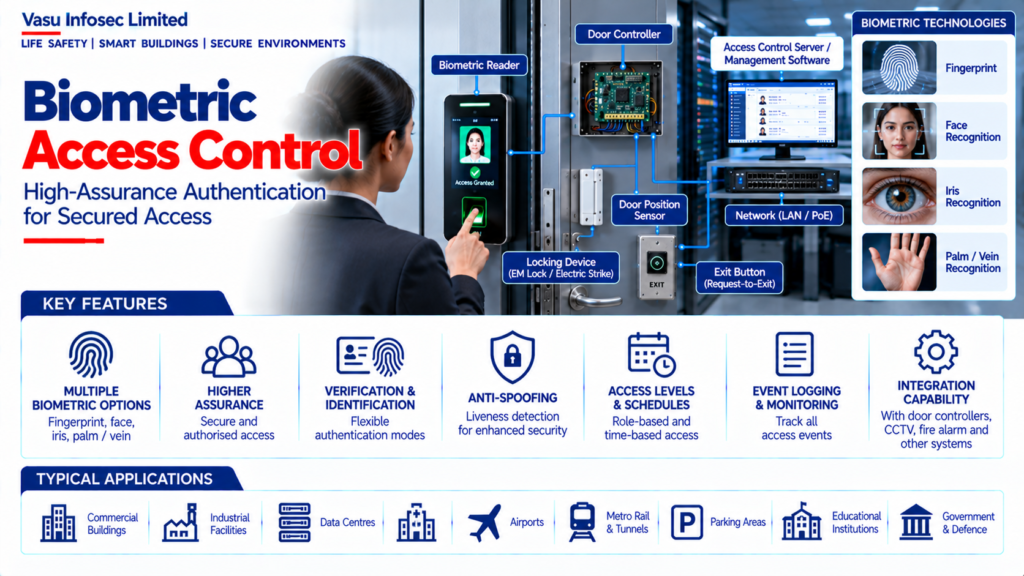
User → Biometric Sensor / Reader → Biometric Matching / Authentication → Door Controller → Locking Device
Door Position Sensor + Request-to-Exit + Emergency Release → Door Controller
Access Control Network → ACS Server / Database → Management Software → Operator Workstation
Supporting Infrastructure → Power Supply / UPS → Network → Time Synchronisation → Cybersecurity
3. Working Principle
The user presents a biometric characteristic to the biometric reader. The sensor captures the biometric sample and extracts relevant features. The system compares the captured features with an authorised template or identity record and determines whether access should be granted or denied.
4. Biometric Modalities
Common biometric modalities include:
- Fingerprint
- Face recognition
- Iris recognition
- Palm / vein recognition
- Other approved biometric technologies
The selected modality should match the required security level, user environment, operational conditions and system requirements.
5. Enrollment Process
During enrollment, an authorised user’s biometric sample is captured and converted into a biometric template or other protected representation. The user identity and access permissions are then associated with the enrolled biometric record.
6. Authentication Process
Typical sequence:
Biometric Presented → Sensor Capture → Feature Extraction → Template Comparison → Authentication Decision → Access Granted / Denied → Event Logged
7. Verification vs Identification
Verification compares a presented biometric against a claimed identity, while identification may search a biometric database to determine the associated identity. The selected operating mode should be based on the approved access-control application.
8. Biometric Reader Architecture
The biometric reader may contain the sensor, processing engine, user interface and communication interface. Depending on the system, biometric matching may occur locally within the reader or through a central server / application.
9. Fingerprint-Based Access
Fingerprint systems analyse distinctive fingerprint patterns for authentication. Sensor type, user population, environmental conditions, hygiene, enrollment quality and required security level should be considered during selection.
10. Face-Based Access
Face-based systems use facial characteristics for authentication. Camera placement, lighting, face orientation, user flow, presentation conditions, privacy requirements and anti-spoofing capabilities should be considered.
11. Iris-Based Access
Iris recognition uses characteristics of the iris for biometric authentication. It may provide high authentication accuracy but requires appropriate sensor positioning, user cooperation and environmental suitability.
12. Anti-Spoofing & Liveness Detection
Where required, biometric systems should incorporate suitable liveness detection or presentation-attack resistance. The selected technology should be evaluated against the security risks and operating environment.
13. False Acceptance & False Rejection
Biometric systems may be evaluated using false acceptance and false rejection performance. The balance between security and user convenience should be established according to the approved application and risk assessment.
14. Environmental Considerations
Biometric readers should be selected according to temperature, humidity, dust, lighting, moisture, outdoor exposure and other site conditions. Outdoor devices should have appropriate environmental protection.
15. User Population & Throughput
Biometric selection should consider the number of enrolled users, expected access transactions, peak user flow and authentication response time. High-throughput entrances may require appropriately sized readers and processing infrastructure.
16. Credential Combination
Biometrics may be combined with cards, PINs or other credentials to provide multi-factor authentication. The authentication method should be selected according to the required security level.
17. Access Control Integration
Biometric devices should integrate with the approved access control platform for user enrollment, access permissions, event logging, door control and alarm management. Compatibility should be verified before final selection.
18. Door Hardware Integration
The biometric system should interface with the door controller, locking device, door position sensor, request-to-exit device and emergency release arrangement. Life-safety requirements should take precedence over normal access control operation.
19. Network & Communication
Network-connected biometric readers should use the approved communication architecture. IP addressing, VLANs, bandwidth, secure communication and controller connectivity should be defined and documented.
20. Data Protection & Privacy
Biometric information should be handled according to the applicable organisational, contractual and legal requirements. Access to biometric templates, enrollment records and administrative functions should be restricted to authorised personnel.
21. Power Supply & UPS
Biometric readers and controllers require appropriate power supplies. Critical access points may require UPS support. Power consumption, cable length and voltage-drop requirements should be included in the access control power design.
22. Installation Requirements
Installation should verify:
- Correct biometric technology
- Correct reader model
- Correct mounting height and location
- Correct environmental rating
- Correct network connectivity
- Correct controller integration
- Correct locking device interface
- Correct emergency release arrangement
- Correct power supply
- Correct enrollment configuration
- Proper cable routing and identification
23. Testing & Commissioning
Biometric access commissioning should verify:
- Successful user enrollment
- Valid biometric authentication
- Invalid biometric rejection
- Authentication response time
- Anti-spoofing / liveness function, where applicable
- Door release
- Door position monitoring
- Request-to-exit
- Emergency release
- Access schedules
- Event logging
- Server / controller communication
24. Maintenance
Maintenance should include sensor cleaning, physical inspection, authentication performance checks, enrollment database review, controller and network health checks, power-supply inspection, software / firmware review and configuration backup.
25. Design Change Control
Changes to biometric technology, reader model, authentication mode, enrollment database, controller, door hardware or system integration should be reviewed because they may affect security, user experience and system compatibility.
26. Documentation
Biometric access control documentation should include, as applicable:
- Biometric reader schedule
- Biometric technology
- Enrollment procedure
- Authentication configuration
- User / access matrix
- Controller allocation
- Door hardware details
- Network / IP details
- Privacy / data-handling requirements
- Testing and commissioning records
- As-built drawings
- O&M manual
27. Engineering Objective
The engineering objective is:
Define Authentication Requirement → Select Suitable Biometric Modality → Establish Enrollment & Matching Architecture → Integrate Reader & Door Controller → Provide Secure Data Handling → Verify Emergency Release → Test Authentication & Door Functions → Establish Secure & Reliable Biometric Access Control
Frequently Asked Questions
What is the main purpose of biometric access control?
Biometric Access Control authenticates users using physical or behavioural characteristics such as fingerprint, face, iris or other approved biometric modalities. It can provide a higher-assurance authentication method than a credential-only system when correctly designed, configured and operated.
What should be checked before selection or installation?
Verify compatibility with the approved system architecture, door hardware and connected devices, power requirements, network or communication interface, environmental conditions and applicable emergency-release requirements.
What should be tested during commissioning?
Test the functions identified in the source technical content and approved project documents, including normal operation, access granted/denied behaviour, monitoring inputs, alarms, emergency release where applicable, power and communication behaviour.
What documentation should be retained?
Maintain applicable schedules, wiring and interface details, configuration records, power calculations, test and commissioning records, as-built drawings and the O&M manual as required by the project.
SEO & Publishing Details
| SEO Title | Biometric Access Control | Technical Guide | Vasu Infosec Limited |
| Meta Description | Biometric Access Control authenticates users using physical or behavioural characteristics such as fingerprint, face, iris or other approved |
| Primary Keyword | Biometric Access Control |
| Secondary Keywords | Biometric Access Control; access control system; electronic security; system architecture; installation and commissioning |
| Suggested URL Slug | biometric-access-control |
| Suggested Image Alt Text | Technical architecture and key components of biometric access control |