
Article
Building Management System Fundamentals
Oct 2026
Direct Answer
A Building Management System (BMS) brings building-service monitoring and authorised control into a structured supervisory platform. It connects field sensors and actuators with local controllers, communication networks, servers and operator interfaces to support visibility of equipment status, alarms, trends, schedules and approved control functions. The final scope and control sequences depend on the approved project design.
1. Engineering Overview
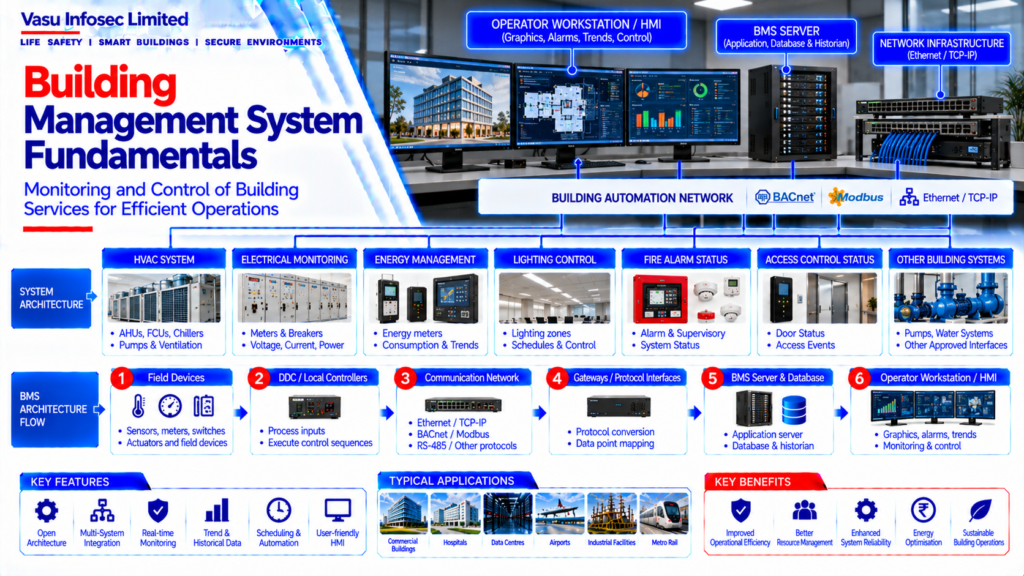
A Building Management System (BMS) is a central supervisory platform used to monitor and, where authorised, control building services such as HVAC, electrical systems, energy systems and other designated facilities. BMS architecture connects field devices, local controllers, communication networks, servers and operator interfaces into a structured building automation environment.
2. BMS Architecture
Field Sensors / Devices → DDC / Local Controllers → Building Automation Network → BMS Server → Database / Application → Operator Workstation / HMI
Typical Systems → HVAC → Chillers → AHUs → FCUs → Pumps → Ventilation → Electrical Monitoring → Energy Monitoring → Lighting / Other Approved Interfaces
3. Field Layer
The field layer contains sensors, switches, actuators, meters and other devices that measure physical parameters or execute control commands. Typical parameters include temperature, humidity, pressure, differential pressure, flow, occupancy and equipment status.
4. Controller Layer
DDC or other local controllers receive field inputs, execute programmed control sequences and generate outputs to actuators and equipment. Local control should remain functional according to the approved control philosophy where required.
5. Sensors & Inputs
Typical BMS inputs may include:
- Temperature
- Relative humidity
- Pressure
- Differential pressure
- Flow
- Equipment run status
- Fault status
- Valve position
- Damper position
- Energy / electrical measurements
6. Actuators & Outputs
Typical outputs may control:
- Control valves
- Dampers
- Fans
- Pumps
- Equipment enable signals
- Setpoints
- Lighting or other approved building functions
7. HVAC Monitoring
BMS commonly monitors HVAC equipment including chillers, cooling towers, pumps, AHUs, FCUs and ventilation systems. Monitoring and control points should be based on the approved equipment schedules and control sequences.
8. HVAC Control Philosophy
Typical HVAC control functions may include equipment enable / disable, temperature control, pressure control, scheduling, interlocking, lead-lag operation and alarm monitoring. Final sequences should follow the approved project control philosophy.
9. Communication Architecture
BMS controllers and integrated equipment may communicate using Ethernet / TCP-IP, BACnet, Modbus, RS-485 or other approved protocols. Communication architecture should define the network topology, addressing and interface requirements.
10. BACnet Fundamentals
BACnet is a building automation communication protocol used for exchanging building service data between compatible devices and systems. BACnet objects and properties provide structured information for monitoring and control.
11. Modbus Fundamentals
Modbus is commonly used for communicating measurement and status data from meters, controllers and equipment. The integration should define communication parameters, addresses, registers, data types and scaling.
12. BMS Server & Database
The BMS server hosts the supervisory application and manages communication, alarms, trends, reports, user access and historical information. Database configuration should support the approved number of points, users and data retention requirements.
13. Operator Workstation & HMI
The operator interface provides graphical access to equipment status, alarms, trends, schedules and authorised control functions. Graphics should follow a consistent hierarchy and clearly identify equipment and operating conditions.
14. Alarm Management
BMS alarms should identify abnormal operating conditions and provide appropriate annunciation. Alarm priorities, acknowledgement, event logging and escalation should follow the approved alarm philosophy.
15. Trend & Historical Data
Trend logging enables review of equipment performance and operating conditions over time. Typical trends may include temperature, pressure, energy consumption, equipment status and other approved parameters.
16. Scheduling
BMS scheduling can automate equipment operation according to approved time schedules, occupancy requirements and operating modes. Schedules should be configurable by authorised users and coordinated with the control philosophy.
17. Interlocks & Sequences
Equipment interlocks prevent unsafe or undesired operation by coordinating related equipment and operating conditions. Examples include pump-fan interlocks, equipment permissives and safety-related shutdown interfaces where approved.
18. Energy Monitoring
BMS may collect energy and electrical data from meters and other systems to support consumption monitoring, trend analysis and reporting. Energy optimisation functions should operate within the approved control boundaries.
19. Installation Requirements
Installation should verify:
- Correct sensors
- Correct actuators
- Correct controllers
- Correct panel wiring
- Correct communication network
- Correct device addressing
- Correct point mapping
- Proper equipment identification
- Adequate access for maintenance
20. Testing & Commissioning
BMS commissioning should verify:
- Sensor readings
- Actuator operation
- Controller logic
- Communication links
- Point mapping
- Alarm generation
- Equipment commands
- Interlocks
- Graphics
- Trends
- Schedules
- Reports
21. Maintenance
Maintenance should include sensor checks, controller inspection, communication diagnostics, server health checks, database backup, alarm review, trend verification and software configuration backup. Faults should be documented and corrected through the approved process.
22. Cybersecurity & User Management
BMS user accounts and network access should follow the approved cybersecurity architecture. User permissions should be role-based, with authorised access to monitoring, acknowledgement, configuration and control functions.
23. Design Change Control
Changes to HVAC equipment, controllers, sensors, communication protocols, point lists, control sequences, graphics or network architecture should be reviewed against the approved BMS design before implementation.
24. Documentation
BMS documentation should include, as applicable:
- System architecture
- Control philosophy
- Point list
- Controller schedules
- I/O schedules
- Network topology
- Communication protocol details
- Graphics hierarchy
- Alarm philosophy
- Control sequences
- Testing and commissioning records
- As-built drawings
- O&M manual
25. Engineering Objective
The engineering objective is:
Accurate Field Measurement → Reliable Local Control → Secure Communication → Correct Supervisory Monitoring → Effective HVAC & Building Service Control → Clear Alarms & Trends → Authorised Operator Control → Complete Commissioning → Maintainable BMS Operation
Frequently Asked Questions
What is a Building Management System (BMS)?
A BMS is a supervisory platform used to monitor and, where authorised, control designated building services through field devices, local controllers, communication networks, servers and operator interfaces.
Which building systems can a BMS monitor?
Depending on the approved project scope, a BMS may monitor HVAC equipment, electrical measurements, energy data, lighting and other designated building systems.
What is the role of DDC or local controllers?
Local controllers receive field inputs, execute programmed control sequences and generate outputs to actuators and equipment according to the approved control philosophy.
What are BACnet and Modbus used for?
They are communication protocols used by compatible building automation devices and systems. The project design should define protocol settings, addressing, data mapping and interface requirements.
What is checked during BMS commissioning?
Typical checks include sensor values, actuator operation, controller logic, communications, point mapping, alarms, commands, interlocks, graphics, trends, schedules and reports.
How should BMS changes be controlled?
Changes to equipment, controllers, sensors, protocols, point lists, control sequences, graphics or network architecture should be reviewed against the approved BMS design before implementation.
SEO & Publishing Details
| SEO title | Building Management System (BMS) Fundamentals | Vasu Infosec Limited |
| Meta description | Understand BMS architecture, field devices, controllers, HVAC integration, BACnet and Modbus communications, alarms, trends, commissioning and maintenance. |
| Primary keyword | Building Management System (BMS) |
| Secondary keywords | BMS architecture, building automation, DDC controllers, HVAC monitoring, BACnet, Modbus, BMS commissioning |
| Suggested URL slug | /building-management-system-fundamentals/ |
| Suggested image alt text | Building Management System architecture showing field sensors, local controllers, communication network, BMS server and operator workstation |