
Article
Bullet Camera Selection
Oct 2026
Direct Answer
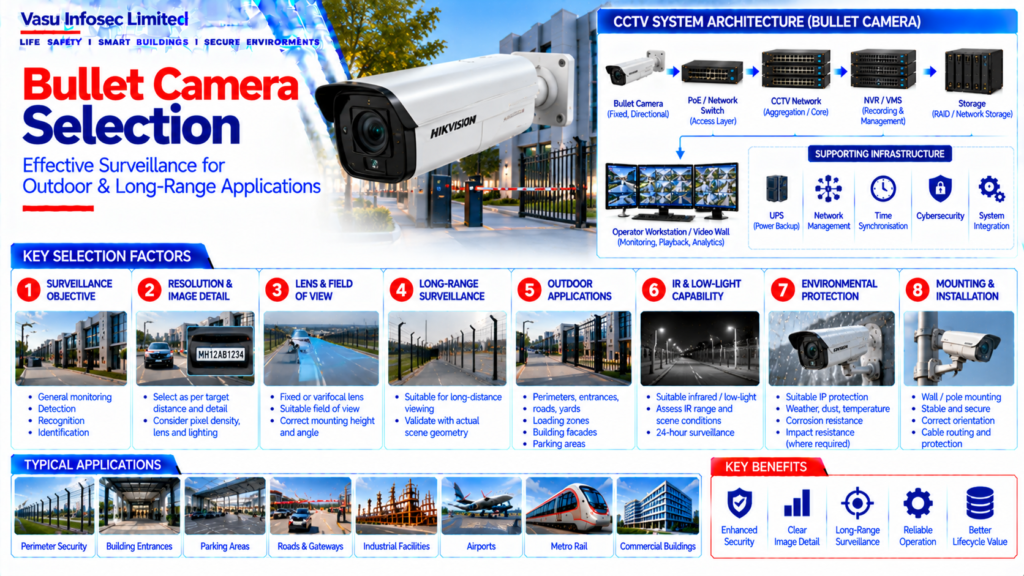
A bullet CCTV camera should be selected according to the surveillance objective, target distance, required image detail, lens and focal length, directional coverage, lighting, environmental exposure, mounting arrangement, network and PoE needs, recording, analytics and cybersecurity requirements. Bullet cameras are commonly used for outdoor and defined directional surveillance, including perimeters, entrances, roads, yards and building boundaries. Long-range performance should be validated against actual scene geometry and the approved project requirements rather than nominal camera specifications alone.
1. Engineering Overview
Bullet cameras are fixed, directional CCTV cameras typically selected for outdoor and long-range surveillance applications. Their visible form factor, directional mounting and environmental housing make them suitable for perimeters, entrances, roads, yards, building facades and other defined surveillance zones.
2. Bullet Camera Architecture
Bullet Camera → PoE / Network Switch → CCTV Network → NVR / VMS → Storage → Operator Workstation / Video Wall
Supporting Infrastructure → UPS → Network Management → Time Synchronisation → Cybersecurity → Approved System Integration
3. Surveillance Objective
Selection should begin with the required surveillance objective: general monitoring, detection, recognition or identification. The objective determines camera resolution, lens, pixel density, mounting geometry, illumination and recording configuration.
4. Camera Resolution
Resolution should be selected according to target distance and required image detail. Higher resolution should be evaluated together with sensor performance, lens quality, field of view, lighting and pixel density.
5. Lens & Focal Length
The selected focal length should provide the required field of view and target detail. Fixed lenses may be suitable for stable applications, while varifocal lenses provide flexibility during final field adjustment.
6. Directional Coverage
Bullet cameras are inherently directional and should be oriented toward the intended surveillance zone. Camera positioning should minimise unnecessary background, obstructions, glare and extreme viewing angles.
7. Long-Range Surveillance
Bullet cameras may be selected for long-distance viewing where the required target distance and lens specification can be achieved. Long-range performance should be validated using actual scene geometry rather than nominal camera specifications alone.
8. Outdoor Applications
Bullet cameras are commonly used for external perimeters, entrances, gates, parking areas, roads, loading zones and building boundaries. Environmental protection should match the actual installation conditions.
9. Environmental Protection
Outdoor bullet cameras should have appropriate ingress protection and, where required, impact resistance, temperature range, corrosion resistance and other environmental characteristics. The selected rating should comply with the project requirements.
10. IR & Night Vision
Where night surveillance is required, suitable infrared or low-light capability should be selected. IR performance depends on range, target reflectivity, lens configuration, environmental conditions and scene geometry.
11. WDR Requirement
WDR may be required at locations with strong contrast between bright and dark areas, such as entrances, gates and locations exposed to direct sunlight. The camera should be evaluated for the expected lighting conditions.
12. Mounting Arrangement
Bullet cameras should be mounted using suitable brackets that provide stable positioning, correct orientation and sufficient maintenance access. Mounting should minimise vibration and tampering.
13. Pole & Wall Mounting
Pole and wall mounting arrangements should consider structural stability, wind exposure, cable routing, camera orientation and accessibility. Approved mounting accessories should be compatible with the camera and support structure.
14. Network & PoE Requirements
IP bullet cameras require suitable Ethernet connectivity. Where PoE is used, switch port capacity, power budget, cable length and camera consumption should be verified. Bandwidth should be calculated based on the selected video configuration.
15. Recording Requirements
The camera should be compatible with the approved NVR / VMS. Resolution, frame rate, compression, recording mode and retention requirements should be coordinated with storage and bandwidth calculations.
16. Analytics Capability
Where analytics are required, the bullet camera and VMS should support the approved functions. Camera mounting geometry and field of view should be suitable for reliable analytics performance.
17. Cybersecurity Considerations
Network-connected bullet cameras should comply with the approved cybersecurity requirements, including secure credentials, controlled access, firmware management, network segmentation and authorised remote access.
18. Installation Requirements
Installation should verify:
- Correct camera model
- Correct resolution
- Correct lens / focal length
- Correct mounting location
- Correct viewing angle
- Correct focus
- Correct environmental rating
- Correct network connection
- Correct PoE power
- Correct IP addressing
- Correct VMS / NVR compatibility
- Proper cable routing and segregation
19. Testing & Commissioning
Bullet camera commissioning should verify:
- Camera connectivity
- Image quality
- Field of view
- Focus
- Target coverage
- Day / night operation
- IR operation, where applicable
- WDR operation, where applicable
- Recording
- Playback
- Analytics, where applicable
- Camera mounting stability
20. Maintenance
Maintenance should include lens and housing cleaning, mounting inspection, image-quality verification, IR / illumination checks, network connectivity, PoE verification, configuration review and periodic confirmation of camera coverage.
21. Design Change Control
Changes to bullet camera model, lens, location, mounting height, orientation, environmental rating, resolution or analytics capability should be reviewed because they may affect surveillance coverage, bandwidth, storage and system integration.
22. Documentation
Bullet camera documentation should include, as applicable:
- Camera schedule
- Camera model and type
- Resolution
- Lens / focal length
- Field of view
- Environmental rating
- Mounting details
- PoE requirements
- Network details
- Analytics capability
- Camera layout drawings
- Testing and commissioning records
- As-built drawings
- O&M manual
23. Engineering Objective
The engineering objective is:
Define Outdoor / Directional Surveillance Requirement → Select Suitable Bullet Camera → Validate Lens & Long-Range Coverage → Confirm Lighting & Environment → Verify Mounting, Network & Power → Confirm Recording & Analytics → Complete Testing → Establish Reliable Directional Surveillance
Frequently Asked Questions
Where are bullet cameras commonly used?
They are commonly selected for outdoor and directional surveillance such as perimeters, entrances, gates, parking areas, roads, loading zones and building boundaries.
How should long-range performance be assessed?
Validate the required target distance, lens specification and actual scene geometry rather than relying on nominal camera specifications alone.
When are IR or night-vision features needed?
Where night surveillance is required, select suitable infrared or low-light capability and assess performance against range, target reflectivity, lens configuration and scene conditions.
What should be checked for PoE cameras?
Verify switch port capacity, power budget, cable length, camera consumption and bandwidth based on the selected video configuration.
What should commissioning include?
Check connectivity, image quality, field of view, focus, target coverage, day/night operation, applicable IR/WDR, recording, playback, analytics and mounting stability.
SEO & Publishing Details
| SEO title | Bullet Camera Selection Guide | Vasu Infosec Limited |
| Meta description | Explore bullet CCTV camera selection for outdoor and long-range surveillance, including lens, coverage, IR, WDR, environmental protection, PoE and commissioning considerations. |
| Primary keyword | bullet camera selection |
| Secondary keywords | bullet CCTV camera, outdoor CCTV camera, long-range CCTV camera, bullet camera lens, IR bullet camera, PoE CCTV camera, CCTV commissioning |
| Suggested URL slug | bullet-camera-selection |
| Suggested image alt text | Outdoor bullet CCTV camera mounted for directional perimeter surveillance |