
Article
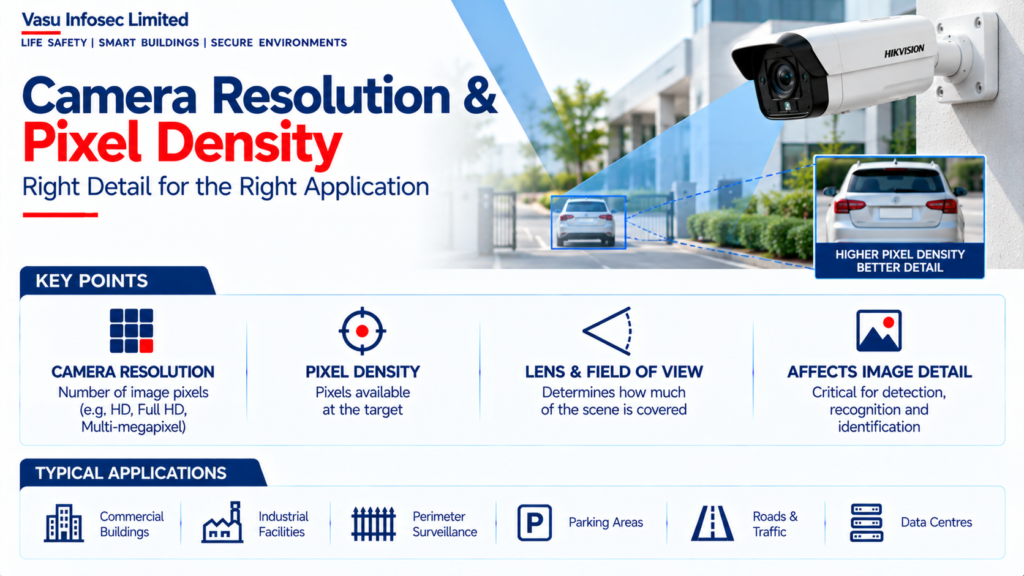
Camera Resolution & Pixel Density
Oct 2026
Direct Answer
Camera resolution defines the number of pixels captured in an image, while pixel density describes how those pixels are distributed across a target area. For CCTV design, the required image detail depends not only on resolution but also on lens focal length, field of view, target distance, lighting, camera placement, compression and recording configuration. Select and validate the camera against the intended detection, recognition or identification objective rather than choosing resolution in isolation.
1. Engineering Overview
Camera resolution and pixel density are fundamental parameters for determining whether a CCTV camera can provide the required level of visual detail at a target location. Resolution defines the number of image pixels produced by the sensor, while pixel density describes how those pixels are distributed across the target scene.
2. Resolution & Pixel Density Architecture
Camera Sensor → Image Resolution → Lens / Field of View → Target Distance → Pixel Distribution → Video Encoding → Network → NVR / VMS → Operator Display
3. Camera Resolution
Camera resolution represents the number of pixels available in the captured image, typically expressed as horizontal × vertical pixels. Higher resolution can provide more image detail, but the benefit depends on lens selection, field of view, lighting and target distance.
4. Common Resolution Classes
CCTV cameras may be available in multiple resolution classes, including HD, Full HD, multi-megapixel and higher-resolution formats. The selected resolution should be based on the project surveillance objective rather than selecting the highest available specification by default.
5. Pixel Density
Pixel density represents the number of pixels covering a defined target width or distance. It is a more application-oriented measure than total camera resolution because it indicates how much image information is available at the target.
6. Resolution vs Pixel Density
A high-resolution camera can still provide inadequate identification if its field of view is excessively wide. Conversely, a lower-resolution camera with an appropriately selected lens and narrow field of view may provide sufficient detail for a specific target.
7. Horizontal Pixel Density
Horizontal pixel density can be assessed by relating the horizontal image resolution to the width of the scene covered at the target distance. This provides an engineering basis for evaluating detection, recognition and identification performance.
8. Target Width Consideration
Pixel density should be assessed against the actual width of the target or critical feature. The required target detail should be established before finalising camera resolution and lens selection.
9. Detection Requirement
Detection generally requires sufficient pixels to establish that a target or object is present within the scene. Camera placement and field of view should be designed to provide adequate pixel distribution over the detection zone.
10. Recognition Requirement
Recognition requires more image detail than basic detection. Camera resolution, lens selection and target distance should be coordinated to provide sufficient distinguishing information for the intended application.
11. Identification Requirement
Identification requires a substantially higher level of image detail and should be treated as a specific design objective. The camera should be positioned and configured so that adequate pixel density is available at the critical identification area.
12. Lens Impact
Lens focal length directly affects the field of view and therefore the distribution of available pixels over the target scene. Lens selection should be performed together with camera resolution rather than independently.
13. Sensor Size & Pixel Performance
Sensor format and pixel characteristics influence image quality, sensitivity and optical performance. Resolution should therefore be evaluated with sensor performance and lens compatibility.
14. Frame Rate
Frame rate determines how frequently images are captured and can influence the ability to observe moving targets. Higher frame rates may be required for traffic, entrances or other applications involving rapid movement.
15. Compression & Image Quality
Video compression can reduce the amount of data transmitted and stored but may affect image detail depending on configuration and scene complexity. Codec, bitrate and quality settings should be coordinated with the surveillance objective.
16. Lighting Conditions
Resolution and pixel density should be assessed together with illumination. Low light, backlighting, glare, shadows and rapidly changing lighting can reduce practical image quality even when the nominal resolution is high.
17. Digital Zoom vs Optical Detail
Digital zoom enlarges existing pixels and does not create new image information. Optical lens selection and adequate pixel density at the target are therefore more important for reliable identification.
18. Storage & Bandwidth Impact
Higher resolution and frame rate generally increase video data requirements. Camera resolution should therefore be coordinated with bandwidth, NVR / VMS throughput and storage retention calculations.
19. Camera Placement
Mounting height, horizontal distance, viewing angle and target geometry influence pixel density. Camera locations should be established through coverage and performance analysis before final installation.
20. Installation Requirements
Installation should verify:
- Correct camera resolution
- Correct lens and focal length
- Correct mounting location
- Correct target distance
- Correct field of view
- Required pixel density at critical areas
- Correct focus
- Appropriate lighting
- Correct recording configuration
- Correct network capacity
21. Testing & Commissioning
Resolution and pixel-density commissioning should verify:
- Image resolution
- Target detail
- Detection performance
- Recognition performance, where required
- Identification performance, where required
- Focus
- Field of view
- Day / night performance
- Recording quality
- Playback quality
22. Design Change Control
Changes to camera resolution, lens, field of view, mounting location or target area should be reviewed because they can change pixel density and may affect surveillance performance, bandwidth and storage requirements.
23. Documentation
Resolution and pixel-density documentation should include, as applicable:
- Camera schedule
- Resolution
- Sensor specification
- Lens / focal length
- Field of view
- Camera location
- Mounting height
- Target distance
- Pixel-density assessment
- Coverage drawings
- Storage and bandwidth calculations
- Testing and commissioning records
- As-built drawings
- O&M manual
24. Engineering Objective
The engineering objective is:
Define Surveillance Objective → Establish Critical Target Area → Select Resolution & Lens → Calculate / Validate Pixel Density → Confirm Lighting & Mounting → Verify Bandwidth & Storage → Complete Testing → Achieve Required Image Detail
Frequently Asked Questions
Is higher camera resolution always better?
Not necessarily. The benefit depends on the lens, field of view, target distance, lighting and the required surveillance objective.
What is pixel density in CCTV?
Pixel density describes how many image pixels cover a defined target width or distance and helps assess the detail available at the target.
What is the difference between detection, recognition and identification?
They are different image-detail objectives. Detection establishes that an object is present; recognition requires distinguishing information; identification requires a higher level of detail for the specified critical area.
Does digital zoom improve actual detail?
Digital zoom enlarges existing pixels and does not create new image information. Optical selection and adequate pixel density at the target are more important.
What should be checked during commissioning?
Verify resolution, target detail, focus, field of view, day/night performance, recording quality and playback quality; also check network and storage configuration.
SEO & Publishing Details
| SEO title | CCTV Camera Resolution and Pixel Density: Engineering Guide |
| Meta description | Understand CCTV camera resolution and pixel density, including lens and field-of-view effects, detection, recognition, identification, lighting, bandwidth and commissioning checks. |
| Primary keyword | CCTV camera resolution and pixel density |
| Secondary keywords | CCTV pixel density; camera resolution; CCTV lens and field of view; detection recognition identification; CCTV camera commissioning; video bandwidth and storage |
| Suggested URL slug | /cctv-camera-resolution-pixel-density/ |
| Suggested image alt text | CCTV camera resolution and pixel density architecture from camera sensor and lens to target area, network, NVR/VMS and operator display. |