
Article
Card Reader Technologies
Oct 2026
Direct Answer
Card readers are electronic devices used to identify and authenticate access credentials presented by users. Reader technology should be selected according to security level, credential type, communication method, environmental conditions, interoperability, user convenience and project requirements.
1. Engineering Overview
Card readers are electronic devices used to identify and authenticate access credentials presented by users. Reader technology should be selected according to security level, credential type, communication method, environmental conditions, interoperability, user convenience and project requirements.
2. Complete Card Reader Architecture
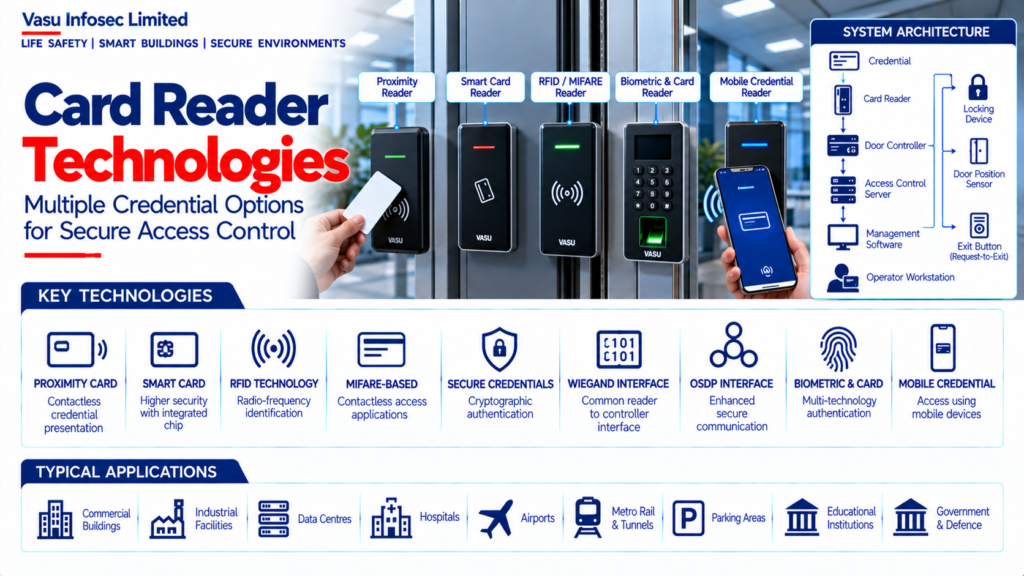
Access Credential → Card Reader → Door Controller → Access Control Server / Database → Management Software → Operator Workstation
Door Controller → Locking Device
Door Position Sensor + Request-to-Exit → Door Controller
Supporting Infrastructure → Power Supply / UPS → Network → Cybersecurity
3. Card Reader Function
The reader detects the presented card or credential and extracts the credential information required for authentication. The reader communicates the credential data to the access control controller through the approved interface.
4. Proximity Card Technology
Proximity readers detect compatible cards or tokens presented within the specified operating range. They are commonly used for general access applications where contactless credential presentation is required.
5. Smart Card Technology
Smart cards contain an integrated chip capable of storing and processing credential information. Depending on the selected technology, smart cards can provide stronger security and support additional authentication functions compared with basic proximity credentials.
6. Contactless Card Technology
Contactless credentials communicate with the reader without physical contact. The technology should be selected according to required security, operating range, card compatibility and approved credential standards.
7. RFID Reader Technology
RFID-based access readers use radio-frequency communication to identify compatible credentials. Frequency, credential format, security features and reader compatibility should be verified during selection.
8. MIFARE-Based Credentials
MIFARE-type technologies may be used for contactless access applications depending on the selected card and security architecture. The exact credential technology and security configuration should be established from the approved system requirements.
9. Secure Credential Technology
Where higher security is required, secure credentials with cryptographic authentication may be selected. Reader, card and controller compatibility should be verified to ensure that the complete authentication chain supports the required security level.
10. Reader Communication Interfaces
Readers may communicate with controllers using approved interfaces such as Wiegand or OSDP, depending on the selected system. The communication interface should be compatible with both the reader and door controller.
11. Wiegand Interface
Wiegand is a commonly used reader-to-controller interface. It generally transmits credential information from the reader to the controller through dedicated data connections. The interface should be selected according to the approved access control architecture.
12. OSDP Interface
OSDP is a modern reader-to-controller communication protocol designed to provide enhanced communication capabilities and security features compared with traditional reader interfaces. Where supported, secure communication should be configured according to the system requirements.
13. Reader Security
Reader security should consider credential cloning risks, communication security, tamper protection, secure authentication and physical protection. Higher-security applications should use appropriately secured credentials and communication methods.
14. Indoor Reader Selection
Indoor readers may be selected based on credential technology, aesthetics, mounting arrangement, communication interface and required security level. Environmental protection should match the installation location.
15. Outdoor Reader Selection
Outdoor readers should be selected with appropriate ingress protection, temperature range, UV resistance, impact resistance and other environmental characteristics suitable for the installation.
16. Biometric & Card Multi-Technology Readers
Multi-technology readers may support cards together with biometric or other credential methods. The selected reader should support the required authentication modes and integration with the approved controller.
17. Mobile Credential Compatibility
Some access control platforms support mobile credentials using approved wireless technologies. Where mobile credentials are required, reader, mobile application, credential platform and controller compatibility should be verified.
18. Reader Mounting
Reader mounting should provide suitable user access, visibility, protection from tampering and correct cable routing. Mounting height and location should comply with the approved architectural and accessibility requirements.
19. Power Requirements
Readers require an appropriate low-voltage power supply. Power consumption, voltage range, cable length and voltage drop should be considered in the access control power calculation.
20. Network & Controller Integration
Readers normally connect to local door controllers, which communicate with the central access control network. Controller capacity, communication interface, cable length and system architecture should be verified during design.
21. Installation Requirements
Installation should verify:
- Correct reader technology
- Correct credential type
- Correct communication interface
- Correct controller compatibility
- Correct mounting location
- Correct environmental rating
- Correct power supply
- Correct cable type and termination
- Correct reader addressing / configuration
- Correct access control software integration
22. Testing & Commissioning
Reader commissioning should verify:
- Valid credential recognition
- Invalid credential rejection
- Read range
- Authentication response
- Controller communication
- Access granted event
- Access denied event
- Reader tamper indication, where applicable
- User access schedules
- Event logging
23. Maintenance
Maintenance should include reader cleaning, physical inspection, credential-read verification, cable and connection inspection, power checks, tamper verification where applicable, firmware / configuration review and event-log review.
24. Design Change Control
Changes to card technology, reader model, communication interface, credential type, mounting location or controller should be reviewed because they may affect system compatibility, security and access-control performance.
25. Documentation
Card reader documentation should include, as applicable:
- Reader schedule
- Credential technology
- Reader model
- Communication interface
- Controller allocation
- Mounting details
- Environmental rating
- Power requirements
- Access level matrix
- Testing and commissioning records
- As-built drawings
- O&M manual
26. Engineering Objective
The engineering objective is:
Define Security & Credential Requirement → Select Appropriate Card Technology → Select Compatible Reader → Confirm Communication & Controller Compatibility → Verify Environment & Power → Configure Authentication → Complete Testing → Establish Secure & Reliable Credential-Based Access
Frequently Asked Questions
What is the main purpose of card reader technologies?
Card readers are electronic devices used to identify and authenticate access credentials presented by users. Reader technology should be selected according to security level, credential type, communication method, environmental conditions, interoperability, user convenience and project requirements.
What should be checked before selection or installation?
Verify compatibility with the approved system architecture, door hardware and connected devices, power requirements, network or communication interface, environmental conditions and applicable emergency-release requirements.
What should be tested during commissioning?
Test the functions identified in the source technical content and approved project documents, including normal operation, access granted/denied behaviour, monitoring inputs, alarms, emergency release where applicable, power and communication behaviour.
What documentation should be retained?
Maintain applicable schedules, wiring and interface details, configuration records, power calculations, test and commissioning records, as-built drawings and the O&M manual as required by the project.
SEO & Publishing Details
| SEO Title | Card Reader Technologies | Technical Guide | Vasu Infosec Limited |
| Meta Description | Card readers are electronic devices used to identify and authenticate access credentials presented by users. Reader technology should be selected |
| Primary Keyword | Card Reader Technologies |
| Secondary Keywords | Card Reader Technologies; access control system; electronic security; system architecture; installation and commissioning |
| Suggested URL Slug | card-reader-technologies |
| Suggested Image Alt Text | Technical architecture and key components of card reader technologies |