
Article
CCTV Bandwidth Calculation
Oct 2026
Direct Answer
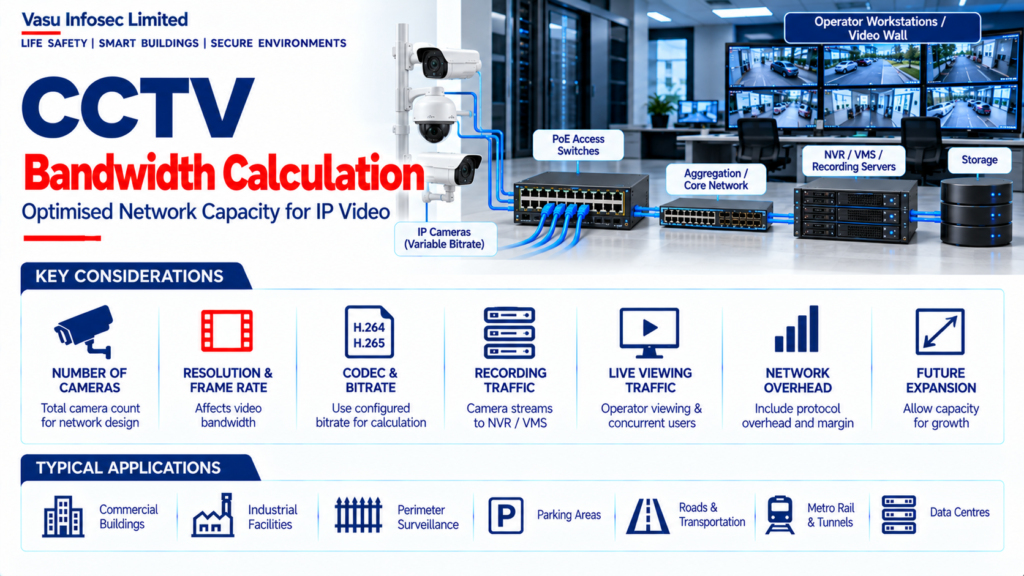
CCTV bandwidth calculation determines the network capacity required to transport video streams from IP cameras to recording servers, NVRs, VMS platforms and operator workstations. Consider camera count, resolution, frame rate, codec, configured bitrate, recording mode, live viewing, analytics traffic, network overhead and future expansion.
1. Engineering Overview
CCTV bandwidth calculation determines the network capacity required to transport video streams from IP cameras to recording servers, NVRs, VMS platforms and operator workstations. The calculation should consider camera count, resolution, frame rate, codec, configured bitrate, recording mode, live viewing, analytics traffic, network overhead and future expansion.
2. Complete Bandwidth Architecture
IP Cameras → PoE Access Switches → Aggregation / Core Network → NVR / VMS / Recording Servers → Storage
Operator Workstations / Video Wall → Live Viewing Traffic → CCTV Network
Supporting Infrastructure → Network Management → Time Synchronisation → Cybersecurity
3. Primary Bandwidth Parameters
The main parameters are:
- Number of cameras
- Camera resolution
- Frame rate
- Codec
- Average / configured bitrate
- Peak bitrate
- Recording traffic
- Live-view traffic
- Analytics / metadata traffic
- Network protocol overhead
- Future expansion
4. Bitrate-Based Calculation
For a camera with an average bitrate B in Mbps:
Total Camera Bandwidth = Number of Cameras × Average Bitrate
The result should be calculated separately for each camera group where cameras have different resolution, frame rate or bitrate profiles.
5. Example Calculation Method
Example:
If 20 cameras each transmit at 4 Mbps:
Camera Traffic = 20 × 4 Mbps = 80 Mbps
The network should then allow for protocol overhead, live viewing, management traffic, redundancy requirements and suitable engineering margin.
6. Average vs Peak Bitrate
Average bitrate is useful for general capacity planning, while peak bitrate should be considered when evaluating network congestion and interface capacity. Variable bitrate cameras can generate higher traffic during complex scenes, movement or rapid image changes.
7. Resolution Impact
Higher camera resolution generally increases the amount of video information and may increase required bitrate. Resolution should therefore be coordinated with the required surveillance performance and network capacity.
8. Frame Rate Impact
Higher frame rates increase the number of video frames transmitted per second and can increase bandwidth requirements. Frame rate should be selected according to the required motion detail and surveillance application.
9. Codec Impact
Codecs such as H.264 and H.265 can reduce bandwidth compared with less efficient encoding methods. The final network calculation should use the actual approved bitrate rather than relying only on the codec name.
10. Variable Bitrate Configuration
Where variable bitrate is configured, the design should consider the manufacturer’s specified range or project-approved bitrate profile. Peak traffic should be reviewed for uplinks and critical network interfaces.
11. Recording Bandwidth
Recording traffic includes the camera streams delivered to NVRs or recording servers. Aggregate recording bandwidth should be calculated for each access, aggregation and core network segment.
12. Live Viewing Bandwidth
Operator live viewing generates additional network traffic depending on the number of cameras displayed, stream profiles and number of concurrent users. Main and sub-stream configurations may be used to manage viewing bandwidth.
13. Playback Bandwidth
Playback and investigation activities can create additional traffic between storage / recording infrastructure and operator workstations. Network capacity should account for the required number of concurrent playback sessions.
14. Sub-Stream Architecture
Sub-streams may be configured at lower resolution or bitrate for routine live viewing, while main streams are retained for recording. This can reduce control-room viewing bandwidth without reducing the approved recording quality.
15. Analytics & Metadata Traffic
Video analytics may generate metadata, events and additional processing traffic. The design should include any material network traffic associated with analytics servers, gateways or integrated platforms.
16. Network Overhead
The usable video bitrate is not the only traffic on the network. Ethernet, IP, transport, management and other protocol overhead should be considered when sizing network interfaces.
17. Access Switch Bandwidth
The access switch should support the aggregate incoming camera traffic on its ports and provide sufficient uplink capacity toward the aggregation layer. Port and uplink utilisation should be assessed under expected peak conditions.
18. Aggregation & Core Bandwidth
Aggregation and core links should be sized for the combined traffic from connected access switches, including recording, live viewing, playback, management and future expansion.
19. Fibre Backbone Capacity
Where fibre is used as the CCTV backbone, optical uplink speed should be selected according to the aggregate bandwidth and required resilience. Optical link capacity should be coordinated with the switch architecture.
20. Bandwidth Margin
An appropriate engineering margin should be provided so the network does not operate continuously at its maximum rated capacity. The margin should be based on project standards, network design practice and expected expansion.
21. Network Segmentation
CCTV traffic should be appropriately segmented from unrelated network traffic. VLANs and routing controls may be used to isolate camera, recording, management and user traffic according to the approved network architecture.
22. Bandwidth Calculation Procedure
The calculation should follow:
- Establish camera quantity.
- Group cameras by bitrate profile.
- Determine average and peak bitrate.
- Calculate aggregate camera traffic.
- Add live-view and playback traffic.
- Include analytics / management traffic where applicable.
- Consider network overhead.
- Apply engineering margin.
- Verify switch and uplink capacity.
- Verify NVR / VMS recording throughput.
23. Installation & Configuration Requirements
Configuration should verify:
- Correct camera bitrate
- Correct resolution
- Correct frame rate
- Correct codec
- Correct stream profile
- Correct switch port allocation
- Correct uplink speed
- Correct VLAN configuration
- Correct NVR / VMS connectivity
- Correct bandwidth monitoring
24. Testing & Commissioning
Bandwidth commissioning should verify:
- Camera stream connectivity
- Configured bitrate
- Link utilisation
- Switch port performance
- Uplink utilisation
- Recording traffic
- Live-view traffic
- Playback traffic
- Network stability
- Packet loss / communication faults
- Performance during representative peak conditions
25. Capacity Monitoring
Network utilisation should be monitored after commissioning. Sustained high utilisation, packet loss, abnormal bitrate growth or congestion should be investigated before they affect video recording or live monitoring.
26. Design Change Control
Changes to camera quantity, resolution, frame rate, codec, bitrate, live-view requirements, recording architecture, analytics or network topology should trigger a bandwidth reassessment.
27. Documentation
CCTV bandwidth documentation should include, as applicable:
- Camera schedule
- Resolution and frame rate
- Bitrate schedule
- Codec
- Recording profile
- Aggregate bandwidth calculation
- Peak bandwidth assessment
- Access-switch capacity
- Uplink capacity
- Fibre backbone capacity
- Network margin
- VLAN / network topology
- Testing and commissioning records
- As-built documentation
28. Engineering Objective
The engineering objective is:
Establish Camera Configuration → Determine Average & Peak Bitrate → Calculate Aggregate Traffic → Add Viewing / Playback / Management Traffic → Include Network Overhead & Margin → Verify Switch & Backbone Capacity → Complete Testing → Achieve Reliable CCTV Video Transmission
Frequently Asked Questions
What is the basic CCTV bandwidth formula?
Total Camera Bandwidth = Number of Cameras × Average Bitrate. Calculate camera groups separately when profiles differ.
Does camera bandwidth include only recording?
No. Include live viewing, playback, analytics/metadata, management traffic and protocol overhead where applicable.
Why consider peak bitrate?
Variable-bitrate cameras can produce higher traffic in complex scenes, so peak conditions matter when assessing congestion and interface capacity.
SEO & Publishing Details
| SEO title | CCTV Bandwidth Calculation: CCTV Engineering Guide |
| Meta description | Understand cctv bandwidth calculation, including key design parameters, architecture, installation, testing and maintenance considerations for CCTV systems. |
| Primary keyword | cctv bandwidth calculation |
| Secondary keywords | CCTV bandwidth calculation; camera bitrate calculation; CCTV network bandwidth; NVR recording bandwidth; live-view bandwidth; CCTV uplink capacity |
| Suggested URL slug | /cctv-bandwidth-calculation/ |
| Suggested image alt text | CCTV Bandwidth Calculation architecture showing key CCTV system components, network or operational connections and supporting infrastructure. |