
Article
CCTV Camera Types & Applications
Oct 2026
Direct Answer
CCTV camera types should be selected according to the surveillance objective, required detection or identification performance, coverage area, lighting, environmental exposure, mounting arrangement, network and power requirements, analytics, and integration needs. Fixed dome, bullet, PTZ, thermal, box, turret, panoramic/fisheye, ANPR/LPR, low-light/IR and WDR cameras serve different operational needs. Final selection should be validated against the approved CCTV design and the conditions at the installation site.
1. Engineering Overview
CCTV camera selection is driven by the surveillance objective, coverage area, lighting conditions, environmental exposure, required image detail, mounting arrangement, analytics requirements and integration needs. Different camera types are engineered for specific operational applications.
2. Camera Classification
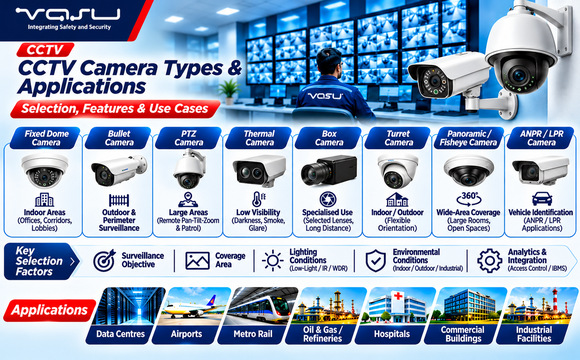
Common CCTV camera categories include fixed dome cameras, bullet cameras, PTZ cameras, thermal cameras, box cameras, turret cameras, panoramic / fisheye cameras, ANPR / LPR cameras and specialised cameras. Final selection should follow the approved surveillance design.
3. Fixed Dome Camera
Fixed dome cameras provide a compact, discreet surveillance solution with a fixed field of view. They are commonly used in offices, corridors, retail areas, lobbies, data-centre support areas and other locations requiring fixed coverage.
4. Bullet Camera
Bullet cameras generally provide a visible directional surveillance arrangement and are commonly selected for outdoor areas, perimeters, entrances, roadways and building facades. Housing, weather protection and mounting should suit the environment.
5. PTZ Camera
PTZ cameras provide remotely controlled pan, tilt and optical zoom. They are suitable for large open areas, perimeter surveillance, traffic monitoring, yards and locations where active operator control or programmed patrols are required.
6. Thermal Camera
Thermal cameras detect infrared radiation rather than relying primarily on visible light. They are suitable for applications requiring detection under darkness, glare, smoke or other challenging visibility conditions, subject to the approved use case.
7. Box Camera
Box cameras provide a flexible camera body that can be paired with selected lenses and housings. They may be used where specialised lens selection, long-distance viewing or custom environmental protection is required.
8. Turret Camera
Turret cameras provide a compact fixed-camera arrangement with flexible orientation and are commonly used for indoor and outdoor surveillance. Selection should consider illumination, weather protection and mounting requirements.
9. Panoramic / Fisheye Camera
Panoramic or fisheye cameras provide wide-area coverage from a single mounting location. They may be suitable for large rooms, open spaces and areas where broad situational awareness is required.
10. ANPR / LPR Camera
Automatic Number Plate Recognition / License Plate Recognition cameras are designed for vehicle identification. They require suitable camera optics, illumination, mounting geometry, shutter configuration and software analytics to achieve the required recognition performance.
11. Low-Light & IR Cameras
Low-light and infrared cameras are selected for areas with insufficient visible illumination. IR performance depends on scene distance, reflectivity, lens selection and environmental conditions. Lighting requirements should be assessed during design.
12. WDR Cameras
Wide Dynamic Range cameras are useful where strong differences exist between bright and dark areas, such as entrances, glazing interfaces and vehicle gates. WDR capability should be evaluated with the expected scene lighting.
13. Environmental Selection
Outdoor and industrial applications may require suitable IP protection, impact resistance, temperature range, corrosion resistance and other environmental characteristics. The camera housing and mounting accessories should match the installation environment.
14. Indoor Applications
Indoor camera selection should consider ceiling height, room geometry, lighting, required field of view, privacy requirements and target identification objectives. Dome and turret cameras are commonly suitable for many indoor applications.
15. Outdoor Applications
Outdoor surveillance requires consideration of weather exposure, sunlight, rain, dust, temperature, vandalism, mounting height and night-time illumination. Bullet, dome, PTZ and thermal cameras may be selected depending on the application.
16. Perimeter Surveillance
Perimeter surveillance may require long-range cameras, PTZ cameras, thermal cameras or analytics-enabled fixed cameras. Camera spacing should be based on required detection and identification performance rather than only physical coverage.
17. Data Centre Applications
Data-centre CCTV may include fixed cameras for entrances, corridors, equipment areas, loading areas and critical access points. Camera selection should consider security zoning, lighting, access-control integration and operational monitoring requirements.
18. Industrial Applications
Industrial CCTV selection should consider hazardous or harsh environments, dust, heat, vibration, moisture, process conditions and required viewing distance. Specialised environmental or certified equipment may be required where applicable.
19. Traffic & Vehicle Monitoring
Traffic and vehicle applications may require specialised cameras for vehicle detection, plate recognition, lane monitoring or wide-area observation. Mounting geometry, shutter speed, illumination and lens selection are critical.
20. Camera Selection Criteria
Camera selection should consider:
- Surveillance objective
- Detection / recognition / identification requirement
- Resolution
- Pixel density
- Lens and focal length
- Field of view
- Lighting conditions
- IR / low-light capability
- WDR requirement
- Environmental conditions
- Mounting arrangement
- Network interface
- PoE requirement
- Storage and bandwidth
- Analytics capability
- Cybersecurity features
21. Mounting Considerations
Camera mounting should provide stable positioning, appropriate viewing angle, required field of view and adequate accessibility for maintenance. Mounting height and orientation should minimise obstruction, glare and tampering.
22. Network & Power Requirements
IP cameras require suitable network connectivity and, where applicable, PoE power. Network switches should be sized for camera count, bandwidth and PoE power budget. Fibre uplinks should be used where distance or bandwidth requires them.
23. Integration Considerations
Camera selection should consider compatibility with the approved VMS / NVR, ONVIF or other supported interfaces, analytics platform, access control, IBMS and other approved integrations.
24. Testing & Commissioning
Camera commissioning should verify:
- Camera identification
- Image quality
- Field of view
- Focus
- Orientation
- Day / night operation
- IR operation, where applicable
- WDR operation, where applicable
- PTZ operation, where applicable
- Network communication
- Recording
- Analytics, where applicable
25. Design Change Control
Changes to camera type, lens, location, mounting height, resolution, analytics or environmental rating should be reviewed against the approved CCTV design because they can affect coverage, bandwidth, storage, network loading and surveillance performance.
26. Documentation
Camera selection documentation should include, as applicable:
- Camera schedule
- Camera type and model
- Resolution
- Lens / focal length
- Field of view
- Environmental rating
- Mounting details
- Power requirements
- Network requirements
- Analytics capability
- Camera layout drawings
- Testing and commissioning records
- As-built drawings
- O&M manual
27. Engineering Objective
The engineering objective is:
Define Surveillance Objective → Select Appropriate Camera Type → Validate Lens & Coverage → Confirm Lighting & Environment → Verify Network & Power → Confirm Recording & Analytics → Complete Testing → Establish Reliable Surveillance Coverage
Frequently Asked Questions
Which CCTV camera type should be used?
Select the camera type based on the approved surveillance objective, coverage, image detail, lighting, environment, mounting and integration requirements.
Are PTZ cameras suitable for every surveillance point?
PTZ cameras support remotely controlled pan, tilt and optical zoom, and are useful for large areas where active operator control or programmed patrols are required. They should be selected for the specific use case.
What should be considered for ANPR/LPR cameras?
Camera optics, illumination, mounting geometry, shutter configuration and software analytics should be suited to the vehicle-identification requirement.
What must be checked during commissioning?
Verify camera identification, image quality, field of view, focus, orientation, day/night operation, applicable IR/WDR/PTZ functions, network communication, recording and applicable analytics.
Can camera type or location be changed after design approval?
Changes to camera type, lens, location, mounting height, resolution, analytics or environmental rating should be reviewed against the approved CCTV design.
SEO & Publishing Details
| SEO title | CCTV Camera Types and Applications | Vasu Infosec Limited |
| Meta description | Understand CCTV camera types and applications, including dome, bullet, PTZ, thermal, panoramic and ANPR/LPR cameras, with key selection and commissioning considerations. |
| Primary keyword | CCTV camera types and applications |
| Secondary keywords | fixed dome camera, bullet camera, PTZ camera, thermal CCTV camera, ANPR/LPR camera, CCTV camera selection, IP CCTV design |
| Suggested URL slug | cctv-camera-types-and-applications |
| Suggested image alt text | CCTV camera types including dome, bullet, PTZ and thermal cameras for different surveillance applications |