
Article
CCTV Control Room Architecture
Oct 2026
Direct Answer
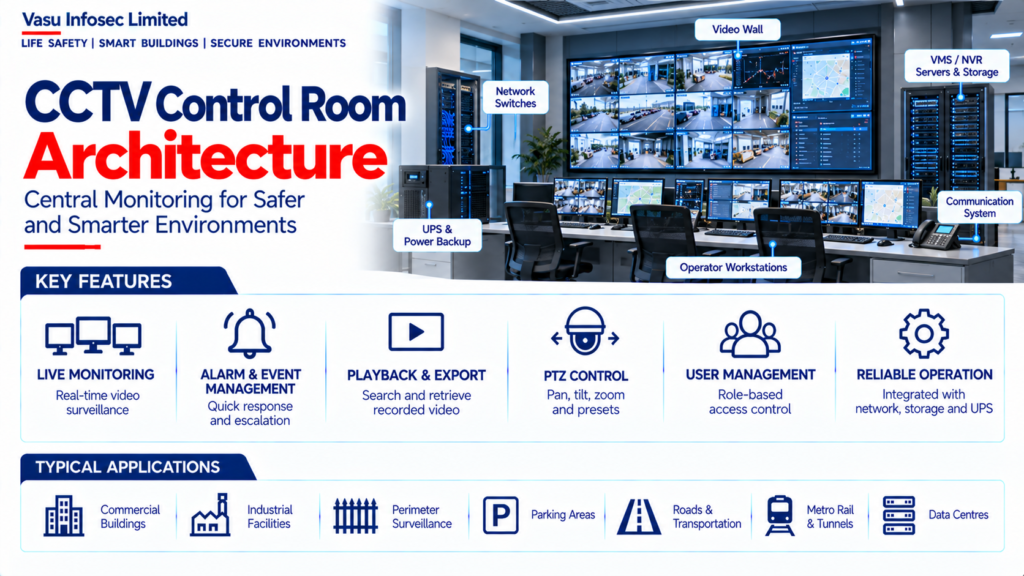
A CCTV Control Room is the central operational environment for monitoring, managing, recording, reviewing and responding to video surveillance events. Its architecture integrates operator workstations, displays, video walls, VMS infrastructure, network equipment, storage interfaces, communication facilities, UPS and controlled access.
1. Engineering Overview
A CCTV Control Room is the central operational environment for monitoring, managing, recording, reviewing and responding to video surveillance events. Its architecture integrates operator workstations, displays, video walls, VMS infrastructure, network equipment, storage interfaces, communication facilities, UPS and controlled access.
2. Complete Control Room Architecture
CCTV Cameras → CCTV Network → NVR / VMS / Recording Infrastructure → Control Room Network → Operator Workstations / Video Wall → Operators
Supporting Infrastructure → Core Switches → UPS → Server / Storage → Time Synchronisation → Cybersecurity → Access Control → Environmental & Ergonomic Infrastructure
3. Control Room Functions
The control room should support live video monitoring, alarm and event management, video playback, evidence search and export, PTZ control, system health monitoring, operator communication and other approved CCTV operational functions.
4. Operator Workstation Architecture
Operator workstations provide authorised personnel with access to VMS functions including live viewing, playback, search, alarm acknowledgement, PTZ control and approved video export. Workstations should be sized according to the number of simultaneous video streams and applications.
5. Display Architecture
Displays may include individual operator monitors, multi-monitor workstations and large-format video walls. Display configuration should be based on operator requirements, viewing distance, number of simultaneous cameras and control-room layout.
6. Video Wall Architecture
A video wall may provide a common situational-awareness display for critical camera feeds, alarms and selected system information. Video wall controllers, displays and associated network / processing infrastructure should be sized according to the approved display layout.
7. VMS Integration
The control room should connect to the approved VMS platform for live monitoring, playback, alarm management, PTZ control, analytics and system administration functions permitted to the operator.
8. NVR / Recording Integration
Operators should have controlled access to recorded video through the NVR or VMS recording infrastructure. Playback and export performance should be adequate for the required number of concurrent investigations.
9. Camera Monitoring Layout
Camera views should be organised according to operational importance, zone, building, floor, perimeter or other approved hierarchy. Critical cameras and alarms should be readily accessible to authorised operators.
10. Alarm & Event Management
The control room should provide appropriate annunciation and display of CCTV alarms and events. Alarm priority, acknowledgement, escalation and event history should follow the approved alarm-management philosophy.
11. PTZ Control
Where PTZ cameras are provided, authorised operators may control pan, tilt, zoom, focus, presets and patrol functions through the VMS or approved controller. PTZ permissions should be role-based.
12. Operator User Management
Control-room access should be managed through individual user accounts and role-based permissions. Viewing, playback, export, PTZ, configuration and administrative functions should be restricted according to operational responsibility.
13. Network Architecture
The control room should be connected to the approved CCTV network through appropriate access / aggregation infrastructure. Network capacity should account for live video, playback, VMS services, video wall traffic and management traffic.
14. Server & Storage Interface
Where servers and storage are located within or adjacent to the control room, appropriate rack space, connectivity, power, cooling and physical security should be provided. Remote server / storage locations should have reliable network connectivity to the control room.
15. UPS & Power Architecture
Operator workstations, network equipment, critical displays, servers and other essential CCTV equipment should receive power from the approved electrical system. UPS support should be provided where required for continuity of critical monitoring functions.
16. Physical Security
The CCTV control room should have controlled physical access. Access should be restricted to authorised personnel, with appropriate visitor management and security controls according to the facility requirements.
17. Ergonomics
Workstations, displays, operator seating, lighting, acoustics and equipment placement should be arranged to support sustained monitoring and reduce operator fatigue. Viewing distance and display height should be coordinated with the control-room layout.
18. Environmental Requirements
The control room should maintain suitable temperature, humidity, lighting, ventilation and cleanliness for personnel and electronic equipment. Critical server / storage areas may require dedicated environmental control.
19. Cable Management
Power, network, display, control and other cables should be routed through appropriate cable-management systems. Power and communication cabling should be segregated as required by the approved installation standards.
20. Cybersecurity
Control-room systems should comply with the approved CCTV cybersecurity architecture, including secure authentication, role-based access, controlled USB / export functions where applicable, network segmentation, endpoint protection and restricted remote access.
21. Installation Requirements
Installation should verify:
- Correct workstation configuration
- Correct display arrangement
- Correct video wall configuration
- Correct VMS connectivity
- Correct NVR / recording access
- Correct PTZ control
- Correct alarm configuration
- Correct user permissions
- Correct network connectivity
- Correct UPS supply
- Proper cable management
22. Testing & Commissioning
Control-room commissioning should verify:
- Live camera viewing
- Multi-camera layouts
- Video wall operation
- Recording playback
- Search and export
- Alarm annunciation
- PTZ control
- User permissions
- VMS connectivity
- Network performance
- UPS operation
- Display failure / communication alarms
23. Failure & Recovery
Where resilience is required, controlled tests should verify response to network failure, workstation failure, display failure, recording-server communication loss and power interruption. Recovery procedures should be documented.
24. Maintenance
Maintenance should include display inspection, workstation health checks, VMS client verification, network checks, UPS checks, cable-management inspection, user-access review, software / configuration backup and periodic functional testing.
25. Design Change Control
Changes to operator count, workstation quantity, display layout, video wall configuration, VMS functions, network capacity or control-room layout should be reviewed against the approved control-room architecture.
26. Documentation
Control-room documentation should include, as applicable:
- Control-room layout
- Workstation schedule
- Display schedule
- Video wall architecture
- VMS architecture
- NVR / storage interface
- Network topology
- IP address schedule
- User access matrix
- Alarm / event matrix
- UPS arrangement
- Testing and commissioning records
- As-built drawings
- O&M manual
27. Engineering Objective
The engineering objective is:
Define Monitoring Requirement → Design Operator Workstations & Displays → Integrate VMS / Recording → Provide Reliable Network & Power → Establish Secure Operator Access → Verify Alarm, PTZ & Playback Functions → Complete Commissioning → Establish Effective CCTV Control Room Operations
Frequently Asked Questions
What functions should a CCTV control room support?
Live monitoring, alarms/events, playback, evidence search/export, PTZ, system health monitoring and operator communication as approved.
What affects video-wall design?
Approved display layout, viewing distance, simultaneous camera count, controller and processing infrastructure.
Why are ergonomics and physical security important?
Workstation and display placement should support sustained monitoring; physical access and user permissions should be controlled.
SEO & Publishing Details
| SEO title | CCTV Control Room Architecture: CCTV Engineering Guide |
| Meta description | Understand cctv control room architecture, including key design parameters, architecture, installation, testing and maintenance considerations for CCTV systems. |
| Primary keyword | cctv control room architecture |
| Secondary keywords | CCTV control room architecture; CCTV control room design; video wall architecture; CCTV operator workstation; VMS control room; CCTV control room ergonomics |
| Suggested URL slug | /cctv-control-room-architecture/ |
| Suggested image alt text | CCTV Control Room Architecture architecture showing key CCTV system components, network or operational connections and supporting infrastructure. |