
Article
CCTV Data Retention Calculation
Oct 2026
Direct Answer
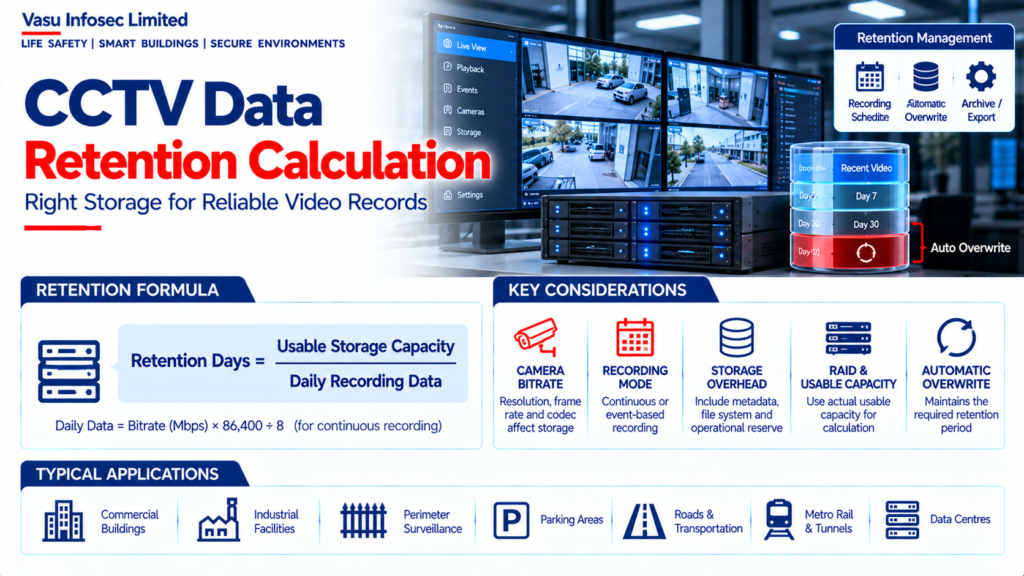
CCTV data retention calculation determines how long recorded video can be maintained within available storage capacity and how much storage is required to satisfy the approved retention period. Consider camera count, bitrate, recording schedule, retention duration, recording mode, codec, storage overhead and redundancy.
1. Engineering Overview
CCTV data retention calculation determines how long recorded video can be maintained within the available storage capacity and how much storage is required to satisfy the approved retention period. The calculation should consider camera count, bitrate, recording schedule, retention duration, recording mode, codec, storage overhead and redundancy.
2. Complete Retention Architecture
CCTV Cameras → Video Streams → NVR / VMS Recording → Storage → Retention Management → Automatic Overwrite / Archive → Authorised Playback / Export
3. Retention Requirement
The required retention period should be established from the project specification, operational requirement, client policy or applicable contractual requirement. Retention should be clearly defined in days or other approved units.
4. Storage-Based Retention Formula
For a known usable storage capacity:
Retention Days = Usable Storage Capacity ÷ Daily Recording Data
The calculation should use the actual configured recording bitrate and recording schedule.
5. Daily Recording Data
For continuous recording:
Daily Data = Bitrate (Mbps) × 86,400 ÷ 8
The resulting data should be converted into the selected storage unit. For multiple cameras, daily data from all camera groups should be aggregated.
6. Camera Group Calculation
Where cameras have different bitrates or recording schedules, each group should be calculated separately:
Group Daily Data = Number of Cameras × Data Generated per Camera per Day
Total Daily Data = Sum of All Camera Groups
7. Continuous Recording Retention
Continuous recording retains video throughout the configured recording period. It provides predictable retention calculation but generally requires greater storage capacity than event-based recording.
8. Motion / Event Recording Retention
Motion or event recording can reduce storage consumption because video is recorded only during defined activity. Actual retention depends on scene activity, event frequency, pre-event duration and post-event duration.
9. Pre-Event & Post-Event Data
Where event recording is used, the retention calculation should include the configured pre-event and post-event recording periods. These periods contribute to total storage consumption.
10. Bitrate & Codec Impact
Camera bitrate is a primary determinant of storage consumption. Resolution, frame rate, codec, image complexity and configuration affect bitrate. The retention calculation should use the approved or measured bitrate rather than relying only on nominal camera resolution.
11. Storage Overhead
Retention calculations should account for storage overhead associated with metadata, file systems, databases, recording indexes and operational reserve. Nominal disk capacity should not be treated as fully usable recording capacity.
12. RAID & Usable Capacity
Where RAID or other redundancy is provided, usable capacity is lower than the aggregate raw disk capacity. Retention should be calculated using the actual usable capacity available to the recording system.
13. Storage Margin
An appropriate operational reserve should be maintained to avoid immediate loss of recording when storage reaches maximum utilisation. The selected reserve should align with the approved storage architecture.
14. Automatic Overwrite
Many CCTV recording systems use automatic overwrite when storage reaches the configured threshold. The overwrite policy should be configured to maintain the required rolling retention period and should be verified during commissioning.
15. Archive Requirements
If selected video is required beyond the normal rolling retention period, an approved archive / export process should be provided. Archive storage should be considered separately from the primary CCTV recording storage.
16. Retention by Camera Group
Critical cameras may require different retention periods from general surveillance cameras. The recording architecture should support the approved camera-specific retention requirements where required.
17. Resolution & Frame Rate
Higher resolution and frame rate can increase bitrate and therefore reduce the retention period for a fixed storage capacity. Changes to these parameters should trigger a retention reassessment.
18. Network & Recording Coordination
Retention calculations should be coordinated with NVR / VMS recording throughput and CCTV network bandwidth. Increasing retention through additional storage does not remove the requirement for adequate recording and network capacity.
19. Example Calculation Method
Example methodology:
- Establish camera quantity.
- Determine bitrate for each camera group.
- Establish recording hours per day.
- Calculate daily data generation.
- Determine usable storage capacity.
- Apply storage overhead and reserve.
- Calculate available retention days.
- Compare calculated retention with required retention.
- Add storage capacity if required.
- Document the final retention arrangement.
20. Installation & Configuration Requirements
Configuration should verify:
- Correct recording schedule
- Correct bitrate
- Correct camera profile
- Correct retention setting
- Correct storage allocation
- Correct RAID / redundancy
- Correct overwrite policy
- Correct archive settings, where applicable
- Correct time synchronisation
- Correct recording status
21. Testing & Commissioning
Retention commissioning should verify:
- Recording operation
- Storage utilisation
- Retention configuration
- Recording schedule
- Automatic overwrite behaviour
- Event recording, where applicable
- Pre / post-event recording
- Playback across the configured retention period
- Storage failure indication
- Archive / export functions, where applicable
22. Retention Monitoring
Storage utilisation and projected retention should be monitored periodically. Unexpected bitrate increases, additional cameras, configuration changes or storage degradation can reduce the achieved retention period.
23. Design Change Control
Changes to camera quantity, bitrate, resolution, frame rate, recording schedule, codec, storage capacity, RAID configuration or retention requirement should trigger a revised retention calculation.
24. Documentation
CCTV retention documentation should include, as applicable:
- Camera schedule
- Bitrate schedule
- Recording schedule
- Recording mode
- Daily data calculation
- Usable storage capacity
- RAID / redundancy arrangement
- Storage reserve
- Required retention period
- Calculated retention period
- Archive requirements
- Testing and commissioning records
- As-built documentation
25. Engineering Objective
The engineering objective is:
Establish Retention Requirement → Determine Camera Recording Profile → Calculate Daily Data → Determine Usable Storage → Apply Overhead & Reserve → Calculate Achievable Retention → Verify Against Requirement → Configure Overwrite / Archive → Complete Testing → Maintain Required Video Retention
Frequently Asked Questions
How is retention calculated from storage?
Retention Days = Usable Storage Capacity ÷ Daily Recording Data. Use the actual configured bitrate and recording schedule.
Does RAID affect retention?
Yes. Usable capacity is lower than raw disk capacity when RAID or other redundancy is used.
What affects event-recording retention?
Scene activity, event frequency, pre-event and post-event durations, configured bitrate and recording schedule.
SEO & Publishing Details
| SEO title | CCTV Data Retention Calculation: CCTV Engineering Guide |
| Meta description | Understand cctv data retention calculation, including key design parameters, architecture, installation, testing and maintenance considerations for CCTV systems. |
| Primary keyword | cctv data retention calculation |
| Secondary keywords | CCTV data retention calculation; CCTV video retention period; CCTV storage calculation; daily recording data; RAID usable storage; automatic overwrite |
| Suggested URL slug | /cctv-data-retention-calculation/ |
| Suggested image alt text | CCTV Data Retention Calculation architecture showing key CCTV system components, network or operational connections and supporting infrastructure. |