
Article
CCTV Lens & Field of View
Oct 2026
Direct Answer
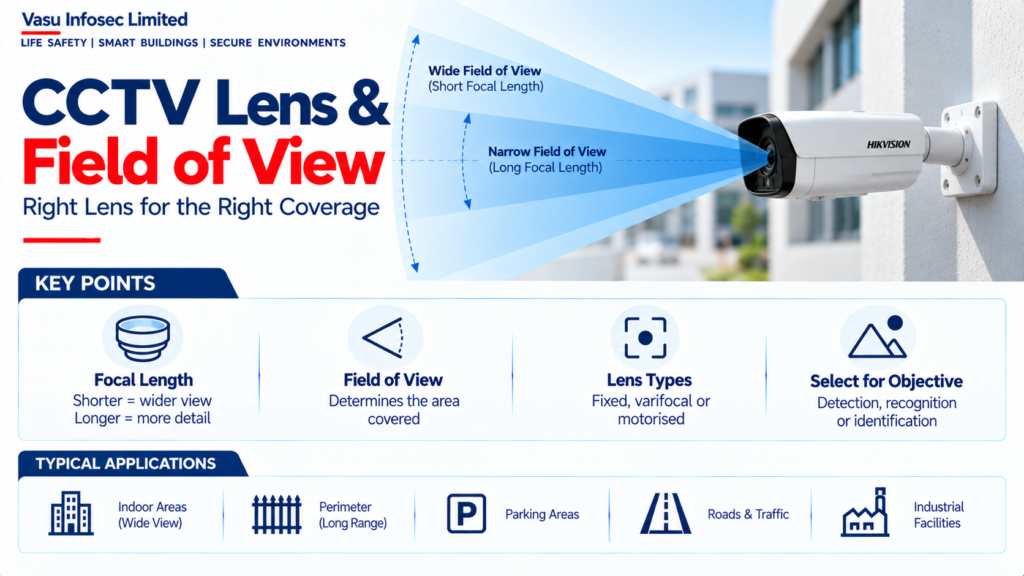
CCTV lens selection determines the scene area visible to a camera and the image detail available at the target. Field of view depends on lens focal length, camera sensor, mounting position and target distance. A shorter focal length generally gives a wider view, while a longer focal length gives a narrower view with greater apparent magnification. The lens should be selected against the actual surveillance geometry and the required detection, recognition or identification objective.
1. Engineering Overview
CCTV lens selection determines how much of a scene is visible and the level of detail available at the target location. Field of view is influenced by the camera sensor, focal length, mounting position and target distance. Correct lens selection is essential for achieving the approved detection, recognition and identification objectives.
2. Lens & Field of View Architecture
Camera Sensor → Lens → Optical Field of View → Target Scene → Image Processing → Network / Recording → VMS / Operator Workstation
3. Lens Function
The lens collects and focuses light onto the camera sensor. Its focal length determines the angle of view and the apparent magnification of objects within the scene.
4. Focal Length
A shorter focal length generally provides a wider field of view, while a longer focal length provides a narrower field of view with greater apparent magnification. The required focal length should be selected from the actual surveillance geometry.
5. Fixed Lens
A fixed lens provides a predetermined focal length and field of view. It is suitable where camera position and coverage requirements are stable and clearly defined.
6. Varifocal Lens
A varifocal lens provides an adjustable focal-length range, allowing the field of view to be fine-tuned during installation. It can be useful where final target coverage requires field adjustment.
7. Motorised Lens
Motorised lenses allow remote adjustment of focal length and, where supported, focus. They can simplify commissioning and adjustment for cameras installed in difficult-to-access locations.
8. Wide-Angle Lens
Wide-angle lenses provide broader scene coverage and are suitable for rooms, corridors, lobbies and other applications where a large area must be monitored from a single camera. Excessive wide-angle selection can reduce target detail.
9. Telephoto / Long-Focal-Length Lens
Longer focal lengths provide narrower views and greater apparent magnification. They may be suitable for long-distance observation, perimeter surveillance and specialised identification requirements.
10. Field of View
Field of view defines the portion of the scene captured by the camera. Horizontal, vertical and diagonal fields of view should be considered where required. The selected view should cover the required surveillance area without unnecessary scene wastage.
11. Horizontal Field of View
Horizontal field of view is particularly important for determining the width of the surveillance scene. It should be coordinated with the target area width, camera mounting height and required image detail.
12. Vertical Field of View
Vertical field of view determines the height of the scene captured. Camera tilt and mounting geometry should be selected so that the required vertical coverage is achieved without excessive sky, floor or other irrelevant areas.
13. Sensor Size
Sensor format influences the effective field of view for a given focal length. Lens and camera sensor compatibility should therefore be verified before final selection.
14. Mounting Height & Distance
Camera mounting height and distance from the target directly affect field of view and pixel density. The lens should be selected only after the camera location, mounting height and target area have been established.
15. Detection, Recognition & Identification
Lens selection should support the required surveillance objective. Detection requires sufficient visibility of a target, recognition requires additional target detail, and identification requires substantially greater image detail. These objectives should be validated using the actual scene geometry.
16. Pixel Density Consideration
Field of view should not be considered independently of pixel density. A very wide field of view may cover a large area but distribute available pixels over that area, reducing detail at critical targets.
17. Lighting & Lens Performance
Lens performance should be considered with the expected lighting conditions, including low-light environments, backlighting, glare and infrared operation. Camera and lens selection should be evaluated as an integrated optical system.
18. Depth of Field & Focus
Depth of field describes the range over which objects appear acceptably focused. Aperture, focal length, sensor characteristics and target distance influence focus performance. Final focus should be verified during commissioning.
19. IR Compatibility
For cameras using infrared illumination, the lens should be compatible with the camera and IR system. Incorrect optical selection can contribute to uneven illumination, reflection or reduced nighttime image quality.
20. Common Lens Selection Applications
Typical applications include:
- Wide-angle lens — rooms and open indoor areas
- Standard lens — general surveillance
- Varifocal lens — adjustable coverage requirements
- Long focal length — perimeter and long-distance observation
- Specialised lens — application-specific surveillance requirements
21. Installation Requirements
Installation should verify:
- Correct lens type
- Correct focal length
- Correct sensor compatibility
- Correct camera mounting position
- Correct field of view
- Correct focus
- Correct target coverage
- Correct image orientation
- Correct lighting performance
- Proper cable routing and camera stability
22. Testing & Commissioning
Lens and field-of-view commissioning should verify:
- Actual horizontal coverage
- Actual vertical coverage
- Target visibility
- Required pixel density at critical areas
- Focus quality
- Day / night performance
- IR performance, where applicable
- Glare and backlight behaviour
- Obstructions and blind areas
23. Design Change Control
Changes to camera location, mounting height, lens focal length, sensor type or target area should be reviewed because they can change field of view, pixel density, coverage, bandwidth and storage requirements.
24. Documentation
Lens and field-of-view documentation should include, as applicable:
- Camera schedule
- Lens type
- Focal length
- Sensor format
- Horizontal / vertical field of view
- Camera location
- Mounting height
- Target distance
- Coverage drawings
- Pixel-density assessment
- Testing and commissioning records
- As-built drawings
- O&M manual
25. Engineering Objective
The engineering objective is:
Define Surveillance Area → Establish Camera Position → Select Sensor & Lens → Validate Field of View → Confirm Pixel Density → Verify Lighting & Focus → Complete Commissioning → Achieve Required Surveillance Coverage
Frequently Asked Questions
What does field of view mean in CCTV?
Field of view is the portion of a scene captured by a camera. Horizontal, vertical and diagonal views may need to be considered.
How does focal length affect the image?
A shorter focal length generally provides a wider view; a longer focal length provides a narrower view with greater apparent magnification.
What is the difference between fixed and varifocal lenses?
A fixed lens has a predetermined focal length and field of view. A varifocal lens allows adjustment within a focal-length range during installation.
Does a wider field of view always improve surveillance?
No. A wider view covers more area but can distribute available pixels across that area, reducing detail at critical targets.
What should be checked during commissioning?
Verify actual horizontal and vertical coverage, target visibility, required pixel density, focus, day/night and IR performance where applicable, glare/backlight behaviour, obstructions and blind areas.
SEO & Publishing Details
| SEO title | CCTV Lens and Field of View Guide | Vasu Infosec Limited |
| Meta description | Learn how CCTV lens focal length, sensor size, field of view, pixel density, lighting and target distance affect camera coverage and surveillance detail. |
| Primary keyword | CCTV lens and field of view |
| Secondary keywords | CCTV lens selection, CCTV focal length, horizontal field of view, vertical field of view, varifocal CCTV lens, CCTV pixel density, telephoto CCTV lens |
| Suggested URL slug | cctv-lens-field-of-view |
| Suggested image alt text | CCTV camera lens field of view showing wide-angle and narrow-angle surveillance coverage |