
Article
CCTV Network Architecture
Oct 2026
Direct Answer
CCTV network architecture defines the communication infrastructure that transports video, management and control traffic between IP cameras, switches, recording platforms, VMS servers and operator workstations. Design should provide adequate bandwidth, availability, segmentation, scalability, cybersecurity and maintainability.
1. Engineering Overview
CCTV Network Architecture defines the communication infrastructure required to reliably transport video, management and control traffic between IP cameras, switches, recording platforms, VMS servers and operator workstations. The architecture should provide adequate bandwidth, availability, segmentation, scalability, cybersecurity and maintainability.
2. Complete CCTV Network Architecture
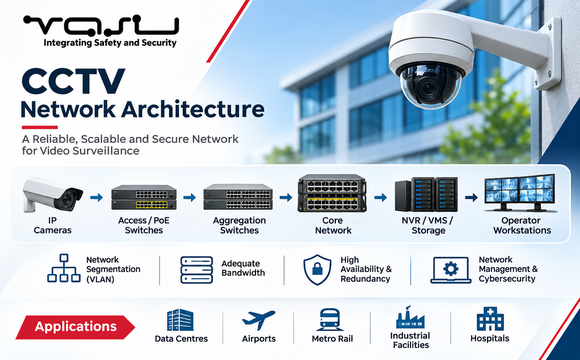
IP Cameras → Access / PoE Switches → Aggregation Switches → Core Network → NVR / VMS / Storage → Operator Workstations / Video Wall
Supporting Infrastructure → Fibre Backbone → Network Management → UPS → Time Synchronisation → Cybersecurity → Approved System Integrations
3. Access Layer
The access layer connects IP cameras to the CCTV network through PoE or suitable Ethernet switches. Switch selection should consider port count, PoE budget, uplink capacity, environmental conditions and required redundancy.
4. Aggregation Layer
Aggregation switches consolidate traffic from multiple access switches and provide higher-capacity uplinks toward the CCTV core. Capacity should be based on the aggregated camera traffic and expected expansion.
5. Core Layer
The core layer provides high-capacity connectivity between CCTV network segments, recording infrastructure, VMS servers and control-room systems. The core should be sized for current and future traffic requirements.
6. Network Topology
The topology may use star, hierarchical star, redundant ring or other approved architecture depending on project requirements. The selected topology should provide clear communication paths and suitable fault recovery.
7. Ethernet Cabling
Copper Ethernet cabling may be used between cameras and local access switches within the permitted transmission distance. Cable category, installation method, shielding and environmental suitability should comply with the approved design.
8. Fibre Optic Backbone
Fibre optic links are suitable for inter-floor, inter-building or long-distance CCTV backbone connections. Fibre type, core count, optical budget, termination, transceivers and redundancy should be coordinated with the network design.
9. PoE Architecture
PoE can provide both network communication and power to compatible IP cameras. Switch power budget should be calculated from the connected camera load, including appropriate design margin.
10. Bandwidth Architecture
Network bandwidth should be calculated from camera resolution, frame rate, codec, bitrate and recording configuration. Aggregate traffic should include camera streams, recording traffic, live-view traffic, management traffic and other approved services.
11. Uplink Capacity
Uplink interfaces should be selected according to the aggregate traffic generated by connected access switches. Oversubscription should be evaluated and controlled according to the approved network performance requirements.
12. IP Addressing
Each network-connected CCTV device should have an approved IP addressing arrangement. IP addresses, subnet masks, gateways and other network parameters should be documented and controlled.
13. VLAN & Segmentation
CCTV traffic should be appropriately segmented from unrelated network traffic. VLANs and access-control policies may be used to isolate camera, management, recording and user traffic according to the approved IT and cybersecurity architecture.
14. Routing & Firewall
Where routing or firewall controls are required, only approved communication paths and services should be permitted. Rules should be documented and coordinated with the project IT / cybersecurity team.
15. Network Redundancy
Critical CCTV networks may use redundant switches, uplinks, paths or other approved resilience arrangements. Redundancy should be engineered according to the required availability and tested during commissioning.
16. Network Availability
Network availability should consider power failure, switch failure, uplink failure, fibre break, device failure and other credible faults. The selected architecture should provide the required operational continuity.
17. Time Synchronisation
Cameras, NVRs, VMS servers, workstations and network equipment requiring coordinated timestamps should use an approved time source. Accurate time supports video investigation and event correlation.
18. Network Management
Network management should provide appropriate visibility of switch status, port status, link health, device availability, bandwidth utilisation and critical faults. Monitoring should support timely fault identification.
19. Cybersecurity
CCTV network security should include appropriate network segmentation, secure credentials, access control, restricted services, controlled remote access, device hardening, firmware management and monitoring in accordance with the approved cybersecurity requirements.
20. Network & Power Coordination
Network switches and critical CCTV infrastructure should receive suitable power from the approved electrical system. UPS support should be considered for critical switches, servers, storage and control-room equipment.
21. Installation Requirements
Installation should verify:
- Correct switch type and capacity
- Correct PoE power budget
- Correct uplink capacity
- Correct cable category
- Correct fibre connectivity
- Correct IP addressing
- Correct VLAN configuration
- Correct routing / firewall rules
- Correct network redundancy
- Correct UPS supply
- Proper cable identification and segregation
22. Testing & Commissioning
Network commissioning should verify:
- Camera connectivity
- IP addressing
- PoE operation
- Link speed
- Uplink performance
- Fibre connectivity
- VLAN operation
- Routing / firewall communication
- Packet loss and network stability
- Recording connectivity
- VMS connectivity
- Network failure indication
23. Failure & Recovery Testing
Where redundancy is provided, controlled tests should verify response to switch failure, uplink failure, fibre interruption, power interruption and other approved failure scenarios. Recovery behaviour should be documented.
24. Capacity Verification
Final network capacity verification should consider:
- Camera quantity
- Aggregate camera bitrate
- Access-switch port capacity
- PoE load
- Aggregation traffic
- Core traffic
- Uplink capacity
- Concurrent viewing traffic
- Recording traffic
- Future expansion
25. Maintenance
Maintenance should include switch health checks, port utilisation review, fibre inspection, cable inspection, PoE monitoring, configuration backup, firmware review, network diagnostics and cybersecurity checks.
26. Design Change Control
Changes to camera quantity, bitrate, switch configuration, VLANs, IP addressing, uplinks, routing, firewall rules or network topology should be reviewed because they may affect CCTV performance and cybersecurity.
27. Documentation
CCTV network documentation should include, as applicable:
- Network architecture
- Network topology
- Switch schedule
- Camera schedule
- IP address schedule
- VLAN schedule
- Port allocation
- PoE calculation
- Bandwidth calculation
- Fibre optic details
- Uplink schedule
- Firewall / routing matrix
- Network redundancy arrangement
- Testing and commissioning records
- As-built drawings
- O&M manual
28. Engineering Objective
The engineering objective is:
Establish Camera Connectivity → Design Access Layer → Aggregate Traffic → Provide High-Capacity Core → Validate Bandwidth & PoE → Implement Segmentation & Security → Provide Required Redundancy → Complete Testing → Establish Reliable CCTV Network Infrastructure
Frequently Asked Questions
What determines CCTV network capacity?
Camera quantity, aggregate and peak bitrate, recording/live-view/playback traffic, management traffic, uplink capacity and future expansion.
Why segment CCTV traffic?
VLANs and access controls can isolate camera, management, recording and user traffic in line with the approved IT and cybersecurity architecture.
What should be tested at commissioning?
Camera connectivity, IP addressing, PoE, link speed, fibre, VLANs, routing/firewall communication, packet loss, recording/VMS connectivity and failure indication.
SEO & Publishing Details
| SEO title | CCTV Network Architecture: CCTV Engineering Guide |
| Meta description | Understand cctv network architecture, including key design parameters, architecture, installation, testing and maintenance considerations for CCTV systems. |
| Primary keyword | cctv network architecture |
| Secondary keywords | CCTV network architecture; IP CCTV network; CCTV network bandwidth; CCTV VLAN segmentation; CCTV fibre backbone; CCTV network redundancy |
| Suggested URL slug | /cctv-network-architecture/ |
| Suggested image alt text | CCTV Network Architecture architecture showing key CCTV system components, network or operational connections and supporting infrastructure. |