
Article
CCTV System: Complete Architecture
Oct 2026
Direct Answer
A CCTV system combines cameras, lenses, network and power infrastructure, recording platforms, video management software, storage and operator interfaces to support video acquisition, transmission, recording, monitoring, retrieval and approved analytics. Its architecture should be designed around the project’s surveillance requirements, coverage and identification needs, bandwidth, retention period, cybersecurity controls and approved integration interfaces.
1. Engineering Overview
A CCTV system is an integrated video surveillance solution comprising cameras, lenses, mounting arrangements, power supplies, network infrastructure, recording equipment, video management software, storage, operator workstations, displays and associated cybersecurity and support infrastructure. The architecture should provide reliable video acquisition, transmission, recording, monitoring, retrieval and approved analytics.
2. Complete CCTV Architecture
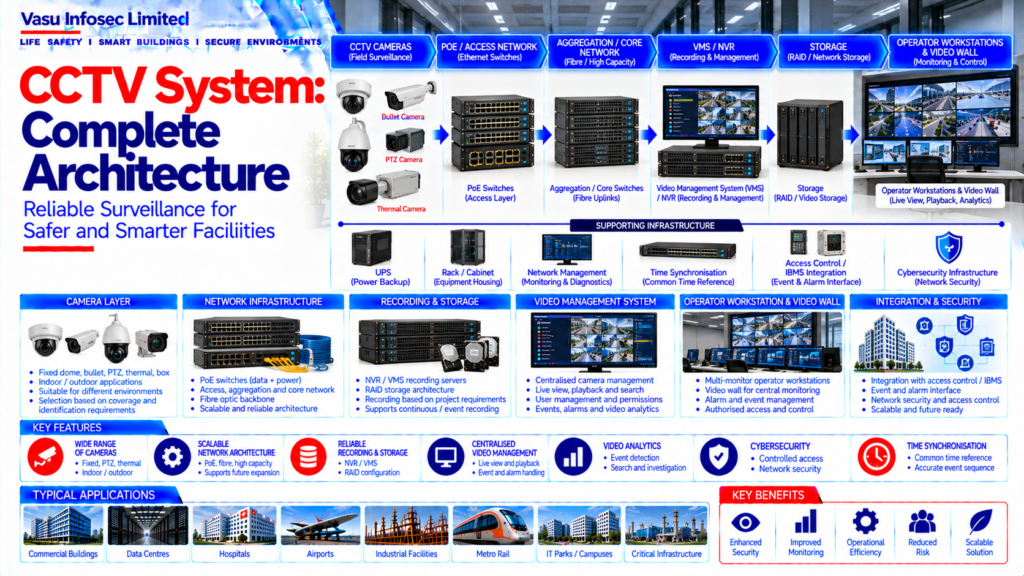
CCTV Cameras → PoE / Network Access Layer → Aggregation / Core Network → Video Management System (VMS) / NVR → Storage → Operator Workstations / Video Wall
Supporting Systems → UPS → Rack / Cabinet → Network Management → Time Synchronisation → Access Control / IBMS Integration → Cybersecurity Infrastructure
3. Camera Layer
The camera layer includes fixed dome, bullet, PTZ, thermal, box and other project-approved camera types. Camera selection should be based on application, field of view, illumination, resolution, environmental conditions, mounting height, identification requirements and required analytics.
4. Lens & Field of View
Lens selection determines the camera’s field of view, scene coverage and identification capability. The selected focal length should be coordinated with target distance, scene width, mounting position and required image detail.
5. Camera Resolution
Camera resolution should be selected based on the required level of surveillance, detection, recognition or identification. Resolution alone should not be treated as the sole selection criterion; pixel density, lens, lighting and installation geometry should also be evaluated.
6. Fixed Camera Architecture
Fixed cameras provide continuous coverage of defined areas. Dome and bullet cameras may be selected according to indoor / outdoor application, vandal resistance, environmental protection, mounting arrangement and required field of view.
7. PTZ Camera Architecture
PTZ cameras provide pan, tilt and zoom functions for active surveillance of larger or dynamic areas. PTZ operation, presets, tours and control permissions should be defined according to the approved surveillance philosophy.
8. Thermal Camera Architecture
Thermal cameras detect infrared radiation and can provide surveillance under low-visibility conditions. They may be used for perimeter, critical infrastructure, fire-risk or other approved applications depending on the project requirements.
9. Network Architecture
IP CCTV systems typically use structured Ethernet networks comprising access switches, aggregation switches, core switches, fibre uplinks and network management infrastructure. The network should be sized for camera count, bandwidth, redundancy and future expansion.
10. PoE Architecture
Power over Ethernet may provide both data communication and power to compatible IP cameras. PoE switch capacity, port power budget, cable length and connected-device requirements should be verified during design.
11. Fibre Optic Backbone
Fibre optic links may be used between CCTV network locations, buildings, floors or control rooms where distance or bandwidth requires them. Fibre type, uplink capacity, termination and redundancy should follow the approved network design.
12. Bandwidth Architecture
CCTV bandwidth depends on camera resolution, frame rate, compression, scene complexity, codec and configuration. Network capacity should be calculated for normal traffic and appropriate engineering margin.
13. Video Recording Architecture
Video recording may be provided through NVRs, VMS recording servers or other approved recording platforms. Recording architecture should support the required camera count, recording mode, resolution, frame rate and retention period.
14. NVR Architecture
An NVR provides network-based video recording and may include camera management, playback, event recording and storage interfaces. NVR capacity should be selected based on camera throughput, storage requirements and required redundancy.
15. Video Management System
The VMS provides centralised management of cameras, live viewing, recording, playback, user permissions, events, alarms, analytics and system health. The VMS architecture should be scalable to the project requirements.
16. Storage Architecture
CCTV storage should be sized based on camera count, recording resolution, frame rate, codec, recording schedule, motion / event configuration and required retention. Storage architecture may include RAID, hot-spare, redundant storage or other approved arrangements.
17. Control Room Architecture
The CCTV control room may include operator workstations, display monitors, video wall controllers, servers, network equipment, storage interfaces, UPS systems and operator consoles. The arrangement should support ergonomic monitoring and controlled access.
18. CCTV Monitoring
Operators should be able to view live video, playback recorded footage, search events, acknowledge approved alarms and operate authorised PTZ functions. User privileges should be controlled through the VMS.
19. Video Analytics
Where required, video analytics may provide functions such as motion detection, intrusion detection, line crossing, loitering, object detection or other approved analytics. Analytics configuration should be based on the project surveillance requirements.
20. Time Synchronisation
Cameras, recording servers, VMS servers and associated systems should use a coordinated time reference where required. Accurate timestamps are essential for event correlation, investigation and evidentiary review.
21. Power & UPS Architecture
CCTV cameras, network switches, servers, recording systems and control-room equipment should receive power through the approved electrical distribution. Critical CCTV equipment should be supported by UPS arrangements where required by the project.
22. Cybersecurity Architecture
The CCTV network should incorporate appropriate cybersecurity measures including network segmentation, controlled user access, secure credentials, device hardening, restricted remote access, firmware / software management and protection of video data.
23. Integration with Other Systems
CCTV may integrate with access control, IBMS, intrusion detection, fire alarm interfaces and other approved systems. Integration should be limited to the defined interface points and should not compromise the dedicated CCTV or life-safety system functions.
24. Installation Requirements
Installation should verify:
- Correct camera selection
- Correct lens and field of view
- Correct mounting height and orientation
- Correct network connectivity
- Correct PoE power
- Correct fibre / copper links
- Correct IP addressing
- Correct VMS / NVR configuration
- Correct storage allocation
- Correct time synchronisation
- Correct user permissions
- Proper cable segregation
25. Testing & Commissioning
CCTV commissioning should verify:
- Camera image quality
- Field of view
- Focus and orientation
- Day / night operation
- IR operation, where applicable
- PTZ operation, where applicable
- Network communication
- Recording
- Playback
- Storage capacity
- Alarm / analytics events
- User access
- Video wall / workstation operation
- Communication failure indication
26. FAT, SAT & Acceptance
Where required, Factory Acceptance Testing should verify equipment and system configuration before dispatch. Site Acceptance Testing should verify the installed CCTV system under actual site conditions. Final acceptance should be based on approved test procedures and documented results.
27. Preventive Maintenance
Preventive maintenance should include camera inspection, lens cleaning, image verification, network checks, storage health checks, VMS / NVR health checks, UPS checks, analytics verification, firmware / software review and configuration backup.
28. Design Change Control
Changes to camera types, locations, lenses, network architecture, recording parameters, storage, VMS configuration, analytics, user permissions or integrations should be reviewed against the approved CCTV design before implementation.
29. Documentation
CCTV documentation should include, as applicable:
- CCTV system architecture
- Camera schedule
- Lens schedule
- Camera layout drawings
- Network topology
- IP address schedule
- PoE switch schedule
- Fibre optic network details
- NVR / VMS architecture
- Storage calculation
- Bandwidth calculation
- Video retention schedule
- Control room layout
- Integration matrix
- Testing and commissioning records
- As-built drawings
- O&M manual
30. Engineering Objective
The engineering objective is:
Correct Surveillance Requirement → Appropriate Camera & Lens → Reliable Network & Power → Accurate Video Transmission → Secure Recording & Storage → Effective Monitoring & Analytics → Controlled Integration → Complete Testing & Acceptance → Preventive Maintenance → Reliable CCTV Surveillance Infrastructure
Frequently Asked Questions
What does a complete CCTV system include?
It may include cameras, lenses, network and power infrastructure, recording equipment, VMS software, storage, operator workstations, displays and supporting cybersecurity infrastructure.
How should CCTV cameras be selected?
Selection should consider application, field of view, illumination, resolution, environmental conditions, mounting height, identification requirements and required analytics.
What determines CCTV bandwidth and storage?
Bandwidth depends on resolution, frame rate, compression, scene complexity, codec and configuration. Storage also depends on recording schedule, motion/event settings and the required retention period.
What should CCTV commissioning verify?
Checks may include image quality, field of view, focus, day/night operation, IR and PTZ functions where applicable, network communication, recording, playback, storage, alarms/analytics, user access and communication-failure indication.
What cybersecurity measures should be considered?
The source identifies network segmentation, controlled user access, secure credentials, device hardening, restricted remote access, software/firmware management and protection of video data.
When should the CCTV design be reviewed?
Changes to camera types or locations, lenses, network architecture, recording parameters, storage, VMS configuration, analytics, user permissions or integrations should be reviewed against the approved design.
SEO & Publishing Details
SEO title: CCTV System Complete Architecture | Vasu Infosec Limited
Meta description: Explore CCTV system architecture covering cameras, lenses, IP networks, VMS/NVR, storage, monitoring, cybersecurity, commissioning and maintenance.
Primary keyword: CCTV system complete architecture
Secondary keywords: IP CCTV system, CCTV network architecture, video management system, NVR storage, CCTV bandwidth calculation, CCTV commissioning
Suggested URL slug: /cctv-system-complete-architecture/
Suggested image alt text: CCTV system architecture showing IP cameras, network switches, VMS/NVR, video storage and operator monitoring.